We are busy people, task oriented people. A thing to do and another thing and then another thing. I have so many thoughts about this disposition, its strengths and weaknesses. Today, however, I want to talk a little about how a person (i.e. me) in a salaried (i.e. never-off) position with both task-based and strategic or project-based work might approach the challenges of all of the individual things and all of the larger ideas all at once.
For me the first and foremost issue is working effectively -- how do I allow myself to be effective and how do I set myself up for success in structuring my work week?
There are times when I can do certain types of work very well and times when I am just banging my head against the very same task. While we don't always have the leisure to structure our workloads to coincide with our highest levels of productivity, knowing what works and what doesn't is always helpful. What I can do in the morning, what I can do between meetings, and what I can do when I'm in a bad mood or hungry or tired is very important.
I think about tasks that get me back on track when I'm not focused: debriefing from meetings, organizing and updating my project to-do lists, triaging my email.
I think about what work I have to do during the day, and what work I can do at home: do I need my dual-monitor workstation to do this project best? Can I do this project while a cat is standing on top of my arms? Do I want to create a separation where I only do research in one place? I try to have my work arrayed so I have the best access to the work best done wherever I am.
I let myself be influenced by my moods. If I am working at home and I'm being very productive, I know that groove may not last, I may not be able to replicate it the next day or even during the week, so I go with it. Have the work ready to go when you're ready to go. I learned this from my father who worked on the road and had a very flexible schedule, and anyone with ADD will tell you the same: the groove is the payoff for all of the other trouble, so use it.
The balance between tasks and projects is a difficult one -- I find tasks to weigh on me more than projects, but also easier to lay aside. Small tasks pile up, and I need a groove to get focused and get them done. At the same time, projects require periods of focus without interruption, including the interruption of remembering all of the small tasks that need accomplished. However, both cases benefit from a mindset of "do the thing right in front of you." I make lists. So many lists.
What about you, how do you deal with all the little things and all the big things?
Keep Rockin'!
-Rachel
Showing posts with label lists. Show all posts
Showing posts with label lists. Show all posts
Monday, February 15, 2016

Thursday, January 8, 2015
Five Books
I had a whole bunch of things happen this morning before I could even finish my coffee, so I'm going to take a break and think about five books that have shaped my life. Foundational texts, if you will. This is where I am coming from.
1) The Structure of Scientific Revolutions by Thomas Kuhn. I read this book in my first semester of college and several times again. Kuhn's work is of the sort that gets diluted and misapplied constantly, which itself is a topic of conversation. The work itself is seminal and I believe that it needs to be read and understood if we are to live in the world we live in today. I think this book probably shaped me in ways I don't even realize and I am glad for it. I am glad I was forced to read this book before I encountered the things it influenced.
2) Murdering McKinley by Eric Rauchway. This 2004 book takes my favorite period of American history and uses it to ask the most important questions about contemporary societies. I will buy you a copy you must read it. This book does an excellent job at history, and at posing challenging and prescient questions for today. I would use it for both of those things and as an model for why history and how history and what is the point of doing history. I love this book very deeply and I am serious I will buy you a copy please read it.
3) Technopoly by Neil Postman. Also, if you like, The End of Education. Really you can just put all of Postman in here. The books are so small, so concise. I adore them for that alone. I think that I was also introduced to these in college as well. The questions that Postman raises in Technopoly are so essential in society broadly, but also specific to libraries. This is a book we should all read again.
4) An Essay On Typography by Eric Gill. This was given to me as a gift, and is another small and wonderful book. Written in 1931, it addresses itself to typography (which, come on, you know you love it) but also to the issue at hand in the field at the time: industrialization and craftsmanship. Philosophical discussion is woven between practical advice about the page. I would recommend this in the same breath as The Shape of Content by Ben Shahn and What The Twilight Says by Derek Walcott, which are similarly delightful in their mixture of criticism, philosophy, and advice, and offer a more diverse background of philosophy. I adore all of those books. Beautiful sentences in there.
5) ....... I'm all out.
I guess that's technically six books. I'm a little sad to see that there aren't any women there. I will take a look at my bookshelves when I get home and see if we can address that.
Well, what books shaped the way you look at the world? What would you have people read to help them understand you? I really want to know.
Keep Rockin',
Rachel
1) The Structure of Scientific Revolutions by Thomas Kuhn. I read this book in my first semester of college and several times again. Kuhn's work is of the sort that gets diluted and misapplied constantly, which itself is a topic of conversation. The work itself is seminal and I believe that it needs to be read and understood if we are to live in the world we live in today. I think this book probably shaped me in ways I don't even realize and I am glad for it. I am glad I was forced to read this book before I encountered the things it influenced.
2) Murdering McKinley by Eric Rauchway. This 2004 book takes my favorite period of American history and uses it to ask the most important questions about contemporary societies. I will buy you a copy you must read it. This book does an excellent job at history, and at posing challenging and prescient questions for today. I would use it for both of those things and as an model for why history and how history and what is the point of doing history. I love this book very deeply and I am serious I will buy you a copy please read it.
3) Technopoly by Neil Postman. Also, if you like, The End of Education. Really you can just put all of Postman in here. The books are so small, so concise. I adore them for that alone. I think that I was also introduced to these in college as well. The questions that Postman raises in Technopoly are so essential in society broadly, but also specific to libraries. This is a book we should all read again.
4) An Essay On Typography by Eric Gill. This was given to me as a gift, and is another small and wonderful book. Written in 1931, it addresses itself to typography (which, come on, you know you love it) but also to the issue at hand in the field at the time: industrialization and craftsmanship. Philosophical discussion is woven between practical advice about the page. I would recommend this in the same breath as The Shape of Content by Ben Shahn and What The Twilight Says by Derek Walcott, which are similarly delightful in their mixture of criticism, philosophy, and advice, and offer a more diverse background of philosophy. I adore all of those books. Beautiful sentences in there.
5) ....... I'm all out.
I guess that's technically six books. I'm a little sad to see that there aren't any women there. I will take a look at my bookshelves when I get home and see if we can address that.
Well, what books shaped the way you look at the world? What would you have people read to help them understand you? I really want to know.
Keep Rockin',
Rachel
Thursday, September 18, 2014
A List of Lists
I set myself up for a busy fall. And now that it is fall I find myself overwhelmingly busy. More than I have been in years. Don't get me wrong, I set myself up to do exciting things, new things, challenging things because I really want to do these things and I know I can get through it, but there comes a time when I just don't know what exactly I need to do at this particular moment to make the world now into the world of the future.
I make lists. I'm a list maker. I don't think I could quit if I tried. Here's a variety of lists that help me get through the busy times:
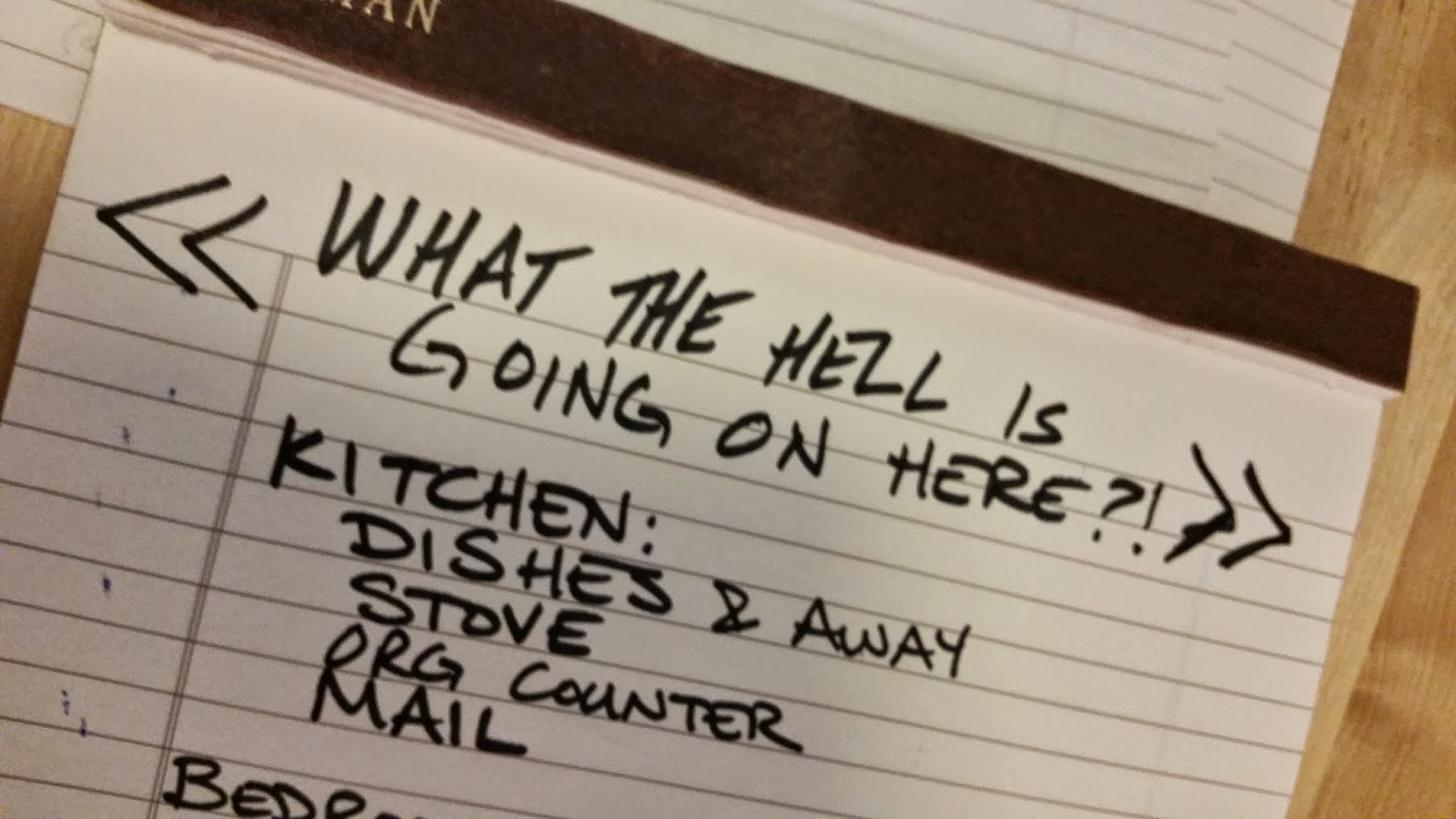 I like to give them titles. I also like to black out the completed items with a sharpie. I also like to tear up the list into very small pieces when it is complete. It's probably not the best idea to delve into the roots of those habits, so we'll just leave it at that.
However, it can be hard to get the right level of specificity on a simple to do list, especially at work. A simple to do list that goes on for pages is more a reminder of the endless suffering you're enduring. See, above, how washing the dishes and putting the dishes away are separate items? When I make my to do lists for home, I list each individual action associated with the laundry; start laundry; change loads; change loads; fold laundry; put clothes away. Otherwise, it doesn't actually happen and/or I don't feel like I've really done anything.
A subset of the Simple To Do List is the Completed Items list, which doesn't really work for me but I've heard good things from other people.
So much of my day is spent answering little questions and putting out fires that I can lose focus on some of the larger things or easily find a way to avoid simple tasks that I don't want to do. In the past few weeks, I've been listing five substantial things that will make me feel like I've accomplished something meaningful during the day. Here's what that looks like:

Now, once upon a time about five or six years ago, I was put in an extremely uncomfortable position that resulted in a lot of feelings in addition to a lot of complicated things to do in a very short time. I had to get my thoughts together about exactly what needed to happen, and I wrote them down in a very, uh, frank manner. I think I averaged two and a half epithets per list item. This list was on a private forum, and when I had completed items, I would strike them, exclaiming in all caps, "done, bitches." Which is how that sort of list is referred to by a certain set. It was very popular as a cohort were completing and defending their dissertations. I recommend using this sparingly, but when you need it, it is extremely effective.
So, what kind of lists do you make? How do you keep yourself on track in a busy time of year? Talk to me in the comments!
Keep Rockin,
Rachel
I make lists. I'm a list maker. I don't think I could quit if I tried. Here's a variety of lists that help me get through the busy times:
Simple To Do List

However, it can be hard to get the right level of specificity on a simple to do list, especially at work. A simple to do list that goes on for pages is more a reminder of the endless suffering you're enduring. See, above, how washing the dishes and putting the dishes away are separate items? When I make my to do lists for home, I list each individual action associated with the laundry; start laundry; change loads; change loads; fold laundry; put clothes away. Otherwise, it doesn't actually happen and/or I don't feel like I've really done anything.
A subset of the Simple To Do List is the Completed Items list, which doesn't really work for me but I've heard good things from other people.
Five Things
So much of my day is spent answering little questions and putting out fires that I can lose focus on some of the larger things or easily find a way to avoid simple tasks that I don't want to do. In the past few weeks, I've been listing five substantial things that will make me feel like I've accomplished something meaningful during the day. Here's what that looks like:
Done, Bitches
Now, once upon a time about five or six years ago, I was put in an extremely uncomfortable position that resulted in a lot of feelings in addition to a lot of complicated things to do in a very short time. I had to get my thoughts together about exactly what needed to happen, and I wrote them down in a very, uh, frank manner. I think I averaged two and a half epithets per list item. This list was on a private forum, and when I had completed items, I would strike them, exclaiming in all caps, "done, bitches." Which is how that sort of list is referred to by a certain set. It was very popular as a cohort were completing and defending their dissertations. I recommend using this sparingly, but when you need it, it is extremely effective.
So, what kind of lists do you make? How do you keep yourself on track in a busy time of year? Talk to me in the comments!
Keep Rockin,
Rachel
Subscribe to:
Posts (Atom)