Showing posts with label productivity. Show all posts

Tuesday, March 1, 2016

This ain't no acrobatics

So, lately I've been writing about catalog records and the contextual needs of users. It's been fun to play with ideas about how we could change the ways in which we catalog our collections in order to meet the needs of users. The part about writing this blog that's enjoyable is that I can put ideas into the world without also having to assign dollar values or staff time to these ideas. Essentially, I can put the in an incubator and see how they grow over time.

But over where ideas meet reality, libraries often don't have the money or the staff to treat resources description in the way that we might want them to. And, in the absence of those resources, they are forced to make choices about how items in their collections are described. But how do we decide--how should we decide?

In 2007, David Banush and Jim LeBlanc wrote an article titled "Utility, library priorities, and cataloging policy" that applied utilitarian principles to cataloging backlogs--specifically liberal utilitarianism. The authors worked at an institution where shifting institutional priorities meant that fewer resources were available for the cataloging of library resources. And in that environment of changing priorities and fewer resources, the Cataloging Department was tasked with reducing their significant backlog.The article discusses the ways in which their institution decided how they could process their backlog to do the greatest amount of good for the largest number of patrons. The institution changed the extent to which humans would intervene in the cases of both original and copy cataloging. The result was accepting more records as-is and creating less detailed records in cases where records didn't exist while also utilizing an automated process to search the bibliographic utility on an ongoing basis for fuller-level records to replace those less detailed records. And while they acknowledge that the long-term effects of the decision's they've made on user access won't be immediately discernible, they were able to share some statistics for 2005/2006 that made it seem like, in the short term, the decisions they made weren't disastrous for user access.

The article makes a good point about how resources in an organization are finite and that when we make one thing a priority over another thing, we decide how to allocate the resources. Banush and LeBlanc write:
If library administrations agree with Mann and others that more resources should be devoted to cataloging as it has been traditionally conceived and practiced, the additional funding and staffing will almost certainly come at the expense of other initiatives (107).
I think that libraries have to provide users with the collections and services they the need to be successful researchers. I also think that Banush and LeBlanc are probably correct when they assert that allocating resources to the emerging collections and services that users need to be successful researchers means that other areas will lose resources in the form of funding or staff positions. And in a world where many information seekers bypass the library's catalog to find information resources, metadata creation and remediation may seem like an easy target for reductions in both funds and staffing.

But I would argue that there is room in this 'do more with less' world for libraries to consider their priorities and how metadata creation and remediation might be embedded in those priorities. Users want access to more digitized and electronic collections? How will you represent those in your catalog and/or on your website? Users tell you on your satisfaction surveys that they can't find what they're looking for in the catalog? How can catalog records be improved to help users succeed in finding what they need?

It's likely that not every item that comes through a library's cataloging department needs hands-on intervention. But whether it's unique collections or specialized areas of collection interest, I suspect that are items that come through the library's cataloging department that need hands-on treatment that don't get it because of financial constraints. And, in that case, library users suffer.

While it's nice to have an incubator space for ideas to grow, I don't think we can write all of them off as wishful thinking or as too expensive. I feel strongly about how well-formed metadata can improve the experience of our users--especially in the realm of subject access. But I also acknowledge that we have to find the places where we're willing to give something to get something. So how do we choose?

Stay positive,
Erin

Works cited:
Banush, David and Jim LeBlanc. "Utility, library priorities, and cataloging policies." Library Collections, Acquisitions & Technical Services 31 (2007) 96-109.



Monday, February 15, 2016

all your favorite tunes ring true

We are busy people, task oriented people. A thing to do and another thing and then another thing.  I have so many thoughts about this disposition, its strengths and weaknesses. Today, however, I want to talk a little about how a person (i.e. me) in a salaried (i.e. never-off) position with both task-based and strategic or project-based work might approach the challenges of all of the individual things and all of the larger ideas all at once.

For me the first and foremost issue is working effectively -- how do I allow myself to be effective and how do I set myself up for success in structuring my work week?

There are times when I can do certain types of work very well and times when I am just banging my head against the very same task. While we don't always have the leisure to structure our workloads to coincide with our highest levels of productivity, knowing what works and what doesn't is always helpful. What I can do in the morning, what I can do between meetings, and what I can do when I'm in a bad mood or hungry or tired is very important.

I think about tasks that get me back on track when I'm not focused: debriefing from meetings, organizing and updating my project to-do lists, triaging my email.

I think about what work I have to do during the day, and what work I can do at home: do I need my dual-monitor workstation to do this project best? Can I do this project while a cat is standing on top of my arms? Do I want to create a separation where I only do research in one place? I try to have my work arrayed so I have the best access to the work best done wherever I am.

I let myself be influenced by my moods. If I am working at home and I'm being very productive, I know that groove may not last, I may not be able to replicate it the next day or even during the week, so I go with it. Have the work ready to go when you're ready to go.  I learned this from my father who worked on the road and had a very flexible schedule, and anyone with ADD will tell you the same: the groove is the payoff for all of the other trouble, so use it.

The balance between tasks and projects is a difficult one -- I find tasks to weigh on me more than projects, but also easier to lay aside. Small tasks pile up, and I need a groove to get focused and get them done. At the same time, projects require periods of focus without interruption, including the interruption of remembering all of the small tasks that need accomplished. However, both cases benefit from a mindset of "do the thing right in front of you." I make lists. So many lists.

What about you, how do you deal with all the little things and all the big things?

Keep Rockin'!
-Rachel

Tuesday, August 4, 2015

There's a ton of the twist, but we're fresh out of shout

Last week, Rachel wrote about what we're trying to do with the catalog. If you haven't read it, you should. Go ahead, I'll wait. Just remember to come back here when you're done.

Okay, I want to spend a little bit of time unpacking this bit that Rachel wrote about shared cataloging and whether or not it is helpful for library patrons. Rachel writes:

An important wrinkle in the story of the library catalog is shared cataloging. I would argue that shared cataloging helps library staff and communicating with other libraries, but is of questionable value to the library patron. After all, I really am not sure that a librarian at Harvard or Duke or even the Library of Congress knows best the description of the item that is both accurate and facilitates my users at Rural State University or Large Public Library or Tinest Library Ever looking for a thing. (this same discussion could be happening about subject cataloging, for instance).
So, in some ways shared cataloging is in our DNA as catalogers. If you pull records into your local catalog from a bibliographic utility you are taking advantage of shared cataloging. This type of shared work allows us to reuse records created by other libraries and saves us from having to create records from scratch for every item in our collection. There is a long tail in library collections, though, and your bibliographic utility of choice will probably not have records for everything in your collection. But by contributing and pulling down records for more commonly held items, your library's catalogers can focus on those unique items for which there is no copy.

Shared cataloging happens on the micro level as well. Consortium and university systems have long banded together to share cataloging resources among their membership. In 2014, the Committee on Institutional Cooperation conducted a cooperative cataloging pilot. The program was opt-in and participants assessed where their cataloging needs were and what they could offer in exchange. The pilot focused on both language and format expertise and helped reduce backlogs at participating institutions. The California Digital Library also has a shared cataloging program whose goal is to provide records for material licensed by the California Digital Library and to eliminate cataloging redundancy among libraries in the University of California campuses.

Shared cataloging is useful in my estimation because it allows libraries to work together to share expertise for certain formats and languages. It is a local solution for outsourcing a problematic backlog of specialized materials because it allows libraries to leverage their strengths to cover their weaknesses. Oh, you have a reading knowledge of Arabic? Great--I know a lot about serials cataloging! Let's work together to clear our respective backlogs! On the macro level, shared cataloging allows us to move widely held material through cataloging and processing to get them on the shelves and into the hands of our users. It also allows libraries to focus on their hidden collections of unique materials.

So, clearly shared cataloging provides value to libraries. But back to Rachel's point about the value of shared cataloging for patrons. Is the value of eliminating backlogs and uncovering hidden collections enough of a boon to users to justify our libraries' involvement in shared cataloging initiatives?

I do think Rachel is right about the fact that different user groups have different needs when it comes to description and access. I wrote earlier about the micromanagement of metadata and how we, as catalogers, need to learn to accept more metadata as-is. I should note that I don't think all local editing of records is bad. Sometimes we do need to augment records with data that will be useful to our users in the form of local notes or copy-specific information. Adding this information falls into the category of adding value to existing metadata. And shared cataloging doesn't mean that we have to leave our users high-and-dry when it comes to meeting their discovery and access needs. It just means that we have a place to start from.

So, no. I don't think that shared cataloging is a panacea for all of our metadata creation woes. We will probably always need to add value to records that reflect the needs of our users. But I do think that shared cataloging allows us to make material available more quickly to our users (always a good thing), and gives us the freedom to address the collections that are unique to our libraries.

Stay positive,
Erin


Thursday, May 14, 2015

Making Space for...

When I was in high school and college I worked at the same company as my mom. Technically, I worked for my mother. I did various things, which we may discuss at some other time if we ever get into our origin stories. What I learned from that job, other than a passing knowledge of microbiology (which isn't really helpful in any way, surprisingly), I learned from watching my mom go about her business.

One of the things she did was have a very tidy workspace. Surely this came from her many years running a research lab -- you can't just leave mouse spleens laying around at the end of the day.  One of the labs that my mother ran was a dirty lab, dirty in that they worked with live human pathogens that could kill you. Put everything away, clean everything, check again, check again. When working in an office, she cleaned and organized her workspace.  Daily neatening, the last hour of her week cleaning her area thoroughly.  Monday morning met with a neat clean ready-to-go workspace.

I managed to pick up some of these habits and carry them to both my kitchen and my shop, but I struggle with them at work. When the end of the work day comes I tend to pack everything into my bag and take it home. Things get more and more disorganized throughout the week, until I need to take a half-day to sort it all out. Random things get spread across my desk and I know that my calculator doesn't go there but I'm "too busy" to take three seconds to put it where it does go.

In this time between class sessions, though, I have enough time to get to inbox zero, so it is a good time to try to reinstate a habit of orderliness. It is important for me because this orderliness has a huge impact on my efficiency and clarity of mind. So I will take tomorrow to organize my office. I will book off the last hour of Friday on my calendar every week to make time for neatening the office. I will resolve once again to take the first and last 20 minutes of the day setting priorities and organizing my tasks.

We let some things slide because they are fundamental. Because we don't appreciate fully how other things are built on them. What core practices help you be your best self? How do you value these in your work day? Let me know in the comments!

Keep Rockin'
Rachel


Thursday, February 19, 2015

On Desire 2: Why Don't We Get What We Want?

On Tuesday, I talked about examining the nature and roots of our desires.  Today, I want to look at the more functional part of the question "if we really want something, what is stopping us from achieving that goal?"

Is it... competing desires?  The way that my desire to stare out the window and sip coffee is nearly equal to my desire to answer my email right now?  When we look at the actions it takes to build the unified library scene, our desire to make that happen in its many little parts is only one set of desires. In my work-life I also desire to be well respected, not misstep politically, achieve tenure, and sometimes sip coffee while staring out the window. All of these desires are occurrent at the same time, and some matrix results in my actual actions which bring about some combination of those desires.  I may be able to achieve some of my desires concurrently, but probably not all, as my inability to speak French and Hebrew fluently should attest. And this competition is messy, with different things gaining the upper hand at different times.  Sometimes I really want to get through my emails, who knows why, and I delete the CFP, and sometimes my strongest desire is to achieve tenure and I send in a proposal.

Is it... the nature of the desire? Am I more likely to work toward something I desire intrinsically? It surely seems like that may be the case, but I'm really not sure. How much power does a second order instrumental desire have? I desire to go to work because I want to pay my rent, that's surely the case, surely that plays into how willing I am to engage in activities that I think will make my desires real but also deem to be risky. Occurrent desires also need not be conscious to influence activity, so I don't even have to be aware of my fear of change for it to stop me from doing something I desire.

Is it... the source of the desire? Some sources of desire allow for desires to be externally imposed, and these are the ones I am specifically thinking about. An attention-based desire could be like my desire to promptly complete annual evaluations so I don't have to think about them any more. Organizational priorities can create the same kind of desires in employees, which seem like they would be disadvantaged in a competition among desires.

I am a person who is interested in getting things done, but I think that examining things like our desires can help us see where we're going, what we want to get done, and what kinds of road blocks we might run into. Having examined the desires and the barriers, we may be more able to fuel appropriate desires, map a course around or deconstruct barriers, and get to where we want to go.

What do you think?

Keep Rockin'
Rachel

Thursday, December 18, 2014

Magical Thinking

In academic libraries, we've come to winter break.  If we're not actually off work, we have some time when there are no students and no faculty. I know that public libraries have a different schedule but surely there are similar times when the routine of the day to day calms enough for a librarian to start thinking.  Thinking big.

It is so tempting to think of all of the things that you can get done over break, or over the summer. I, for instance, according to this list, am going to catch up on my reading for an outside course, completely clean my house decimating the number of things I own, write two papers, outline a book, completely cull and reorganize my email, plan all of 2015 with subgoals any waymarkers, work on the library at my synagogue, apply to business school, do a 4,000 piece jigsaw puzzle while catching up on netflix, and, of course, catch up on all of my email and do budget planning for the next three years. Oh, and I have to also do that conference presentation.

It's break! I can do anything! I can do everything! It's break!

Now. Friends. I submit to you that whatever plans you have for break it is impossible to do them over break. It is possible that it is impossible for any person in any period of time to complete all of those things that you thought of. You simply cannot do it. I know I can't do it.

Even as I wrote the above paragraph I thought of about four more things that I can do can't possibly get done over break. So two things about the magical thinking of break:

There is a middle ground between doing all of the things you can never do and eating cookie dough in front of netflix for three weeks. Making the most of break means actually making it more relaxing and recharging for next semester. I've, sadly, found that eating cookie dough while playing Doctor Mario all day long is not the most reinvigorating. How do you, personally, reach a place where you're able to make progress on the things that are important to you while still making the most of break? It's different for everyone, so just think about that.

What other time are you able to sit down and think about all of the things that you need or want to make happen and still remain in a good mood than thinking about break? When the broad expanse of break is before us, possibilities are open. We can think "what WOULD I do, if I had all the time in the world?" Don't waste that feeling. Go ahead and make that list that not even an alien from the future could complete. Harness your dreams.

Knowing that I can't get all of this done over break and figuring out what is most important to me will let me set goals for each day where I am easily able to get everything done on my list, feel great about my productivity, and still chill out. I think I will be able to get more done AND feel more refreshed going in to next semester.

What's your plan for break? What is the thing that you're gonna get done? What is the thing you can't possibly accomplish?

Keep Rockin',
Rachel

Thursday, September 18, 2014

A List of Lists

I set myself up for a busy fall.  And now that it is fall I find myself overwhelmingly busy. More than I have been in years.  Don't get me wrong, I set myself up to do exciting things, new things, challenging things because I really want to do these things and I know I can get through it, but there comes a time when I just don't know what exactly I need to do at this particular moment to make the world now into the world of the future.

I make lists. I'm a list maker. I don't think I could quit if I tried. Here's a variety of lists that help me get through the busy times:

Simple To Do List


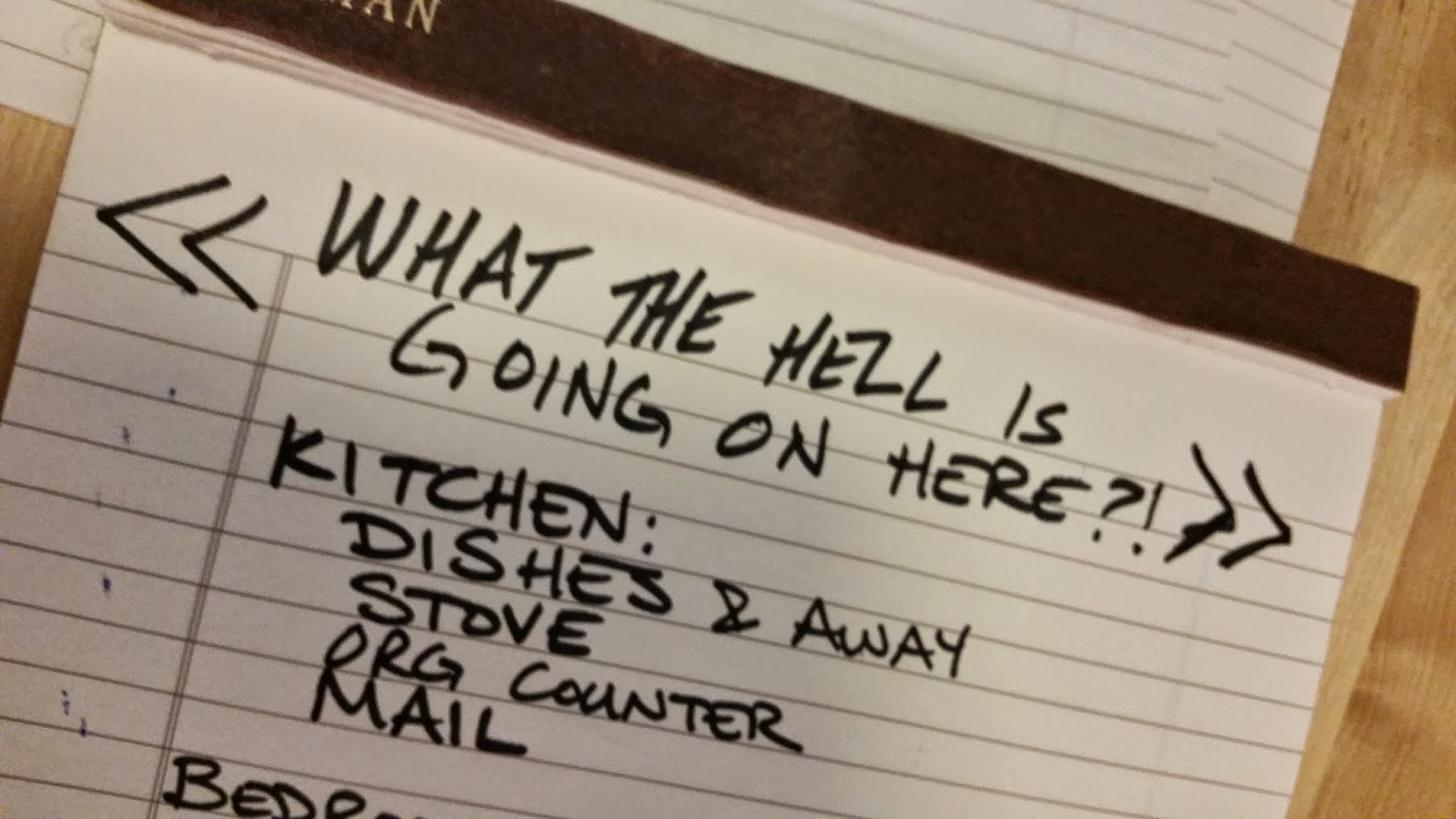
I like to give them titles. I also like to black out the completed items with a sharpie. I also like to tear up the list into very small pieces when it is complete. It's probably not the best idea to delve into the roots of those habits, so we'll just leave it at that.

However, it can be hard to get the right level of specificity on a simple to do list, especially at work.  A simple to do list that goes on for pages is more a reminder of the endless suffering you're enduring.  See, above, how washing the dishes and putting the dishes away are separate items? When I make my to do lists for home, I list each individual action associated with the laundry; start laundry; change loads; change loads; fold laundry; put clothes away. Otherwise, it doesn't actually happen and/or I don't feel like I've really done anything.

A subset of the Simple To Do List is the Completed Items list, which doesn't really work for me but I've heard good things from other people.

Five Things


So much of my day is spent answering little questions and putting out fires that I can lose focus on some of the larger things or easily find a way to avoid simple tasks that I don't want to do. In the past few weeks, I've been listing five substantial things that will make me feel like I've accomplished something meaningful during the day.  Here's what that looks like:


Done, Bitches


Now, once upon a time about five or six years ago, I was put in an extremely uncomfortable position that resulted in a lot of feelings in addition to a lot of complicated things to do in a very short time. I had to get my thoughts together about exactly what needed to happen, and I wrote them down in a very, uh, frank manner. I think I averaged two and a half epithets per list item. This list was on a private forum, and when I had completed items, I would strike them, exclaiming in all caps, "done, bitches." Which is how that sort of list is referred to by a certain set. It was very popular as a cohort were completing and defending their dissertations. I recommend using this sparingly, but when you need it, it is extremely effective.


So, what kind of lists do you make? How do you keep yourself on track in a busy time of year? Talk to me in the comments!

Keep Rockin,
Rachel