The dust is finally settling on ALA Midwinter 2017 and I left Atlanta on Tuesday feeling like this conference was different than other ones. I know that some of it had to do with the ways in which the world changed around us during the conference, but the shift in my feelings wasn't only driven by external forces.
As I've moved into my mid-career years, I care more about ALA-level governance. In some ways, I think this deepened interest stems from my volunteer work within ALCTS. But I also think it comes from the recognition that at both the macro-level and micro-level, the Association reflects the values of the member volunteers who act as its leadership. Beginning in November, there has been a lot of chatter about whether and how ALA represents the values of its members. And while there are some people among its leaders who are paid staffers, many people in positions of power are members.
It would be foolish not to acknowledge a significant number of systems and structures that are meant to further white supremacy and oppress marginalized communities within ALA. At two different times, in two public venues, a black woman was either not given the opportunity to speak or was cut off when she was speaking. During Council II, ALA Council resolved to continue to have the MLS as a required qualification for the ALA Executive Director position. And while ALA Council resolved at Council II to protect caregiver and parent volunteers from punishment if those duties kept them from attending in-person ALA commitments, there is still no protection for people who are unable to attend for other reasons--financial or otherwise.
I have made it a priority to attend at least a little bit of ALA Council meetings at ever ALA Midwinter and Annual conference I attend. But this time I devoted significantly more time to attending these events. I attended both ALA Council I and II and felt like I got a good sense of how these meetings function. I also saw the ways in which ALA Council is (and isn't) a representative body. Many of the same councilors got up to speak at every opportunity, and many of the councilors seemed...disengaged from the process entirely. While the resolution on the MLS requirement for the ALA Executive Director position had a good bit of discussion, I wished that there had been lively conversation around every topic. I didn't attend Council III, so I can't speak to what happened there. I also didn't attend any of the Council Forums, so maybe discussion and discourse happens there instead of in the actual Council sessions? I also wondered to what extent politic-ing happens around Council resolutions. Do councilors form voting blocks?
I also attended the ALA Presidential Candidates' Forum. It was interesting to hear three candidates give platforms that both overlap and diverge wildly. I left that event not feeling sure about who I think should lead our association, and feeling like I have much more work to do before I make that decision. It was valuable to hear not only the prepared statements that the candidates made, but also to hear questions from the audience about the things that mattered to them. I look forward to reading more about and from the candidates in the weeks between now and the ALA election.
Finally, I attended the ALA Town Hall which gave members an opportunity to state their frustrations, hopes, and dreams for the association. As I stood at the microphone to make a comment, I recognized how brave you have to be to stand in an enormous room and speak your truth in front of a room of people who don't all share your views. Many, many people had much more impassioned and eloquent things to say than I did. But I felt an obligation to state publicly that I am holding ALA leadership at all levels accountable for the ways in which their actions support (or don't support) our association's emerging commitment to equity, diversity, and inclusion.
My sense from all of these experiences is that if we truly want our Association to reflect our values, we have to find candidates for ALA-level leadership positions who are willing to advance those values and them hold them accountable for the work they do (and don't do) on our behalf. I think this means fielding and voting for candidates whose values align with our own and then holding them accountable by attending Council meetings and publicizing what happens there. I livetweeted council, as did many other people in the room, in the hopes of boosting a signal about what is emerging as important work of the Association.
I keep tweeting about this, but it's worth saying again: Association governance work is boring, but it's also valuable. There are a million other things you could be doing other than reading the ALA Council listserv and attending Council meetings and forums at conference. But if we want ALA to reflect our values in an increasingly divisive and challenging world, we need to do this work. I don't think that the change that people want to happen within ALA is impossible. But I do think it requires being intentional. I'll be watching, reading, listening, and voting. If you're an ALA member, I invite you to join me.
Stay positive,
Erin
Showing posts with label organizational dynamics. Show all posts
Showing posts with label organizational dynamics. Show all posts
Thursday, January 26, 2017

Tuesday, November 22, 2016
The personal is political is personal
I'm currently reading a book by Frances E. Kendall called Understanding white privilege: creating pathways to authentic relationships across race. In the chapter titled "Understanding white privilege," Kendall tells an anecdote about something that happened in conjunction with one of the diversity-related training sessions she facilitated. During a break on the second day of the workshop, a white woman and a Latina from the class ended up at the same store. The white woman watched how the Latina was treated by the sales clerk from which she was trying to make a purchase--being asked for additional identification when she presented her credit card, being told that the security guard would want to see her receipt when she left--and contrasted that with her own experience. The white woman came back to the training session and told Kendall that she wouldn't have believed how her Latina colleague was treated if she hadn't seen it with her own eyes. Kendall writes:
There is a piece of this conversation that relates to the passage from Kendall's book that I want to highlight. In its most recent communication on this issue, the ALA President stated "the ALA executive board will discuss these issues and our processes and will use your comments to help guide us in our discussion and planning as we work to earn back the trust of our members and prepare for the work ahead during this new administration."
So, let's talk about trust.
ALA has identified diversity as one of its key action areas, charging a task force and then a subsequent implementation working group with considering how equity, diversity and inclusion could be built both within ALA and in wider library community. You can read the task force's final report here. By charging people at the Association-level to do the work of identifying and proposing ways to further DEI-related initiatives, the Association has both implicitly and explicitly asked the margainalized people throughout ALA what can be done to make ALA a more diverse, equitable, and inclusive place. The Association has asked people to entrust us with their stories and told people that it is part of our value system that we will hold those stories and respond in an appropriate way. And then we have chosen not to believe them when they tell us that they are afraid that they will be the targets of state-sponsored violence.
In the same week, ALA's President released a statement affirming ALA's commitment to diversity, equity, and inclusion and two statements affirming ALA's commitment to working with the incoming administration. And, yes, one of those statements was taken down and an apology issued. But one can see how people within the Association's membership would be outraged that such an affirmation was issued in the first place. ALA asked people what they needed to trust the Association as a diverse, equitable, and inclusive organization and then didn't listen to them as they expressed their loudest fears and their deepest concerns.
In the days following the election, Hugh Acheson posted to Instagram a letter he sent to the staff at each of the restaurants he owns. In the letter he writes "The customer is always right, until they are wrong. And when they are wrong with epithets or cruelty they will be asked to leave. This is not me giving you an aggressive power to wield, but rather making sure you understand the ethos I have in protecting what I believe in, and what I do not have the patience for."
I understand that ALA has a dual responsibility to serve both libraries and the people who staff them. To that end, I believe that our goal in libraries should be to serve the communities in which we find ourselves, even when their beliefs don't align with ours. Libraries should be places that foster conversation and an exchange of ideas, but I believe that in libraries, as in Acheson's restaurants, there is a point past which the patron isn't always right--especially when a member of our user community is wrong with cruelty.
So how does the Association go about the work of rebuilding trust?
First, I think it is incumbent upon Association-level leadership to restore the relationship between the Association and its members by centering the voices and taking seriously the concerns the people among its membership who will be most vulnerable in the coming years.
Second, I think it is incumbent upon the membership to make even more space for people who are traditionally underrepresented in librarianship to take on leadership roles. The includes not only providing increased support for programs like the Spectrum Scholarship Program but also the development of a pipeline for leadership both at the Division-level and Association-level.
Finally, I think it is incumbent upon both Association-level leadership and Association membership to ensure the safety of our most vulnerable members through both our words and our actions.
I'm sure that the path toward a restored relationship between the Association and its membership will not be without bumps and will probably look different than what I've suggested here. But I do hope that it happens. And I'll continue to attend ALA Council meetings and ALA Midwinter and ALA Annual in the hopes of seeing signs of the Association working toward that restoration.
Stay positive,
Erin
even though Debbie had been listening to employees of color talk about their painful experiences for a day and a half, she had essentially chosen not to believe what they said; she had continued to say that she thought the different experiences were individual, not race based. She used her own privilege of expecting to be educated about race by the people who were most affected--those of color--and then chose not to believe them (61).I read this passage right around the time that people were starting to express their outrage over the press releases that ALA sent out regarding its desire to work with the newly elected administration and which highlighted a trio of initiatives that it felt aligned with the newly elected administration's stated goals for its administration. People have addressed this situation in smarter, and more nuanced ways that I have. If you're interested in reading other people's points of view, I would suggest checking out #notmyALA on Twitter. A lot of opinions and posts are aggregated there.
There is a piece of this conversation that relates to the passage from Kendall's book that I want to highlight. In its most recent communication on this issue, the ALA President stated "the ALA executive board will discuss these issues and our processes and will use your comments to help guide us in our discussion and planning as we work to earn back the trust of our members and prepare for the work ahead during this new administration."
So, let's talk about trust.
ALA has identified diversity as one of its key action areas, charging a task force and then a subsequent implementation working group with considering how equity, diversity and inclusion could be built both within ALA and in wider library community. You can read the task force's final report here. By charging people at the Association-level to do the work of identifying and proposing ways to further DEI-related initiatives, the Association has both implicitly and explicitly asked the margainalized people throughout ALA what can be done to make ALA a more diverse, equitable, and inclusive place. The Association has asked people to entrust us with their stories and told people that it is part of our value system that we will hold those stories and respond in an appropriate way. And then we have chosen not to believe them when they tell us that they are afraid that they will be the targets of state-sponsored violence.
In the same week, ALA's President released a statement affirming ALA's commitment to diversity, equity, and inclusion and two statements affirming ALA's commitment to working with the incoming administration. And, yes, one of those statements was taken down and an apology issued. But one can see how people within the Association's membership would be outraged that such an affirmation was issued in the first place. ALA asked people what they needed to trust the Association as a diverse, equitable, and inclusive organization and then didn't listen to them as they expressed their loudest fears and their deepest concerns.
In the days following the election, Hugh Acheson posted to Instagram a letter he sent to the staff at each of the restaurants he owns. In the letter he writes "The customer is always right, until they are wrong. And when they are wrong with epithets or cruelty they will be asked to leave. This is not me giving you an aggressive power to wield, but rather making sure you understand the ethos I have in protecting what I believe in, and what I do not have the patience for."
I understand that ALA has a dual responsibility to serve both libraries and the people who staff them. To that end, I believe that our goal in libraries should be to serve the communities in which we find ourselves, even when their beliefs don't align with ours. Libraries should be places that foster conversation and an exchange of ideas, but I believe that in libraries, as in Acheson's restaurants, there is a point past which the patron isn't always right--especially when a member of our user community is wrong with cruelty.
So how does the Association go about the work of rebuilding trust?
First, I think it is incumbent upon Association-level leadership to restore the relationship between the Association and its members by centering the voices and taking seriously the concerns the people among its membership who will be most vulnerable in the coming years.
Second, I think it is incumbent upon the membership to make even more space for people who are traditionally underrepresented in librarianship to take on leadership roles. The includes not only providing increased support for programs like the Spectrum Scholarship Program but also the development of a pipeline for leadership both at the Division-level and Association-level.
Finally, I think it is incumbent upon both Association-level leadership and Association membership to ensure the safety of our most vulnerable members through both our words and our actions.
I'm sure that the path toward a restored relationship between the Association and its membership will not be without bumps and will probably look different than what I've suggested here. But I do hope that it happens. And I'll continue to attend ALA Council meetings and ALA Midwinter and ALA Annual in the hopes of seeing signs of the Association working toward that restoration.
Stay positive,
Erin
Tuesday, July 26, 2016
I never want to be anyone's enemy
At the end of June, I wrote a post about how I thought that people with reference and instruction duties should spend time working with metadata creators in order to help enhance access to the collections they curate. My thought process is that having a holistic view of the library helps everyone become better at their jobs and that the burden to cross-train shouldn't be placed exclusively upon the shoulders of technical services librarians.
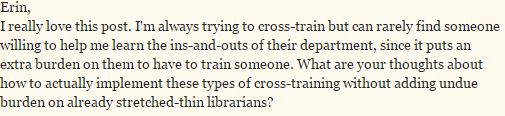
I got a really great comment on this post that made me pause for a moment in self-reflection.
It's a great question, right? How do you actually implement a cross-training program when everyone feels stretched so thin that they can't take the time to work with someone from another department?
After thinking about it a lot, I identified three things I've seen work at various places that I've worked.
1. Start small:
I don't think it's necessarily realistic to show up in another department and ask to be cross-trained, especially if it's not the culture at your library. Start by bringing genuine questions about how things work to someone in the department you'd like to learn more about. Are you a public services librarian who wants to learn more about metadata? Start by asking a friendly cataloger about why a search you did in the online catalog produced different results than you thought it would. Are you a metadata creator who wants to know more about how library users access information in the online catalog? Start by asking a friendly public services librarian about what complaint they hear the most during one-on-one transactions or during instruction sessions. They don't have to be long, in-depth conversations. But do enough to start building relationships with people in departments outside your own and showing interest in the work that your colleagues do.
2. Focus on fixed-term projects:
Sometimes the slow season for one department will align with the busy season for another. Or sometimes the workload of a person in a particular department ebbs and flows. These natural changes in the rhythm of the library make space for people to cross-train on projects. Is there a project in your department that nobody has time to do or a project that requires an extra set of hands? This would be a great opportunity to find people in other parts of the library who are looking for skill-building opportunities outside of their own departments. Bonus points if the project you're looking for help with utilizes talents that the person doing the project doesn't get to use in their day-to-day work. You don't have to give a person working on a fixed-term project enough training to be a full-fledged member of the department, which helps if you feel like you don't have time to spare with a programmatic cross-training initiative.
3. Make the first move:
Not every person in every department is going to be open to cross-training or collaboration. Some people don't want to learn more about metadata creation or information literacy because they'd rather focus on the work they're actually assigned to do.
And that's okay.
But I feel like libraries have to create a culture where people who do want to collaborate or cross-train are supported in doing so. Yes, it takes time to teach people. Yes, it is hard when you're already stretched really thin. But libraries should reward people who want to learn more and do more instead of treating those people like burdens.
Sometimes, you have to be the change agent in your library and decide that you're going to be the person to make the first move and give up your time in order to change the culture. Ask questions and make it clear you're willing to answer questions. Be friendly and curious--someone that people in other departments want to approach with questions--and use the capital you've earned to ask people questions. If you want to talk to people, try to approach them on their terms. If they prefer emails to a phone call or a drop-in conversation, respect that. If they'd like for you to make an appointment so that they have time to give your question the time and attention it deserves.
Final thoughts:
In my first job out of library school, two things happened around the same time. First, I developed an interest in library instruction because I felt like it would be my best chance (based on the climate and culture of my library) to learn more about how students accessed information. Second, I became the go-to person in the cataloging department for a couple of instruction librarians just by being friendly. Luckily for me, one of those people was the instruction coordinator and she believed in me enough to mentor me in instruction and to allow me to teach a library orientation class each semester. By being curious about what she did and friendly when she asked questions, I was able to help her and to grow my own skills.
Look, I get it. It's possible that you'll try all of these things and people will still be stretched too thin to cross-train you. In which case, you might have to find opportunities to learn more about other parts of librarianship from people you don't work with. If you're a person working in public services who feels like there is no one in metadata creation that you can talk to, feel free to reach out to me. While I can't give you work to do, I'm happy to answer your questions and to serve a sounding board for ideas you might have.
Stay positive,
Erin
Tuesday, October 27, 2015
One chance to stay something deep in the audio
Last Wednesday, I co-presented a webinar with my friend, and former colleague, Jaleh. We talked about establishing effective Technical Services/Public Services collaborations. It was a well-attended session and the attendees were engaged and asked great questions. Overall, it was a really enjoyable experience. When the recording goes up, you should give it a listen.
In the meantime, Jaleh storified the event because she is awesome. Check it out!
One of the questions during the Q&A portion of the event was about how to establish Technical Services/Public Services collaborations in a work environment that didn't encourage collaboration to the point of outright discouraging it.
I am not great at rapid-fire Q&A. I am one of those people who likes to think about something before I talk about it. In most meetings, I am the last person to give my opinion because I like to think about an issue and hear everyone's opinions before giving my own. So, in that moment, I kind of panicked and said what was true about my experience in libraries: I have never really been told no in my professional life. It's annoying and I recognize how fortunate I am.
Having spent almost a week considering the question, I feel like I have a better answer.
I should start by saying that I have never worked in a library that actively discouraged people from different departments working together collaboratively. More often, my experience has been that some departments have a more formalized structure where they require people to go "up and over" in the org chart in order to work with people in that unit. And even then, it wasn't a guarantee that you would be allowed to collaborate.
I feel like leaders put their departments under lock and key for a couple of reasons. One, I think, is that they are more oriented toward job duties than problem solving. A job duty orientation says that I am responsible for the processes and products that are mine--nothing more or less. And in that case, why would you collaborate? A person in that kind of department picks up a process where another functional area leaves off and drops off that process where the next department picks up. I think that this kind of mindset leads to problematic processes, full of unnecessary work and pain points for users. But it's a mindset that some leaders have.
Another reason I think leaders put their departments under lock and key is that the department has a lot of daily tasks to get done and the leader believes that the only way to get things done is to cut down on distraction. After focusing on one's daily work, there is little time left in their schedule for cross-departmental collaboration or problem solving. I think that those departments are often victims of the do more with less thing that libraries seem so fond of. This myopia also leads to pain points for users, but it's also a mindset that people have.
Okay...so what?
I think that quite often, we react to a situation where a department won't make space for collaborative work by going around them to get things done. So-and-so won't work with us, we think, so we just have to figure out a way to get things done. But here's the thing about that, it allows that group of people to continue not being collaborative. And if what you want is to build a culture of cross-departmental collaboration, you have to be deliberate about getting everyone to the table when it matters.
When we think about organizational silos, the thing to know is that different functional areas have different priorities. And sometimes those priorities compete. So the way to build collaboration is to build consensus by putting everyone's priorities on the table, knowing that everything is going to have to give something up to achieve that common goal.
So, how do you build collaboration between Technical Services and Public Services in a library that doesn't encourage collaboration?
When a process breaks down or a new service is about to be implemented, bring leaders from all of the functional areas together. Start by identifying the priorities of each functional area and being honest about where those priorities compete. Then, when you've done that, come to consensus about goals and commonalities and figure out how each functional area can both give something up and gain something.
And when you do this, invite everyone--not just the people who you know are good collaborators. It's how you start to build community.
Stay positive,
Erin
In the meantime, Jaleh storified the event because she is awesome. Check it out!
One of the questions during the Q&A portion of the event was about how to establish Technical Services/Public Services collaborations in a work environment that didn't encourage collaboration to the point of outright discouraging it.
I am not great at rapid-fire Q&A. I am one of those people who likes to think about something before I talk about it. In most meetings, I am the last person to give my opinion because I like to think about an issue and hear everyone's opinions before giving my own. So, in that moment, I kind of panicked and said what was true about my experience in libraries: I have never really been told no in my professional life. It's annoying and I recognize how fortunate I am.
Having spent almost a week considering the question, I feel like I have a better answer.
I should start by saying that I have never worked in a library that actively discouraged people from different departments working together collaboratively. More often, my experience has been that some departments have a more formalized structure where they require people to go "up and over" in the org chart in order to work with people in that unit. And even then, it wasn't a guarantee that you would be allowed to collaborate.
I feel like leaders put their departments under lock and key for a couple of reasons. One, I think, is that they are more oriented toward job duties than problem solving. A job duty orientation says that I am responsible for the processes and products that are mine--nothing more or less. And in that case, why would you collaborate? A person in that kind of department picks up a process where another functional area leaves off and drops off that process where the next department picks up. I think that this kind of mindset leads to problematic processes, full of unnecessary work and pain points for users. But it's a mindset that some leaders have.
Another reason I think leaders put their departments under lock and key is that the department has a lot of daily tasks to get done and the leader believes that the only way to get things done is to cut down on distraction. After focusing on one's daily work, there is little time left in their schedule for cross-departmental collaboration or problem solving. I think that those departments are often victims of the do more with less thing that libraries seem so fond of. This myopia also leads to pain points for users, but it's also a mindset that people have.
Okay...so what?
I think that quite often, we react to a situation where a department won't make space for collaborative work by going around them to get things done. So-and-so won't work with us, we think, so we just have to figure out a way to get things done. But here's the thing about that, it allows that group of people to continue not being collaborative. And if what you want is to build a culture of cross-departmental collaboration, you have to be deliberate about getting everyone to the table when it matters.
When we think about organizational silos, the thing to know is that different functional areas have different priorities. And sometimes those priorities compete. So the way to build collaboration is to build consensus by putting everyone's priorities on the table, knowing that everything is going to have to give something up to achieve that common goal.
So, how do you build collaboration between Technical Services and Public Services in a library that doesn't encourage collaboration?
When a process breaks down or a new service is about to be implemented, bring leaders from all of the functional areas together. Start by identifying the priorities of each functional area and being honest about where those priorities compete. Then, when you've done that, come to consensus about goals and commonalities and figure out how each functional area can both give something up and gain something.
And when you do this, invite everyone--not just the people who you know are good collaborators. It's how you start to build community.
Stay positive,
Erin
Thursday, July 9, 2015
In Your Own Back Yard
As I mentioned, I have just recently bought a house and put all of my stuff in the house or adjacent to the house. People keep asking me about the house. I'm always tempted to respond, "it's gonna be great... once I change everything." It's not that the house is bad. The house is entirely serviceable and serves its housely functions admirably for the house it is. I'm telling you, though, I have plans for this place. It's gonna be so great and so amazing and so perfect. When I'm done replacing everything. I mean, everything is possible.
Thing about my grand goals is that there is no way that I can make them all happen at once. I don't have the time or the money or the will to make it all happen right this moment. What I can do is plan, do what I can right now, set the stage for the future. For instance, after I paint and put out the room-sized carpet, I'll feel a lot better and be able to move in. Even that, though, is a temporary solution, because I'm going to have to move everything out to put in the wood floors later. I'm getting new appliances, but I might have to get different things when I remodel the kitchen. Each step, though, each step, even if it seems slightly off direction, is a step toward the goal, toward the Great House which I've got my target on.
The same happens in our organizations. We have great plans for our programs, our institutions, even our organizational culture. It's impossible to take it all out and put in a new one. We work with what we've got, and there are always limitations. But one step at a time we make changes to ourselves, our plans, and the circumstances. I see three main things that I, personally, have to focus on to keep my heart happy and my eyes on the prize.
1) know your capacity
Part of what we have to do to live with what we've got right now is what Erin talked about, knowing what we can and can't do and setting the stage for success where we're able. I (probably) can't fix everything in my house. I really don't want to spend a week in my crawlspace changing the plumbing. But I can make my goals clear to a plumber. I can also talk to the strategic planning committee about what I think would work best for our organization, and let them do the rest.
2) do what you can; track progress
Just because you can't do everything now doesn't mean you can't do anything. It is essential to keep moving forward with intent. Even if you keep running (sometimes literally) into walls. Take small steps. When things go exactly like you'd planned they'd go in the ideal library, shout for joy and tell the world. When I finish the new deck you know I'm having a big big party. Look at what we've done, how far we've come. More to go, but much has been done.
3) be patient
Things. Take. Time.
You can't do everything. You are one person. You have to sleep.
I remind myself constantly to be patient with, well, everything.
People take time, thinking takes time, changing takes time. Figure out how to work on it in a way that builds, but also builds capacity for more change. Figure out how to reward yourself or your organization for the progress you've made. Know that you can only do so much, and that that is okay. Because if you fail trying to do too much, you're further behind than when you started and heartbroken too. So do what you can. And take a deep breath.
I found myself staring at the piles of things in my garage for who knows how long the other day. I have almost no idea how I'm going to get to the house I see in my mind from what exists in reality. I know that I will get there, though, because I mean to. It will take a while, but it is starting now, and I get to be here to watch it happen.
Keep Rockin'
Rachel
Thing about my grand goals is that there is no way that I can make them all happen at once. I don't have the time or the money or the will to make it all happen right this moment. What I can do is plan, do what I can right now, set the stage for the future. For instance, after I paint and put out the room-sized carpet, I'll feel a lot better and be able to move in. Even that, though, is a temporary solution, because I'm going to have to move everything out to put in the wood floors later. I'm getting new appliances, but I might have to get different things when I remodel the kitchen. Each step, though, each step, even if it seems slightly off direction, is a step toward the goal, toward the Great House which I've got my target on.
The same happens in our organizations. We have great plans for our programs, our institutions, even our organizational culture. It's impossible to take it all out and put in a new one. We work with what we've got, and there are always limitations. But one step at a time we make changes to ourselves, our plans, and the circumstances. I see three main things that I, personally, have to focus on to keep my heart happy and my eyes on the prize.
1) know your capacity
Part of what we have to do to live with what we've got right now is what Erin talked about, knowing what we can and can't do and setting the stage for success where we're able. I (probably) can't fix everything in my house. I really don't want to spend a week in my crawlspace changing the plumbing. But I can make my goals clear to a plumber. I can also talk to the strategic planning committee about what I think would work best for our organization, and let them do the rest.
2) do what you can; track progress
Just because you can't do everything now doesn't mean you can't do anything. It is essential to keep moving forward with intent. Even if you keep running (sometimes literally) into walls. Take small steps. When things go exactly like you'd planned they'd go in the ideal library, shout for joy and tell the world. When I finish the new deck you know I'm having a big big party. Look at what we've done, how far we've come. More to go, but much has been done.
3) be patient
Things. Take. Time.
You can't do everything. You are one person. You have to sleep.
I remind myself constantly to be patient with, well, everything.
People take time, thinking takes time, changing takes time. Figure out how to work on it in a way that builds, but also builds capacity for more change. Figure out how to reward yourself or your organization for the progress you've made. Know that you can only do so much, and that that is okay. Because if you fail trying to do too much, you're further behind than when you started and heartbroken too. So do what you can. And take a deep breath.
I found myself staring at the piles of things in my garage for who knows how long the other day. I have almost no idea how I'm going to get to the house I see in my mind from what exists in reality. I know that I will get there, though, because I mean to. It will take a while, but it is starting now, and I get to be here to watch it happen.
Keep Rockin'
Rachel
Thursday, April 30, 2015
On Getting Better
I've been thinking about a lot of things. If you know me well you know that I have a penchant for speaking through parables. So as I'm thinking through the change that's going on in my life personally and professionally, thinking about current events in Baltimore, thinking about change in libraries and in the profession, all that comes to mind is my Tuesday acupuncture session. So I'll just tell my parable and let you take from it what you will.
I love acupuncture, it's my favorite kind of magic: old magic that works REAL GOOD. Most of the time when I get acupuncture, we're working on a realignment, a little course correction, and it feels good. If you've known acupuncture, you've known the zen space that it creates. Time for a little deep breathing, a little visualization, just sorting things out. You leave that appointment feeling fantastic, and you feel better and better after the treatment. Getting better is fun and easy it's magic with no cost. Okay a little cost, but not too much really. That's how it works, right? That's how it should be?
This week, though, what happened at acupuncture was this: what we found was an old issue that was possibly the cause of a bunch of other stuff. So we went to work on it. I did not get 20 minutes of meditative visualization. There was twenty minutes of pain and suffering. Incoherent moaning even. It just hurt. The whole time. A lot.
In fact, it still hurts. The the exercises that I am supposed to be doing, they also hurt. My shoulder? it hurts. It'll probably hurt when I go back next week. Because it wasn't working right. I didn't hurt when it wasn't working right. But it hurts now. And it's gonna keep hurting for a while.
I guess I could ignore it and hope it goes back to mostly not hurting and not working right. We could do that. But I won't, and we shouldn't.
I want to get better and I want us to get better and I want to believe we want to be better.
Sometimes it hurts.
I love acupuncture, it's my favorite kind of magic: old magic that works REAL GOOD. Most of the time when I get acupuncture, we're working on a realignment, a little course correction, and it feels good. If you've known acupuncture, you've known the zen space that it creates. Time for a little deep breathing, a little visualization, just sorting things out. You leave that appointment feeling fantastic, and you feel better and better after the treatment. Getting better is fun and easy it's magic with no cost. Okay a little cost, but not too much really. That's how it works, right? That's how it should be?
This week, though, what happened at acupuncture was this: what we found was an old issue that was possibly the cause of a bunch of other stuff. So we went to work on it. I did not get 20 minutes of meditative visualization. There was twenty minutes of pain and suffering. Incoherent moaning even. It just hurt. The whole time. A lot.
In fact, it still hurts. The the exercises that I am supposed to be doing, they also hurt. My shoulder? it hurts. It'll probably hurt when I go back next week. Because it wasn't working right. I didn't hurt when it wasn't working right. But it hurts now. And it's gonna keep hurting for a while.
I guess I could ignore it and hope it goes back to mostly not hurting and not working right. We could do that. But I won't, and we shouldn't.
I want to get better and I want us to get better and I want to believe we want to be better.
Sometimes it hurts.
Tuesday, April 21, 2015
A thousand compromises (don't add up to a win)
I often find that when I
am uncomfortable with something, I need to pause and think about what it is
about that thing that makes me uncomfortable beyond my initial knee-jerk
reaction.
So it was when I read
this this essay from Inside Higher Ed. (hat tip to Jacob
Berg, noted
BeerBrarian).
I agreed with much of
what Ward had to say about how envisioning the future a campus library has to
be a collaborative effort between the library’s leadership and campus-wide
stakeholders.
Ward writes:
It will take a university community to shape a future library that meets the specific needs of learning and research at that institution. This transition is not just about libraries. It is about how colleges and universities come together to solve a collective challenge. Libraries cannot puzzle out their future alone.
And as much I as I
agreed with Ward on this, something didn’t sit right with me. After
writing and deleting several blog posts worth of material, suddenly I was
confronted with what made me uncomfortable about Ward’s essay.
Ward is right in that
academic library leadership must
understand the decision-making process of key university stakeholders and he is
correct that that process is both “complex and ambiguous.” Understanding what faculty and administrators
value is important when considering what areas of collections or services you
need to develop. Are members of your science faculty working more on securing grants?
Great—work on developing a plan to build up your data management services,
including better understanding grant requirements. Are members of your
humanities faculty working more on incorporating geospatial components to their
research? Great—maybe it’s time to consider investing in a GIS Librarian!
Ward writes:
At the same time, librarians will be unsuccessful in planning for the future on their own. They possess much expertise about libraries, but less about trends in research and curriculum. Moving forward, the process of recreating the library must be one that involves many people in many roles on campus.
But I feel like it goes
both ways. The academic library plays a unique role on a college campus, but I
feel like its leadership is not always invited to participate in conversations
in which it possesses expertise. Does someone from your library serve on your
college’s curriculum committee? Is your library represented on your college’s
committee on rank and tenure?
Academic library leaders
should absolutely involve campus stakeholders in the planning process. Have
summits, run focus groups, host strategic planning days to better understand
the needs of constituencies. Develop relationships
with your stakeholders based on areas of mutual concern. I have
written before about how important it is to develop relationships with
stakeholders by crafting compelling stories about our services and collections.
But academic library
leadership shouldn’t stop there. They should be active in their
college’s community, offering their expertise on issues where their library is uniquely
qualified to comment and offer solutions.
So, I guess the question
is—what is it that the academic library is uniquely qualified to do that no
other department on campus can? And how do we include stakeholders in
developing our future without giving that away?
Stay positive,
Erin
Wednesday, March 18, 2015
On metadata and user experience
In addition to writing on the blog, I tweet. A lot. While Twitter is great for rapid fire conversations, the downside of Twitter is that 140 characters doesn't allow for a lengthy development of a thought. The upside is having a blog where you can expand on an idea.
Today, I tweeted the following tweets:
There seems to be a disconnect between the notion of patron's discovering information via the online catalog and the creation and remediation of the metadata that populates the online catalog.
Cataloging departments are often understaffed and underfunded. Positions in cataloging departments often go unfilled after they are vacated, their funding line reallocated to a different part of the library. The 'do less with more' meme is true everywhere in libraries, but it feels truer in cataloging.
The value that administrators place on the creation and remediation of metadata in their organizations is less than, say, the value they place on the experience of users in libraries. But one inescapable part of a user's experience of the library is discovery of library materials in an online catalog. Maybe your users aren't looking for the same kind of material now that they were a decade ago. And maybe the ways they search are different. But if someone is coming to your library to find something, chances are that an online catalog of your library's materials is often the first place they go.
You can't have a good online catalog without good metadata driving it. And the best way to get good metadata is to support the creation and remediation of metadata within your organization.
Yes, there are tools that can automate this process. And yes, there are ways that we can streamline the cataloging of materials. I am not opposed to outsourcing of cataloging or the purchase of vendor records. But a value has to be placed on the metadata that is created from these sources as well.
So why are we, as catalogers, so terrible at communicating our value to the people in our organizations who drive decisions?
I think it circles back to yesterday's post on creating compelling stories. As much as we want people to understand our point of view, we have to start talking about how our work impacts the experience of library users in a jargon-free way. We all say that cataloging is a public service, but do we explain how the metadata that has been created and remediated in the appropriate ways has a direct effect on whether or not a user finds what they're looking for? Do we explain how fields in the records we create effect facted searching and how incorrectly coded records show up under the wrong facet?
I don't think it's always that administrators won't listen. I think it's that administrators have limited resources and it's not immediately apparent how the creation and remediation of metadata impacts how users experience the library. When you're trying to be a good steward of funds, it's easy to allocate resources to the services that you can see directly and immediately impacting library users.
I'm going to take my own advice on this one. I'm going to work on coming up with a compelling, jargon-free elevator pitch in support of allocating resources to the creation and remediation of metadata. I'm not saying it will solve the problem. But maybe it will start the conversation.
Stay positive,
Erin
Today, I tweeted the following tweets:
We talk about making library collections more discoverable w/out also talking about supporting creation/remediation of underlying metadata.
— Erin Leach (@erinaleach) March 18, 2015
Like, how do you expect your "next gen" OPACs to work if the metadata in them is really terrible?
— Erin Leach (@erinaleach) March 18, 2015
Libraries have to spend money on metadata creation/remediation if they want to improve the experience of their patrons on the search end.
— Erin Leach (@erinaleach) March 18, 2015
And based on the number of re-tweets they got, I can tell that I struck a nerve.There seems to be a disconnect between the notion of patron's discovering information via the online catalog and the creation and remediation of the metadata that populates the online catalog.
Cataloging departments are often understaffed and underfunded. Positions in cataloging departments often go unfilled after they are vacated, their funding line reallocated to a different part of the library. The 'do less with more' meme is true everywhere in libraries, but it feels truer in cataloging.
The value that administrators place on the creation and remediation of metadata in their organizations is less than, say, the value they place on the experience of users in libraries. But one inescapable part of a user's experience of the library is discovery of library materials in an online catalog. Maybe your users aren't looking for the same kind of material now that they were a decade ago. And maybe the ways they search are different. But if someone is coming to your library to find something, chances are that an online catalog of your library's materials is often the first place they go.
You can't have a good online catalog without good metadata driving it. And the best way to get good metadata is to support the creation and remediation of metadata within your organization.
Yes, there are tools that can automate this process. And yes, there are ways that we can streamline the cataloging of materials. I am not opposed to outsourcing of cataloging or the purchase of vendor records. But a value has to be placed on the metadata that is created from these sources as well.
So why are we, as catalogers, so terrible at communicating our value to the people in our organizations who drive decisions?
I think it circles back to yesterday's post on creating compelling stories. As much as we want people to understand our point of view, we have to start talking about how our work impacts the experience of library users in a jargon-free way. We all say that cataloging is a public service, but do we explain how the metadata that has been created and remediated in the appropriate ways has a direct effect on whether or not a user finds what they're looking for? Do we explain how fields in the records we create effect facted searching and how incorrectly coded records show up under the wrong facet?
I don't think it's always that administrators won't listen. I think it's that administrators have limited resources and it's not immediately apparent how the creation and remediation of metadata impacts how users experience the library. When you're trying to be a good steward of funds, it's easy to allocate resources to the services that you can see directly and immediately impacting library users.
I'm going to take my own advice on this one. I'm going to work on coming up with a compelling, jargon-free elevator pitch in support of allocating resources to the creation and remediation of metadata. I'm not saying it will solve the problem. But maybe it will start the conversation.
Stay positive,
Erin
Thursday, January 29, 2015
Introverts and Introspection
One of the first things that Erin and I connected over was "introverts and leadership." As we move along in our explorations here at Constructive Summer, the ways that we (us introverts) want to make change is all about relationships and caring about people, about dreaming big and making a path to get there. Introverts and introversion have become a real popular topic recently, and there is a lot of research that I haven't read on the subject of introverts and leadership, and relationships, etc etc etc.
That all puts me in mind of personality tests as management tools. When the myriad of different personality tests are administered as some sort of management tactic or team building effort, the real goal of such an effort isn't so much to have people reflect on themselves. The real goal (which I have not ever seen fully implemented) is to provide a framework for understanding ourselves in relation to our coworkers. The goal is to facilitate a discussion of our work dynamics.
Attention to others is, for me, the foundation of what exhausts me about being around other people. I spend a great deal of energy trying to figure out where people are coming from, what their likely moves are, that I am truly understanding what they are saying, and so forth. Additionally, I spend a lot of energy considering the interactions I have had specifically, in addition to just generally doing a great deal of reflection, which I will discuss later.
I don't think that being introverted is the root of what I feel I am good at, but I do think that my introversion is deeply connected with the way I am in the world and the practices that do make me good at what I do. I'd love to hear from you (especially extroverts) if you have the same experience. The tools that make me good at what I do, the ones that make me a good leader and effective professional are: attention to detail with an ability to scope out to a systems view; the ability, desire and openness to understand other perspectives and the assumptions underlying those views; and the sum of the two -- an attention to how I and the messages I am sending will be received by different audiences.
It seems all very Machiavellian when I lay it out like that, and maybe it is. For me, operating in a social world has always been about trying to figure out the rules and, because I operate fueled entirely by the approval of others, follow them very carefully for the advancement of my chosen causes. I don't think I'm all that different from a lot of people. Which all goes to say the kind of reflection that management may try to get at through team building personality tests may already be baked in to how many library employees operate. Tapping into that may be more efficient than trying to recreate it from scratch.
The kind of understanding we build when we reflect on ourselves and our relationships with our work colleagues is the first building block of a successful............. strategic plan. Tune in next week for building block number two!
Keep Rockin'
Rachel
That all puts me in mind of personality tests as management tools. When the myriad of different personality tests are administered as some sort of management tactic or team building effort, the real goal of such an effort isn't so much to have people reflect on themselves. The real goal (which I have not ever seen fully implemented) is to provide a framework for understanding ourselves in relation to our coworkers. The goal is to facilitate a discussion of our work dynamics.
Attention to others is, for me, the foundation of what exhausts me about being around other people. I spend a great deal of energy trying to figure out where people are coming from, what their likely moves are, that I am truly understanding what they are saying, and so forth. Additionally, I spend a lot of energy considering the interactions I have had specifically, in addition to just generally doing a great deal of reflection, which I will discuss later.
I don't think that being introverted is the root of what I feel I am good at, but I do think that my introversion is deeply connected with the way I am in the world and the practices that do make me good at what I do. I'd love to hear from you (especially extroverts) if you have the same experience. The tools that make me good at what I do, the ones that make me a good leader and effective professional are: attention to detail with an ability to scope out to a systems view; the ability, desire and openness to understand other perspectives and the assumptions underlying those views; and the sum of the two -- an attention to how I and the messages I am sending will be received by different audiences.
It seems all very Machiavellian when I lay it out like that, and maybe it is. For me, operating in a social world has always been about trying to figure out the rules and, because I operate fueled entirely by the approval of others, follow them very carefully for the advancement of my chosen causes. I don't think I'm all that different from a lot of people. Which all goes to say the kind of reflection that management may try to get at through team building personality tests may already be baked in to how many library employees operate. Tapping into that may be more efficient than trying to recreate it from scratch.
The kind of understanding we build when we reflect on ourselves and our relationships with our work colleagues is the first building block of a successful............. strategic plan. Tune in next week for building block number two!
Keep Rockin'
Rachel
Friday, January 16, 2015
From The Outside
I've been involved in a few space planning projects now, and it always seems that we are surprised at how we look when we see ourselves reflected back through the eyes of outsiders we've invited. Architects and other outside consultants can offer a view that we can't get from our own entrenched positions and that is a good thing.
Outsiders only know what you tell them and what they can see. When you see yourself through their eyes, you can get a good look at the foundational narratives of your organization: the stories you tell yourselves. These can be good or bad, but they are foundational in a way that makes them hard to uncover during day to day business. When what they see and what they hear don't align, that gets drawn out in discussions and narratives. You find yourself being asked to clarify why things that conflict with your narratives exist.
Outsiders don't have a vested interest in the organization. They can't retaliate directly against anyone, and can anonymize issues. If you let folks talk directly to the architects, consultants, etc, either individually or in peer groups, you can get feedback that might never get spoken aloud in other contexts.
A colleague of mine recently invited an "equity consultant" to come and work with their department. The consultant held a day of open forums for undergraduates, graduates, untenured tenure track faculty, adjunct faculty, women, faculty of color. The forums were open to those groups specifically, and afterwards he reported back what he had heard to the administrators and leaders in the department. The result was a deconstruction of the narrative of "we've got a few issues but we're doing okay" based on hearing comments that people only felt comfortable making in a safe space.
Even when a consultant isn't hired specifically to address issues like "are we a truly equitable workplace" or "what are our foundational narratives," when you pay attention to the organizational dynamics that go on when an outsider is involved (especially for an extended period like with an architect), you can learn a lot about your organization. And, most importantly, you can use that information to start to make changes to be a better organization.
Keep Rockin'
Rachel
Outsiders only know what you tell them and what they can see. When you see yourself through their eyes, you can get a good look at the foundational narratives of your organization: the stories you tell yourselves. These can be good or bad, but they are foundational in a way that makes them hard to uncover during day to day business. When what they see and what they hear don't align, that gets drawn out in discussions and narratives. You find yourself being asked to clarify why things that conflict with your narratives exist.
Outsiders don't have a vested interest in the organization. They can't retaliate directly against anyone, and can anonymize issues. If you let folks talk directly to the architects, consultants, etc, either individually or in peer groups, you can get feedback that might never get spoken aloud in other contexts.
A colleague of mine recently invited an "equity consultant" to come and work with their department. The consultant held a day of open forums for undergraduates, graduates, untenured tenure track faculty, adjunct faculty, women, faculty of color. The forums were open to those groups specifically, and afterwards he reported back what he had heard to the administrators and leaders in the department. The result was a deconstruction of the narrative of "we've got a few issues but we're doing okay" based on hearing comments that people only felt comfortable making in a safe space.
Even when a consultant isn't hired specifically to address issues like "are we a truly equitable workplace" or "what are our foundational narratives," when you pay attention to the organizational dynamics that go on when an outsider is involved (especially for an extended period like with an architect), you can learn a lot about your organization. And, most importantly, you can use that information to start to make changes to be a better organization.
Keep Rockin'
Rachel
Tuesday, December 2, 2014
Helping people to Do Awesome Things
My friend, @winelibrarian, writes a really great blog about Boss Stuff. Basically, she blogs about all of the things you wish your administrator would talk to you about.
Yesterday she wrote a blog post about learning to let go of control when you're in a management position and can no longer do all of the things. She points out that even when you have staff that Do Amazing Things, it's still not easy to let them do it. One of the things that struck me about this blog post was the list of "resolutions" at the end of the post--especially #3: If you think someone in your organization cannot do something so you'll just do it yourself, get them the training they need.
In librarianship, it seems like we go to great lengths to work around the people who we think can't (or, perhaps, can no longer) do the jobs they were hired to do. Departments are restructured and job duties reallocated to work around people. We play Org Chart Twister to the point that when people look at how our institutions are structured, we have to explain how a certain decision was made because so-and-so doesn't do their job well. Sometimes I think we do this because we can't stomach the thought of letting people go who don't meet our expectations or do their share to realize our library's mission. Other times, structural situations like tenure make the decision for us.
Working around people to get things done is hard on everyone. People who have to absorb additional job duties have a harder time getting excited about coming to work because we teach them that being a conscientious, skilled worker leads to having more worked piled on you. People who have job duties taken away from them have a harder time getting excited about coming to work because they feel isolated and like their contributions to the organization don't matter. It's a lose-lose situation.
What if, instead of taking people's responsibilities away from them, we assess what they need to succeed and then provide them with as many resources as is reasonably possible? What if we identified the problems that hold them back and got their buy-in in identifying and implementing solutions?
I recognize that this approach won't work with every person in a library. Some people don't want to improve or can't be helped with any amount of resources. But what about those people who can be helped? Don't we owe it to each other to put our colleagues in a position to be successful?
I get it. This kind of coaching takes time--time that you don't have. You're being pulled in a million different directions by people and projects who compete for your attention and your resources. But the people who work in a library are, perhaps, it's most valuable asset. And what would it be like if we could put them in a position to Do Awesome Things?
Stay positive,
Erin
Yesterday she wrote a blog post about learning to let go of control when you're in a management position and can no longer do all of the things. She points out that even when you have staff that Do Amazing Things, it's still not easy to let them do it. One of the things that struck me about this blog post was the list of "resolutions" at the end of the post--especially #3: If you think someone in your organization cannot do something so you'll just do it yourself, get them the training they need.
In librarianship, it seems like we go to great lengths to work around the people who we think can't (or, perhaps, can no longer) do the jobs they were hired to do. Departments are restructured and job duties reallocated to work around people. We play Org Chart Twister to the point that when people look at how our institutions are structured, we have to explain how a certain decision was made because so-and-so doesn't do their job well. Sometimes I think we do this because we can't stomach the thought of letting people go who don't meet our expectations or do their share to realize our library's mission. Other times, structural situations like tenure make the decision for us.
Working around people to get things done is hard on everyone. People who have to absorb additional job duties have a harder time getting excited about coming to work because we teach them that being a conscientious, skilled worker leads to having more worked piled on you. People who have job duties taken away from them have a harder time getting excited about coming to work because they feel isolated and like their contributions to the organization don't matter. It's a lose-lose situation.
What if, instead of taking people's responsibilities away from them, we assess what they need to succeed and then provide them with as many resources as is reasonably possible? What if we identified the problems that hold them back and got their buy-in in identifying and implementing solutions?
I recognize that this approach won't work with every person in a library. Some people don't want to improve or can't be helped with any amount of resources. But what about those people who can be helped? Don't we owe it to each other to put our colleagues in a position to be successful?
I get it. This kind of coaching takes time--time that you don't have. You're being pulled in a million different directions by people and projects who compete for your attention and your resources. But the people who work in a library are, perhaps, it's most valuable asset. And what would it be like if we could put them in a position to Do Awesome Things?
Stay positive,
Erin
Tuesday, October 7, 2014
On silos
Confession time:
As much as I preach cross-collaboration, I am guilty of "silo thinking."
"Silo" is a concept developed in 1988 by Phil Ensor and documented in this essay. Essentially, a siloed organization is one where each process is managed in a top-down way with very little interaction with other functions. It's bad for an organization because there is very little cross-collaboration and it's bad for employees because they feel stuck in top-down relationships with management.
This top-down way of accomplishing things is referred to as "siloed" because the process looks, well, like a silo.

Though "silo" is a business buzzword, it certainly shows up in libraries, too. Cataloging exists in one silo and only works with Acquisitions when there are questions about order records. Reference exists in a silo and only reaches out to Cataloging when it runs into trouble with something in the OPAC. Digital Projects exists in another silo and only partners with Cataloging when a collection of items is digitized and the MARC metadata needs to be cross-walked into another schema.
I think that to some extent, there is no getting around having silos in a library. Each department in a library has its own set of priorities and its own way of accomplishing those goals. Cataloging has to get books onto the shelves, real or virtual, and must have a process for accomplishing that task. Reference has to help users find resources and must have a process for identifying what users need.
But I also think that there are functions that are larger than any one department. And that's where "silo thinking" doesn't work Responsibility for those cross-departmental functions may rest upon a single person and that person may reside in a department. But what really makes these bigger-than-me functions succeed is when we agree to bust out of this way of thinking and really work together.
I was faced with my own "siloed thinking" recently when someone suggested that ALCTS, the American Library Association's technical services division, should be involved in Open Access Week. It was a cool idea, sure, but I didn't immediately see the connection between technical services and open access. But upon further examination, I recognized my own "silo thinking" at work. Open access is one of those bigger-than-me functions that requires buy-in and effort from every part of the library. Yes, the Scholarly Communications Librarian may be situated in Reference. But in order to make a push at your library to make open access work, you need Acquisitions to be on board with adding OA publications to your Knowledge Base. And you have to have Digital Projects on board with supporting the institutional repository.
Where do you get stuck in "siloed thinking" and what can you do to bust out of it? Drop me a line in the comments!
Stay positive,
Erin
As much as I preach cross-collaboration, I am guilty of "silo thinking."
"Silo" is a concept developed in 1988 by Phil Ensor and documented in this essay. Essentially, a siloed organization is one where each process is managed in a top-down way with very little interaction with other functions. It's bad for an organization because there is very little cross-collaboration and it's bad for employees because they feel stuck in top-down relationships with management.
This top-down way of accomplishing things is referred to as "siloed" because the process looks, well, like a silo.
I think that to some extent, there is no getting around having silos in a library. Each department in a library has its own set of priorities and its own way of accomplishing those goals. Cataloging has to get books onto the shelves, real or virtual, and must have a process for accomplishing that task. Reference has to help users find resources and must have a process for identifying what users need.
But I also think that there are functions that are larger than any one department. And that's where "silo thinking" doesn't work Responsibility for those cross-departmental functions may rest upon a single person and that person may reside in a department. But what really makes these bigger-than-me functions succeed is when we agree to bust out of this way of thinking and really work together.
I was faced with my own "siloed thinking" recently when someone suggested that ALCTS, the American Library Association's technical services division, should be involved in Open Access Week. It was a cool idea, sure, but I didn't immediately see the connection between technical services and open access. But upon further examination, I recognized my own "silo thinking" at work. Open access is one of those bigger-than-me functions that requires buy-in and effort from every part of the library. Yes, the Scholarly Communications Librarian may be situated in Reference. But in order to make a push at your library to make open access work, you need Acquisitions to be on board with adding OA publications to your Knowledge Base. And you have to have Digital Projects on board with supporting the institutional repository.
Where do you get stuck in "siloed thinking" and what can you do to bust out of it? Drop me a line in the comments!
Stay positive,
Erin
Thursday, September 4, 2014
Problems on the Path to Promotion
I have a few related thoughts to what Erin talked about yesterday, and I'm just going to throw them out there without data or citations.
When I got my very first job as a librarian at a small liberal arts college, one of the orientation steps was sitting down with the provost. He was a very smart guy. He sat me down, asked me how everything was going, and then said, "you need to think about whether you want to go into administration." It wasn't a reflection on my vast potential, but a reaction to the climate of higher education.
In higher ed, we have a weird kind of career ladder which makes sense when you go assistant professor, tenure, associate professor, full professor. All of those are the same kind of job. But somewhere in there is dean. It's not a promotion from associate or full professor. A dean is a completely different job. One that we need people who are good at and want to do.
The same is true in libraries. Especially true for the kind of "traditional" library jobs like reference and cataloging. Dean or Director is a fully separate job than that. One that there is no clear path toward.
The dynamics of a professional class with a bimodal age distribution (many boomers, many young folks) is that the jobs aren't where the applicants are. They are in middle and upper management. What my provost was trying to tell me when I was a tiny baby librarian is that, decide now if leadership is for you because things will happen fast.
If we need quality people in leadership roles, we need to ask all new librarians the question that I was asked. The answer may be "no," that's okay, but when the answer is "yes," we need to work with that so that we can create the kind of leaders that we need. Great leaders are going to rise quickly from the ranks of new librarians who have an aptitude and a desire to lead.
However, there are some inherit tensions in this situation. The first is that leaders (or even just managers) are going to be "promoted" into those wholly different positions past the folks who said "no" to administration. Just because you don't want a job doesn't mean you're not going to resent the person that got it for any number of reasons. We need to work on that individually and collectively. Perhaps the "do you want to administrate" question was only asked tacitly, and creating an environment where it is an honest discussion would help.
Additionally, in many institutions, there is not much room for advancement and most of the staff stay in their positions or desire to remain in the same institution. In these situations, developing leaders can often mean investing in staff only to see them leave your institution for opportunities with greater responsibility and long term advancement. The worst form of this is seeing someone with a great potential and (perhaps unconsciously) hamstringing their development so that they will stay at their current position. No. We need to understand that our field will benefit from the best leaders in the positions best suited for them, and we should help our colleagues in their professional development because it is the right thing to do by them as professionals and for our profession. As managers, you need to be flexible and advocate for what they need for advancement.
I think if we confront those two tensions, if we help each other think about leadership and our own professional goals, we can make libraries way more awesome for everyone who already works here and everyone trying to get a job in a library. What do you think?
Keep Rockin',
Rachel
When I got my very first job as a librarian at a small liberal arts college, one of the orientation steps was sitting down with the provost. He was a very smart guy. He sat me down, asked me how everything was going, and then said, "you need to think about whether you want to go into administration." It wasn't a reflection on my vast potential, but a reaction to the climate of higher education.
In higher ed, we have a weird kind of career ladder which makes sense when you go assistant professor, tenure, associate professor, full professor. All of those are the same kind of job. But somewhere in there is dean. It's not a promotion from associate or full professor. A dean is a completely different job. One that we need people who are good at and want to do.
The same is true in libraries. Especially true for the kind of "traditional" library jobs like reference and cataloging. Dean or Director is a fully separate job than that. One that there is no clear path toward.
The dynamics of a professional class with a bimodal age distribution (many boomers, many young folks) is that the jobs aren't where the applicants are. They are in middle and upper management. What my provost was trying to tell me when I was a tiny baby librarian is that, decide now if leadership is for you because things will happen fast.
If we need quality people in leadership roles, we need to ask all new librarians the question that I was asked. The answer may be "no," that's okay, but when the answer is "yes," we need to work with that so that we can create the kind of leaders that we need. Great leaders are going to rise quickly from the ranks of new librarians who have an aptitude and a desire to lead.
However, there are some inherit tensions in this situation. The first is that leaders (or even just managers) are going to be "promoted" into those wholly different positions past the folks who said "no" to administration. Just because you don't want a job doesn't mean you're not going to resent the person that got it for any number of reasons. We need to work on that individually and collectively. Perhaps the "do you want to administrate" question was only asked tacitly, and creating an environment where it is an honest discussion would help.
Additionally, in many institutions, there is not much room for advancement and most of the staff stay in their positions or desire to remain in the same institution. In these situations, developing leaders can often mean investing in staff only to see them leave your institution for opportunities with greater responsibility and long term advancement. The worst form of this is seeing someone with a great potential and (perhaps unconsciously) hamstringing their development so that they will stay at their current position. No. We need to understand that our field will benefit from the best leaders in the positions best suited for them, and we should help our colleagues in their professional development because it is the right thing to do by them as professionals and for our profession. As managers, you need to be flexible and advocate for what they need for advancement.
I think if we confront those two tensions, if we help each other think about leadership and our own professional goals, we can make libraries way more awesome for everyone who already works here and everyone trying to get a job in a library. What do you think?
Keep Rockin',
Rachel
Wednesday, September 3, 2014
The incredible shrinking librarianship
The Wall Street Journal published an article which presents a variation on a theme about the future of libraries. In this article, it suggests that librarianship is a shrinking profession and that there aren't enough young workers to fill the positions vacated by retiring librarians.
According to the chart in the article, librarianship is not in as poor a position as occupational therapy or home health care aides. But I suspect that if you're a new graduate from a LIS program, you might find yourself objecting to the notion that librarianship is suffering for young workers to fill vacant positions.
It seems like the reaction to this piece has mostly been that there are, in fact, too many young workers trying to fill too few positions. This 2011 In the Library with the Lead Pipe piece by Brett Bonfield lays out a lot of interesting data about graduation rates from LIS programs. Bonfield also points out some of the challenges associated with this data--namely that identifying the number of people who graduated with an MLS from an ALA-accredited program in any given year is really challenging.
Given all of that, my hot takes on this article aren't related to whether or not there aren't enough young workers to fill positions vacated by retiring librarians.
I want to focus, instead, on this notion that librarianship is a shrinking profession.
It's my sense that when librarians retire, administrators are either not filling the positions or are rewriting job descriptions to fill gaps in skills. This might mean that in an academic library a reference librarian position gets rewritten into, say, a data curation position. Or, when a cataloger retires, the position is not filled at all and the work gets done through outsourcing or shelf-ready processing.
So you have a lot of people who want to be reference librarians and catalogers, but a lot of libraries who need data curation specialists or programmers with specific programming language skills.
Which is great, if you have the skills to fill these positions. But what if you don't? What then?
I suspect that this need for people with niche skills isn't going to go away any time soon. So how do we prepare ourselves for this new reality?
One answer is to find employment outside of librarianship. It's absolutely true that your information organization skills are transferable to the world outside of libraryland. But what if what you really want is to stay in librarianship?
Andromeda Yelton wrote this really great piece for Letters to a Young Librarian about skill building to equip you for life after library school. And I think it's great advice for wherever you are in your career. What skills do you have now and how can you demonstrate them? What skills do you need to deal with the new reality of a shrinking profession and how can you acquire them?
I don't think there's anything wrong with acknowledging how challenging this new reality is. But I also think we can equip ourselves for it.
Stay positive,
Erin
According to the chart in the article, librarianship is not in as poor a position as occupational therapy or home health care aides. But I suspect that if you're a new graduate from a LIS program, you might find yourself objecting to the notion that librarianship is suffering for young workers to fill vacant positions.
It seems like the reaction to this piece has mostly been that there are, in fact, too many young workers trying to fill too few positions. This 2011 In the Library with the Lead Pipe piece by Brett Bonfield lays out a lot of interesting data about graduation rates from LIS programs. Bonfield also points out some of the challenges associated with this data--namely that identifying the number of people who graduated with an MLS from an ALA-accredited program in any given year is really challenging.
Given all of that, my hot takes on this article aren't related to whether or not there aren't enough young workers to fill positions vacated by retiring librarians.
I want to focus, instead, on this notion that librarianship is a shrinking profession.
It's my sense that when librarians retire, administrators are either not filling the positions or are rewriting job descriptions to fill gaps in skills. This might mean that in an academic library a reference librarian position gets rewritten into, say, a data curation position. Or, when a cataloger retires, the position is not filled at all and the work gets done through outsourcing or shelf-ready processing.
So you have a lot of people who want to be reference librarians and catalogers, but a lot of libraries who need data curation specialists or programmers with specific programming language skills.
Which is great, if you have the skills to fill these positions. But what if you don't? What then?
I suspect that this need for people with niche skills isn't going to go away any time soon. So how do we prepare ourselves for this new reality?
One answer is to find employment outside of librarianship. It's absolutely true that your information organization skills are transferable to the world outside of libraryland. But what if what you really want is to stay in librarianship?
Andromeda Yelton wrote this really great piece for Letters to a Young Librarian about skill building to equip you for life after library school. And I think it's great advice for wherever you are in your career. What skills do you have now and how can you demonstrate them? What skills do you need to deal with the new reality of a shrinking profession and how can you acquire them?
I don't think there's anything wrong with acknowledging how challenging this new reality is. But I also think we can equip ourselves for it.
Stay positive,
Erin
Thursday, August 7, 2014
Thoughts on Thinking
Every time I rolled with Kevin in jiu jitsu, he tried to give me a chance, but I ended up getting choked out anyway. My jiu jitsu buddy's first words to me were, "you're a thinker, I can tell," after choking me out. It's true, am a thinker. I like to know things, I like to know how things fit together, I like to know how to do things well.
Academia is full of thinkers, but I've been pondering how I'm different than most of my colleagues. Sure I'm a thinker, but I'm a doer too. For me, the purpose of thought is to guide action. Data are there to inform the best course of action. I want to get right to getting it done. I don't like meetings without agendas, I don't like discussions straying into many divergent tangents, I don't see the point of all that talking if it has no immediate result. So I find myself often in meetings thinking "Yeah, but what are we gonna DO?"
 |
| Our Hero, back right, survives jiu jitsu |
Academia is full of thinkers, but I've been pondering how I'm different than most of my colleagues. Sure I'm a thinker, but I'm a doer too. For me, the purpose of thought is to guide action. Data are there to inform the best course of action. I want to get right to getting it done. I don't like meetings without agendas, I don't like discussions straying into many divergent tangents, I don't see the point of all that talking if it has no immediate result. So I find myself often in meetings thinking "Yeah, but what are we gonna DO?"
Subscribe to:
Posts (Atom)