Showing posts with label change. Show all posts

Thursday, February 13, 2020

It's easier to lose and it's hard to face the truth

For the last couple of years, there has been a conversation around the merger of ALCTS, LITA, and LLAMA. And for as long as this conversation has been happening, I have felt a lot of resistance around the idea. ALCTS has been my professional home for almost 15 years and I can't imagine a world in which it doesn't exist. But "the Core question" is going to be on the spring ALA election ballot and there's a pretty good chance it's going to pass.

There are a lot of good reasons for this proposed division to become an actual division, most of them related to leveraging material resources to build a better experience for division members, leadership, and staff. And when I am honest with myself, I can see these good reasons and can believe in what the leadership of each of these divisions is trying to do. But I am often not honest with myself. I am often sad and angry that a thing I loved and worked so hard to build is growing and changing and I am in danger of being left behind.

Neither Rachel nor I have blogged in a while. It's been since April 2019. I know because I checked. But this great blog post by Eira Tansey led me to tweet this tweet, which led me to think that I needed to process my Core Question thoughts in a very public way.

Acknowledging your own professional mortality is really hard. I know because it's a thing I've been struggling with since I started to realize that I probably won't be long for cataloging after the next round of changes to our cataloging code. The combination of the fact that I am in a doctoral program in a field that isn't librarianship and the fact that I just don't really understand what a post-MARC, post original RDA world looks like means that I will probably be finding my way out of cataloging by end of the next decade.

We spend a long time working to build our skills and our reputation in a particular field. We become experts in our craft and set policy and practice around how we want to grow the field in which we work. We write papers and give presentations and build the infrastructure that undergirds the present and the future that we think makes the most sense to us. And then a new generation of practitioners enter our field and they want to space to become experts and set policy and practice and to build the infrastructure that undergirds the present and the future that makes the most sense to them.

If we are gracious, we make space for those "new professionals." We help them find work and we give them opportunities to grow and take on leadership roles. And then we get the hell out of their way so that they can get to work. But most of all, if we are gracious, we trust that those who will replace us in our field will use their sound judgement to not only take care of the field but to make it better than we ever could.

Our challenge is to accept that not only are we mortal, but so are our careers. And that by holding on more tightly to the past--to the world we've created--doesn't lead to professional immortality. Gate keeping doesn't lead to professional immortality. We don't ensure our legacies through gate keeping or by standing in the way of progress.

I am sad that ALCTS will almost certainly be dissolving. But my grief doesn't mean that the decision to move forward with establishing Core is wrong. And my challenge is to accept that the people who are building Core will take care of the field I helped to build.

Stay positive,
Erin

Tuesday, February 13, 2018

You're pretty good with words, but words won't save your life

Have you even been in a moment and realized that you were witnessing a turning point in the life of a relationship or an organization? I just got back from Denver and, honestly, that's what ALA Midwinter felt like for me this year. It felt like the American Library Association is standing at a crossroads and its members and leaders are going to have to start having some hard conversations and making some tough choices if they want to organization to continue to be relevant in the current day and in a future that seems poised to leave the organization behind.

Attendance at ALA Midwinter has been declining steadily over the past few years and this year, attendance numbers fell just short of 8,000. Attendance at ALA Midwinter suffers from the fact that winter is a hard time to travel by airplane, given the chances of travel problems. But it also suffers from changing organizational norms. While ALA Council and some of the committees at various levels of the organization need to meet in person to do their business, many committees do not need to meet in person two times per year because their business can be conducted online. It was my experience that many committees where in-person attendance was not required had fewer than half of their members present. Add to that the fact that because ALA Midwinter has historically been a business meeting, there are significantly fewer opportunities at ALA Midwinter for engagement and learning. To their credit, it does seems like ALA and its leadership are trying to figure out how to reckon with these challenges. But to my untrained eye, it doesn't seem like the conference will be able to continue in its current form in perpetuity.

But beyond numbers, there was a significant dissonance that was hard to shake. Two things struck me. First, that the discussion about whether or not the ALA Executive Director should be a degreed librarian continues apace. In November, ALA Council voted to change the educational requirement for the ED from "required" to "preferred." A petition to overturn the Council's actions got enough votes to make it onto the ballot for ALA's spring elections and so here we are. The search committee will reconvene after the vote and I saw badge ribbons at ALA that read "Vote Librarian!" One of the pro-librarian talking points is that we need an ED with a MLIS because we want to find someone who is familiar with and represents our values. I have a hard time with this conversation, mostly because I feel like that's a slap in the face to the countless numbers of library workers who are not degreed and who keep our libraries running smoothly. I also wondered how those in the "Vote Librarian!" camp felt about having a non-degreed librarian as a featured speaker on the ALA Present's Program panel. Chris Bourg's comments were passionate and as representative of library values but do we discount them because she isn't a degree-holding librarian? I wonder how those in the "Vote Librarian!" camp would be able justify either discounting Bourg's words OR holding her in high esteem while also having a viewpoint that makes her less-than in the eyes of the organization. I wonder what kind of mental gymnastics that takes. Frankly, it seems exhausting.


Second, and perhaps more importantly, we have to talk about ALA's failure to walk its talk when it comes to equity, diversity, and inclusion. ALA has declared that equity, diversity, and inclusion are core values of the organization. But it felt at this conference like the organization and its leaders weren't really walking the talk. It was noted by more than one person (and I experienced it myself) that gender-neutral restrooms were few and far between at this conference. And those restrooms that had been converted were in far off corners of the convention center. Given the size of the convention center, the surfeit of restrooms, and the dearth of gender-neutral restrooms in the convention center, it seemed like a choice to not have converted more of them. And choosing not to convert more of the restrooms to gender neutral is not a great way to live into your values which foreground equity, diversity, and inclusion. Also, let's circle back to the "Are Libraries Neutral?" debate that was the ALA President's Program. Neutrality has definitely been on the minds of many in the library community so I can understand wanting to devote a program to talking about it. But as I was watching this debate I couldn't help but think of the privilege required to have a space devoted to the idea of neutrality. Because nearly 90% of librarians are white, we have the luxury of being able to have theoretical discussions about whose points of view we are required to give space to in our collections and our spaces. But I couldn't help but think about our colleagues in marginalized communities for whom this conversation is not actually theoretical because including certain points of view in our collections and our spaces is dangerous for them. How must it feel for our colleagues from marginalized populations to walk into a ballroom filled with jaunty music and sit through a conversation that argues that the rights of people who do not believe in their right to exist are more important than, well, their rights to exist. How can we, members of the Association, claim walk the talk of equity, diversity, and inclusion when we make spaces hostile for those in marginalized communities?

At ALA Midwinter, Junot Diaz gave an impassioned speech that, among other things, held those working in libraries accountable for how we treat our colleagues of color. The blog post on the American Libraries' website suggests that he "got real" in this conversation. The quote that I saw retweeted was "I wish that libraries would finally have a reckoning and know that [staffs that are] 88% white means 5000% agony for people of color, no matter how liberal and enlightened you think you are. We have to decolonize [libraries]." And I saw a lot of my more privileged colleagues quote tweeting this with some kind of "Yes!" as part of their commentary. But wokeness is performative when we say one thing and then prove with our actions that we're not really committed to it.

I have much respect for the Association and its leaders and members. But I also feel like we are really good at performative wokeness and, as Diaz points out, feeling really liberal and enlightened. I don't know where we go from here, but I also feel like this posturing is not a sustainable long-term solution. Declining Association membership and dwindling attendance numbers should tell us that what we're currently doing isn't working and that reinvisioning how the Association and its meetings are structured won't be enough to save us.

Stay positive,
Erin

Tuesday, January 9, 2018

Days of swim or sink

Two things happened this past week that got me thinking about technical services workflows--a scintillating topic to be sure.

The first thing that I noticed this past week is the program for the ALA Midwinter meeting of the ALCTS Technical Services Workflow Efficiency Interest Group. Three of the four presentations address how members of technical services units in academic libraries evaluated workflows and redesigned them in order to improve efficiency within their units.

The second thing was more a thing that happened to me than a thing that I noticed. When I was cataloging something this past week, I happened upon a record in Ye Olde Bibliographic Utility that seemed to have been created by a vendor. Stop me if you've heard this one before: it had many obvious errors, incomplete description, and sub-par subject analysis. I spent a lot of time working on this record in order to make it worth importing into my local bibliographic database. Though many people have griped about the issue of incomplete vendor records in public venues and listservs, I didn't necessarily mind doing the work because improving upon the work of others is at least one the purposes of a universal bibliographic utility. It did, however, get me thinking.

As the resources (both financial and personnel) of technical services units have dwindled, those who staff them have had to make choices about how to accomplish the nearly impossible task of doing more with less. And one obvious way that libraries can do more with less is to outsource the creation of metadata either to a metadata creation vendor or by using records provided by vendors. But, maybe now is a good time to ask ourselves that question that Rachel often poses to us: What is it we're trying to do here?

It isn't so much that I think that vendor-created metadata is universally bad. I don't. But I do think that the leaders of libraries who have chosen to move large portions of their collections off-site in an attempt to transform their spaces have to consider the fact that without the ability to browse, catalog records become the only means of discover for a large portion of a collection. And yes, while some disciplines have moved from monographs being the main way information is disseminated to serials being the information vehicle of choice, there are still those who find books a meaningful component of their research.

I can imagine it feels daunting to have the kinds of conversations that lead to the kind of workflow changes that the three libraries featured in the ALCTS Technical Services Workflow Efficiency IG program. People can be territorial about the processes that they manage and it's hard to give up the workflows that have become worn into our institutional memories over time. But it's the hard conversations and difficult introspection that comes with workflow evaluation that leads to real, lasting, and meaningful changes within organizations.

Technical services units and those who lead them are not doing their patrons any favors by choosing to pick off the low hanging fruit of metadata creation when it comes to reducing cost and increasing efficiency. The myth of the catalog as a useless and outdated relic of years past is perpetuated when the newly created metadata added to it is not useful or meaningful within the context of a user community. Sure, library leaders, you've save money buy accepting metadata of a lower quality that those who are trained in cataloging would have created. But you've also made more work for your public services staff and your users.

I propose that 2018 be the year that we in technical services librarianship stop choosing the lowest handing fruit. Instead, I propose that we embrace hard conversations, workflow evaluation, and identifying what we can let go of to take on the tasks that matter.

Stay positive,
Erin

Thursday, June 29, 2017

There ain't much traffic on the highway

Before I returned home from ALA Annual 2017 in Chicago, I put my headphones on and walked to a local coffee shop to pick up some coffee beans and then back to my hotel to pick up my luggage. On my walk, I reflected on my conference experience.

There were a lot of ways in which this ALA Annual Conference was like all of the ones that came before it. I had a lot of meetings and attended some sessions, including the one where Rachel gave a great presentation using the idea of a playlist as the core upon which the talk was built. A talk after my own heart, that one.

Unlike the ALA Annual Conferences that came before it, this was the first time that I felt my mid-career status so strongly. Mid-career is one of those big stretches of professional time between when you are new and when you are at the end of your career, so in some ways it isn't a particularly helpful designation. But I saw very clearly at this particular ALA Annual Conference the ways in which the next generation of cataloging professionals is starting to move from being the "future" or cataloging to the "now" of cataloging. I am really happy to such a thoughtful, engaged, activist cohort of catalogers is coming up behind me to challenge the systems and structures currently in place.

I had this strong sense of feeling unmoored at this ALA Annual 2017 that I attributed to so clearly seeming my mid-careerness. I think that happens to us mid-career types as we move away from our libraryland niches into management or as we come to a moment of reckoning with our burnout. There is a moment, I think, where you realize that you have drifted very far from where you started out and, in some cases, where you mean to be.

As part of my reflection process, I thought about who I wanted to be at the beginning of my career. I wanted to be good at cataloging and to be an influential leader in my library. And I could also see threads, even back then, of wanting to build a Unified Library Scene. In my earliest days as a baby cataloger, I wanted to understand the behavior of library users and what catalogers could to to clear the way for library users to find the information they needed to be successful. In my earliest days as baby cataloger, I was talking and listening to my public services colleagues and trying to cultivate relationships built on areas of mutual concern. But I also didn't recognize the power of my own voice in creating change. I didn't present or write for the first twelve years of my career. In the past three months, I've presented three times at two different conferences. Even though I'd been writing in this space, I didn't feel like I had anything to say that people wanted to come to a session to hear. In the twelve years that I wasn't writing and presenting, I've seen people come up beside and around me to be emerging voices in libraryland. And, real talk, even when those voices had strong messages that need to be shared, I couldn't help having a little bit of FOMO about when it was going to be my turn.

But even after reflecting on who I wanted to be and who I am now, I'm still not sure where I want to go next. I made a joke recently about how I don't have a research agenda because I'm such a dilettante. As a person enamored with thinking about things, my attention often bounces from one idea to another and I rarely stay quiet long enough to dive deeply into a topic. If you ask my mom, I've always been a dilettante. She will regale you with tales of half-finished projects and half-cooked ideas. Even with the things I care deeply about, for example running, I have to work very hard not to get bored and move on to new things. It took me a lot of processing in recent years of therapy to accept that how I am is normal, even if it's annoying to the people around me sometimes. I have learned that I work best when I work closely with a details person who can help temper my big ideas-ness with their follow through.

In some ways, the next act of my career will be directed by my starting graduate school in August. Being a full-time library worker and part-time PhD student will limit how much I will be able to do in ALCTS and how much I can travel to attend conferences. But who I will be as a cataloger and a mid-career library worker seem still very much up in the air.

One of my biggest takeaways from ALA Annual 2017 is that I want to be more intentional about how I live my life and how I do my work. I want to focus less on becoming a person that people believe to be influential and, instead, try being a person who quietly does the work. Someone tweeted in recent weeks about how they wanted to focus more on being the kind of person who does what they say they're going to do. And I sort of feel like that's where I need to be, too. I want to embrace that part of me which dreams big, but I also need to be a person who either follows through on those ideas or lets them go to be realized by people more qualified or passionate than me who can see them through. I need to spend less time talking and more time making space for others to talk and for my own quiet reflection. I need to make space to find a place to drop my anchor in the midst of my mid-career feelings.

Maybe you need to hear that it's okay to feel unmoored and in transition. Maybe you need to know that it's okay to reflect quietly and plan your next move. If you need permission to live intentionally, consider it given.

Stay positive,
Erin

Wednesday, June 14, 2017

It's not comforting, cheery, or kind

ALA Annual 2017 is nearly upon us and one of the things I am most looking forward to is Dr. Hope Olson's talk at the ALCTS Cataloging and Metadata Management Section's forum. Like most people who concern themselves with the myth of neutral and unbiased description of resources, I read Dr. Olson's book, The Power to Name, and found in it some arguments that have helped to orient my thinking on this topic.

CaMMS leadership posted some questions over on twitter in the hopes of generating discussion around the topic of a code of ethics for cataloging and one of the questions was about what a code of ethics might cover.
So let's do this. Let's talk about ethics in technical services librarianship.

The first thing to acknowledge is that The Guidelines for ALCTS Members to Supplement the ALA Code of Ethics was adopted by the ALCTS Board in 1994 at the most recent revision of the Code of Ethics of the American Library Association happened in 2008.

For a lot of us, the world today is incredibly different than the world we lived in 23, or even 9, years ago. But for a lot of us, for a lot of reasons, many things are the same as they ever were.

It's a fairly tepid take, but I think the values codified in both the Code of Ethics of the American Library Association and The Guidelines for ALCTS Members to Supplement the ALA Code of Ethics reflect the fact that our profession is almost 90% white. Yes, our identities are intersectional so some of the white librarians in that oft-quoted statistic, exist in both privileged and marginalized spaces. But the idea inherent in both of these documents that the professional is not also somehow personal comes from the privileged place of believing that people can simply turn off their personal beliefs and ignore their lived experiences when it comes time to staff a service point or catalog a book.

Let's be clear: the illusion of neutrality in libraries is a luxury afforded to those with privilege enough to believe that libraries somehow exist outside of systems of oppression. Libraries have always been biased and those of us with privileged identities have been part of systems that have oppressed our colleagues and our user communities whose identities are more marginalized than our own.

A catalog code of ethics that comes anything short of addressing both the ways in which libraries have served as an oppressive force and the ways in which our lived experiences impact our work is not worth the paper it's written on. And those of us with privileged identities need to ignore our impulse to engage in vocational awe (a term coined by Fobazi Ettarh in this wonderful post).

Libraries are not neutral spaces. The acquisition, description, and preservation of the materials in libraries is not a neutral act. Librarianship is not an inherently noble profession.

We build the systems and structures in our own image.

Stay positive,
Erin

Tuesday, April 18, 2017

It's like a dead-end when a road map is useless

One thing I like to talk about over here at Unified Library Scene headquarters is the value of well-formed metadata. Because I'm a cataloger, I'm often looking at the idea of well-formed metadata as it relates to the library catalog. But I think that well-formed metadata has value outside of the cataloging department as well. I was interested to read this post on OCLC's Hanging Together blog about how the changing landscape of metadata creation and remediation requires an emphasis on new skill sets for both early career and incumbent metadata creators.

I was especially interested to think about the Hanging Together blog post in relationship to this post from Ithaka S+R which highlighted aspects of their 2016 US Library Survey. Figure 1 of this post addresses the functional areas of the library to which library directors at baccalaureate, masters, and doctoral academic libraries indicated they would add positions over the next five years. At doctoral institutions, nearly 70% of respondents indicated they would be adding positions related to "specialized faculty research support (digital humanities, GIS, data management, etc.)."  At masters institutions, this functional area was significantly smaller at about 25%. At those institutions, the area that stands to see the greatest amount of growth in the next five years is "instruction, instructional design, and information literacy services" at nearly 40%.

If you go back to the 2016 US Library Survey, you can see a table that corresponds with this one. In this table, library directors at masters and baccalaureate institutions indicated which functional areas they would be reducing employee positions. It will probably not surprise you to learn that technical services, metadata, and cataloging was the highest vote getting functional area at about 25%. In fairness, this was down from close to 30% in 2013.

While it's worth noting that the responses for added and reduced positions aren't exactly one-to-one since there isn't data on which functional areas library directors at doctoral institutions would target for position reduction. But I suspect, anecdotally anyway, that technical services would be what they chose were they to have been queried.

The Hanging Together blog posts indicates that managers are looking for people to work with metadata who understand how information is organized rather than being skilled at working with a specific schema. The post also suggests that those of us who are interested in helping to recruit and retain the next generation of metadata creators "should promote metadata as an exciting career option to new professionals in venues such as library schools and ALA's New Members Roundtable." The author goes on to state that "emphasizing that metadata encompasses much more than library cataloging can increase its appeal, for example: entity identification, descriptive standards used in various academic disciplines, and describing born-digital, archival, and research data that can interact with the semantic Web."

While some of the tasks the author outlines in their post can be directly mapped to the faculty research support described in the Ithaka S+R survey, much of it still maps directly into functional areas of the library that may be cut in the next five years. And while many of the respondents to the Ithaka S+R survey indicated that they have a commitment to reskilling staff and reallocating them to different areas of the library, it's no wonder that people who understand metadata concepts and have technological skills are choosing careers in industries outside of librarianship--a problem that the Hanging Together post points out.

The disconnect between the need to recruit and retain people who can create well-formed metadata and the fact that these positions are some of the first to be targeted for elimination in academic libraries is one that needs to be addressed. After all, some of the emerging faculty support services rely upon well-formed metadata to be successful. I hope that connecting the dots is the first step in facilitating this difficult but necessary conversation.

Stay positive,
Erin


Wednesday, March 1, 2017

Waging wars to shape the poet and the beat

In 1994, the Program for Cooperative Cataloging emerged from the work of a group called the Cooperative Cataloging Council. The founding documentation of this movement toward a national-level cooperative cataloging initiative came as the result of the work of a group called the Cooperative Cataloging Council. This group identified potential goals of a cooperative cataloging program and then charged task groups with writing recommendations in each of these areas. A short monograph, Towards a New Beginning in Cooperative Cataloging, includes both background documents and the final reports of each of these tasks groups. The six task groups reported on record creation and reuse, availability and distribution of records, authorities, standards, cataloger training, and foreign MARC. At 76 pages, it's a quick read. And one I would recommend if you're curious about the history of the PCC. It felt especially timely to look at the PCC's original strategic plan in light of the fact that the group will soon be embarking on a new strategic planning cycle.

Task Group 1's final report, titled "More, Better, Faster Cheaper," proposed a new model for the cooperative cataloging of non-serial materials. The group contextualizes its argument by stating "they [current cooperative cataloging efforts/models] fail because they are based on the belief (or hope) that any library can, and will, create a cataloging record that will be fully usable by other libraries. In fact, no single library can create such a cataloging record. Or, perhaps more accurately, it won't-nor should it be expected to" (30). Task Group 1 goes on to argue that the non-serial cataloging community should see the cataloging process as iterative in the way that, at the time, the CONSER program did. "Rather than focusing on cooperative cataloging, CONSER has focused on cataloging cooperatively, if you will: on cooperative creation and maintenance of cataloging records" (30). Task Group 1 then went on to propose that the cataloging community "should be putting its efforts into fostering an environment in which cataloging records are 'vouched for' or 'authenticated' and made part of the national database for subsequent use and emendation as necessary" (30). One can imagine that Task Group 1's report served as the foundation for BIBCO. And it gives us the basis for our current understanding of the record creation and reuse model that we know and love today.

As a serials cataloger, I feel really connected to the idea that cataloging is an iterative process. Because a serial record covers the entire life of the publication, our work on a record representing a serial title is not done as long as the serial continues to be published. And I like that other communities took seriously the idea that it makes more sense to build upon the work done by others rather than continue to duplicate their work. The current record creation and reuse model is a smart one, built on collegiality and on enhancing the work of others.

I'll be honest, though, I bristled a little when I read the title of Task Group 1's report. And it's the same reason that I struggle to accept the current record creation and reuse model. If our motivation for accepting this model is for cost savings and efficiency, how much does the cataloging community truly build upon the work done by others? How often do we accept the records we find as being good enough for our local context when our local context might vary significantly from the one where the record was originally created?

And this, I think, is where I find myself feeling stuck when it comes to thinking about the current catalog record creation and reuse model. I don't think it would be a wise use of our resources to go backwards in time to a place where catalogers at many libraries created records for the same title. I think that thinking of cataloging as an iterative process where one cataloger enhances the record created by another, leveraging each one's strengths makes much more sense. But our motivation for cataloging cooperatively in any format should be to create records that others can not only reuse but can also enhance.

I also think that part of the record creation and reuse model has to incorporate a consideration of the context of users in any given library. Records downloaded from a bibliographic utility or purchased from vendors should be evaluated to ensure that their metadata reflects the needs of a particular user community. This may mean enhancing those records in any number of ways, including additional access points or additional subject analysis. This requires a commitment to well-formed metadata that goes far beyond a more/better/faster/cheaper way of thinking.

I felt grateful to read this book because it helped me understand the ideas that undergird so much of our modern ideas about catalog record creation and reuse. And it helped me better understand and articulate my feelings about that process. I think we should continue to think of the cataloging process for all formats as iterative, and think about how our local processes could change as a result.

Stay positive,
Erin

Works cited:
Towards a New Beginning in Cooperative Cataloging. Washington, D.C. : Library of Congress Cataloging Distribution Service, 1994.

Tuesday, February 21, 2017

Looking at life through the eyes of a tired hub

Like many libraries these days, my library is planning a migration to a new integrated library system/library management system. And, like many libraries these days, the software we're migrating to moves us from a module-based system that puts an emphasis on functional areas to a system where functionality is more process-based.

This movement toward process-based functionality has me thinking more and more about systems thinking and how libraries are, generally speaking, not great at it.

When I think of systems thinking in libraries, it is helpful to me to think of a system as a set of component parts that interact in a dynamic way. There are a lot of projects and ongoing processes in my library whose component processes "live" in different functional areas. A systems thinking approach would suggest I should look at the whole of a process or project, rather than only looking at the processes that make up the components of the system I'm responsible for. By looking at the system as a whole, I can work more flexibly and collegially with the people who are responsible for other component parts of the system.

I think that moving toward seeing the whole of a process or project rather than just the component parts that make them up is not always a natural inclination for people who work in libraries. We often tend to see the world as processes that are our job and those that aren't. It feels so unnatural, I would argue, that libraries are starting to hire project managers to help coordinate the component parts of a project or are designating someone to serve as project manager. Having someone serve as the hub of a project or process from which all of the component parts flow in and out is helpful when it comes to time sensitive, deadline-based projects. But I would argue that adopting a systems thinking mindset should be the responsibility of everyone in the organization.

One of the goals of the Unified Library Scene is to build better relationships--especially between functional areas within libraries. It's hard to do that, though, when you have a 'this is my job and everything else isn't' mentality. Having that mindset makes establishing areas of mutual concern really difficult and it makes having a shared understanding about the relationship between component parts of a process. Yes, cross-departmental projects and processes can run smoothly and efficiently without a commitment to a systems thinking approach. But there's only so far those projects and processes can go if those responsible for the component parts aren't interested in the work happening in other component parts.

As I've been thinking about how my work will change as a result of my library's adoption of software based around processes, I've been thinking more about how I can move out of a "component parts" mindset. One thing I've found valuable as a starting point is looking at a process that I'm involved in that crosses into multiple departments and talking to people about their component part tasks. Who is responsible for the process before it gets to me and what are the choices they make that impact my work? Who picks up the process where I left off and how do the choices I make impact their work? I don't need to be the center hub of the wheel from the very start, but a good place to start is understanding the spokes closest to me.

The ways that our libraries work best is when we aren't ruled by the silos that our functional areas create for us. Instead, we work best when we think of not only our place as component parts in the system, but when we think of the system as a whole.

Stay positive,
Erin

Wednesday, December 7, 2016

It's gonna have to get a little bit heavy

I didn't submit this anonymous tweet to the LIS Grievances bot, but I could have.
There is an oft-quoted aphorism about metadata: Metadata is a love note to the future. It's a great idea, right, that the metadata you create will help future generations access information? But I think that we do ourselves a great disservice when we don't acknowledge that well-formed metadata is really the best kind of love note to the future.

I think the problem with not being able to see the future is that it can lead us to make choices that make sense in the moment. It's easy to say that the feelings that catalogers have about poorly-formed metadata spring from a misguided place filled with artisanally created catalog records. It's easy to say that catalogers are perfectionists who have trouble accepting "good enough" records that get the job of discovery done. It's easy to say that the catalog is a place where we can cut corners because the catalog has less to do with the library user's experience than, say, the physical space. But saying all of those things can be problematic in the long run.

When decide that metadata creation isn't a task worth doing well, we're not writing a love note to the future. We're writing it a passive-aggressive note.

When we place value on quantity over quality or bottom-line over long term investment, we're making it more difficult for those future generations to access information in our libraries.  When we accept poorly-formed metadata into our systems, we are creating a future where people we will likely never meet will have to remediate our metadata in order to make it usable. We are suggesting that it's fine to kick the can down the road, as the saying goes, to let someone else deal with it rather than taking the time to do things right the first time.

I should be clear about one thing. Vendors aren't inherently the villains in this story. Sometimes because of lack of staffing or money or expertise, a library has to outsource some of its cataloging to someone else. And whether we like to acknowledge it or not, those records we download from our bibliographic utility of choice are technically from a vendor. So whether you're downloading records from a bibliographic utility, sending pockets of your collection to be cataloged, or receiving MARC record with your newly purchased material, the fact that you're getting your metadata from a vendor isn't the problem. The problem comes when the records we receive have poorly-formed metadata and we either don't remediate it or don't demand that vendors create metadata that is up to our standards.

So it's time to acknowledge that simply creating metadata to describe a resource alone isn't a love note to the future. If we truly want to write a love note to the future, we should decide in the present that well-formed metadata is something to which we're willing to dedicate sufficient staff and financial resources.

Stay positive,
Erin


Tuesday, August 30, 2016

Always climbing, to fall down again

I just got back from a week's vacation and I'm slowly but surely digging out from all of the things that accumulated in my absence. It was with great interest that I saw that the ALA Midwinter pre-conferences had been rolled out. I was especially interested to learn that the Association for Library Collections and Technical Services (ALCTS) is having a pre-conference at 2017 ALA Midwinter Meeting called "Equity, Diversity, and Inclusion: Creating a new future for library collections."

A couple of things:
1. I don't speak for ALCTS. At all. So nothing in my post should be taken as any kind of anything on behalf of that organization.
2. I don't make a cut of the profit if you sign up from that link, and this is not a sponsored post.

I'm interested to hearing how this conversation unfolds and what change might come from it. I wonder what it might mean for us to think about how we might change our acquisitions, collections, metadata, and preservation practices in order to develop collections that support and represent the margainalized voices in our user communities. I hope this symposium gives the people who are in positions to be change agents in their libraries a place to have conversations about the places in collections and in technical services where change can begin.

One thing I think we have to acknowledge at the outset of this kind of conversation is that it's not going to be easy. And people tend to move away from things that cause them discomfort rather than interrogating those feelings. And I really do understand that tendency. Considering how the current practices of acquisitions, collection development, metadata creation, and preservation perpetuate the margainalization of parts of our user communities is difficult work. It requires difficult conversations and a lot of self-reflection. But it's important work, valuable work.

I also think we have to acknowledge that if we want to build collections that support and represent that marganalized voices in our user communities,  we're going to have to lose some practices to which we've become especially attached. I think this starts with decentering the voices of the people in power in favor of making space for those we don't normally hear from. If we're going to imagine where the intersection of collections and equity, diversity, and inclusion live, the people we hear from have to include margainalized voices. And we have to be aware of not asking our speakers to be diversity tokens and we definitely have to be aware of not asking our speakers to do the work of educating we, the privileged, about the things we don't understand.

But it doesn't end there. We have interrogate the language that we use to describe out collections and how they are othering to people in our user community. We have to examine our collection development practices to consider who we are (and aren't) collecting and why. And we have to not only do the work of interrogation and examination--we also have to decide as a community to do things differently.

In short, we have to decide what we're willing to give up to get the future we say that we want to build.

I believe in ALCTS. If I didn't, I wouldn't be a member and a volunteer. I believe that this association has within its membership the people to have the kinds of conversations that lead to real change. And I also believe that the membership is thoughtful enough to do the self-reflection necessary to begin to change structures and systems. I look forward to hearing this conversation and to seeing the future that we build as a result.

Stay positive,
Erin


Tuesday, August 2, 2016

The time to rise had been engaged

I am always a little bit cheered when someone outside of the metadata creation universe champions a metadata or metadata-adjacent cause. A lot of what I write about is about the value of well-formed metadata in the larger library ecosystem--especially as it relates to a user's ability to discover things in a digital environment.

So given my soapbox feelings about well-formed metadata and its role in discovery, I was interested to Chris Bourg's blog post about the role of serendipity in the research process and browsing in the online environment. I was even more interested to know that Chris gave this talk to members of the IviesPlus group as part of IviesPlus Discovery Day, because I feel like those are the people and institutions with the resources to really dig into these issues.

The part of Chris' blog post that really caught my attention was this:
What we are hearing are scholars who want us to build tools, or facilitate the building or deployment of tools, that will allow them to see connections to their work and their teaching and their interests that they cannot see now. They want to discover articles and books and data and images and maps and primary sources and teaching objects and people on the fringes of their own areas of focus, but that are otherwise kind of in their blindspots. They want to make happy & unexpected discoveries; and they want it not to be by accident, but to be because the library has provided the tools, the data, and the metadata to make it so.
What I appreciate about this statement is the acknowledgement of the fact that creating this kind of world, this kind of future, requires well-formed metadata. Researchers want to be able to discover the things they didn't know that they wanted to discover and I believe that library would love to make that experience available to users. But, as Chris points out, that requires a different set of tools than are currently available to users. It also requires a commitment to understanding what metadata those tools require to provide the kind of experience that users want and, once those needs are assessed, the commitment to developing that kind of metadata.

Creating the descriptive and subject access to library materials that will facilitate the kind of user experience Chris describes is costly. Yes, metadata from other parts of the supply chain can (and should) be used. And yes, linking to authoritative source outside of the current authority ecosystem will help cut down one cost. But at some point, libraries will have to take on the task of creating and remediating metadata in order to make it useable by the tools that are necessary to facilitate true, serendipitous discovery. And that creation and remediation is timely in terms of time and in terms of personpower.

I am grateful that Chris put forth this vision for the future of discovery. And I'm doubly grateful that metadata was mentioned in the same breath with tools and data. It isn't enough for metadata creators to talk ceaselessly about the value of well-formed metadata in the discovery process. We need for administrators to talk about it, too. I am inspired by the ideas that Chris put forth in the talk that lead to the blog post. And I hope that we, as metadata creators, have the resources we need to create the well-formed metadata that will lead to those ideas becoming reality.

Stay positive,
Erin


Tuesday, July 26, 2016

I never want to be anyone's enemy

At the end of June, I wrote a post about how I thought that people with reference and instruction duties should spend time working with metadata creators in order to help enhance access to the collections they curate. My thought process is that having a holistic view of the library helps everyone become better at their jobs and that the burden to cross-train shouldn't be placed exclusively upon the shoulders of technical services librarians.

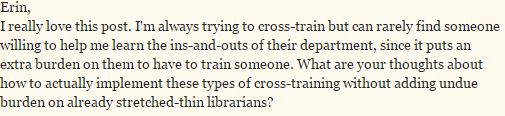
I got a really great comment on this post that made me pause for a moment in self-reflection.


It's a great question, right? How do you actually implement a cross-training program when everyone feels stretched so thin that they can't take the time to work with someone from another department? 

After thinking about it a lot, I identified three things I've seen work at various places that I've worked. 

1. Start small:
I don't think it's necessarily realistic to show up in another department and ask to be cross-trained, especially if it's not the culture at your library. Start by bringing genuine questions about how things work to someone in the department you'd like to learn more about. Are you a public services librarian who wants to learn more about metadata? Start by asking a friendly cataloger about why a search you did in the online catalog produced different results than you thought it would. Are you a metadata creator who wants to know more about how library users access information in the online catalog? Start by asking a friendly public services librarian about what complaint they hear the most during one-on-one transactions or during instruction sessions. They don't have to be long, in-depth conversations. But do enough to start building relationships with people in departments outside your own and showing interest in the work that your colleagues do.

2. Focus on fixed-term projects:
Sometimes the slow season for one department will align with the busy season for another. Or sometimes the workload of a person in a particular department ebbs and flows. These natural changes in the rhythm of the library make space for people to cross-train on projects. Is there a project in your department that nobody has time to do or a project that requires an extra set of hands? This would be a great opportunity to find people in other parts of the library who are looking for skill-building opportunities outside of their own departments. Bonus points if the project you're looking for help with utilizes talents that the person doing the project doesn't get to use in their day-to-day work. You don't have to give a person working on a fixed-term project enough training to be a full-fledged member of the department, which helps if you feel like you don't have time to spare with a programmatic cross-training initiative. 

3. Make the first move:
Not every person in every department is going to be open to cross-training or collaboration. Some people don't want to learn more about metadata creation or information literacy because they'd rather focus on the work they're actually assigned to do.

And that's okay.

But I feel like libraries have to create a culture where people who do want to collaborate or cross-train are supported in doing so. Yes, it takes time to teach people. Yes, it is hard when you're already stretched really thin. But libraries should reward people who want to learn more and do more instead of treating those people like burdens. 

Sometimes, you have to be the change agent in your library and decide that you're going to be the person to make the first move and give up your time in order to change the culture. Ask questions and make it clear you're willing to answer questions. Be friendly and curious--someone that people in other departments want to approach with questions--and use the capital you've earned to ask people questions. If you want to talk to people, try to approach them on their terms. If they prefer emails to a phone call or a drop-in conversation, respect that. If they'd like for you to make an appointment so that they have time to give your question the time and attention it deserves.

Final thoughts:
In my first job out of library school, two things happened around the same time. First, I developed an interest in library instruction because I felt like it would be my best chance (based on the climate and culture of my library) to learn more about how students accessed information. Second, I became the go-to person in the cataloging department for a couple of instruction librarians just by being friendly. Luckily for me, one of those people was the instruction coordinator and she believed in me enough to mentor me in instruction and to allow me to teach a library orientation class each semester. By being curious about what she did and friendly when she asked questions, I was able to help her and to grow my own skills.

Look, I get it. It's possible that you'll try all of these things and people will still be stretched too thin to cross-train you. In which case, you might have to find opportunities to learn more about other parts of librarianship from people you don't work with. If you're a person working in public services who feels like there is no one in metadata creation that you can talk to, feel free to reach out to me. While I can't give you work to do, I'm happy to answer your questions and to serve a sounding board for ideas you might have.

Stay positive,
Erin

Tuesday, July 12, 2016

There's gonna come a time when the true scene leaders forget where they differ and get big picture

I think you wouldn't have much trouble convincing people that technical services departments are losing positions and having resources reallocated leading to the dreaded "do more with less" directive from administrators. I think you also wouldn't have much trouble convincing people that people working in technical services would do well to partner with their colleagues in technical services as well as their colleagues in other areas of the library  to identify and solve big-picture problems in order to help users more successfully find the resources they need to be successful. In fact, one of the foundational idea of the Unified Library Scene is building relationships between functional areas of the library in order to improve the experience of library users.

In the article "Creating solutions instead of solving problems: emerging roles for technical services departments," Sally Gibson argues technical services staffs should move from being problem-solvers who view their work as transactional to being solution-creators who identify and address the underlying issues that emerge in the course of doing one's work. Gibson describes solution-creators this way:
Solution-creators recognize patterns, anticipate needs, and translate those solutions in a way that can be understood by faculty, students and staff. They focus on skill sets and ability rather than rigid roles and organizational procedures. They ask "why" and "how." Issues are addressed as a whole rather than examined at the individual level (149).
Gibson believes that technical services staff see their work as production-oriented and that this kind of work attracts people because it is detail-oriented and relies on the adherence to local and universal standards. Gibson also points out that work in a production-oriented environment is problematic. "Traditional library services are transactional in nature, which translates into real possibilities of its traditional services becoming automated or experiencing decreased importance" (146). Gibson suggests that a combination of technical ability and soft-skills will help technical services staff make the pivot from problem-solver to solution-creator.

Gibson also addresses the kind of environment needed to foster the development of solution-creators. Gibson addresses the fact that departmental leadership needs to establish a growth mindset which Gibson describes this way: "A growth mindset believes that intelligence can be developed" (151). She also writes that ideas much come from all levels of the department and that technical services staff must have permission to experiment with different ideas and different processes.

I should start by saying that there is a lot about Gibson's various arguments that I agree with. Technical services librarians need to think more holistically about the work that they do and how it aligns with the overall mission and vision of the library. And there definitely needs to be more flexibility in how we apply local and universal practices--especially when what we're doing makes it harder for our users to acquire the information they need to be successful. I agree that identifying and centering the 'how' and the 'why' is important--maybe the most important thing technical services staff can do.

But there are parts of Gibson's arguments that don't work as well for me. I am not on board with the idea that technical services is the safe haven in the library for people who love detail-oriented work and that our technical services departments are full of people who see their jobs as solving a single problem in front of them without regard for identifying emerging patterns and without the desire to solve them. While some us do need to change from problem-solvers to solution-creators, there are already solution-creators among us. The problem is that many of them don't have the resources or the administrative support to solve the problems they've identified. Technical services librarians love identifying and fixing problems and very few of the people I've met in technical services librarianship aren't looking for bigger patterns, aren't looking for emerging themes. While fixed-growth mindset and problem-solving persist among technical services librarianship, they are as much a story we tell ourselves as they are the reality of a situation. If you don't have the resources or support to create solutions, you can't solve the big-picture problems. And if you can't solve the big-picture problems, you're not going to receive administrative support. It's a really vicious cycle and one that persists in technical services librarianship.

It is also not clear to me how a solution-creator oriented technical services department would be run. Even if we work to identify and resolve emerging problems, there are still daily tasks to be done. We need to order materials and make sure they are findable, even as we evaluate and retool our current processes to meet the needs of users. But Gibson believes that we should move beyond rigid roles to focus more on skills, writing "Someone can be defined by their combination of technical and soft skills rather than their job title and description" (149). And while I agree that a combination of technical and soft skills are necessary for a person to succeed in technical services librarianship, there is also some need for people to take ownership of specific processes.

So let's agree to think more critically about the work that we do in technical services librarianship. Let's let go of the things that no longer provide value to make room to take on new tasks that help our users. Let's work more closely with each other and with our colleagues in other areas of libraries to identify and solve problems. And let's stop perpetuating the idea that there is a dearth of people working in technical services librarianship who are either not capable of or not interested in looking at the bigger picture is a big problem. Instead, let's talk about how a lack of resources keeps solution-creators from making the kinds of changes in workflow and practices that will benefit the user.

Stay positive,
Erin


Work cited:
Gibson, Sally. "Creating solutions instead of solving problems: emerging roles for technical services departments." Technical Services Quarterly. 33:2 (2016). 145-153.

Tuesday, July 5, 2016

I don't have a clue (and neither do you)

During a meeting at the 2016 ALA Annual conference, the ACRL Board decided to rescind the Information Literacy Competency Standards for Higher Education. To its credit, ACRL has been working on developing infrastructure to help people move forward in the post-Standards world. And from what I can tell, it's going to be a long road in getting from where people in the information literacy world are now to where they need to/want to be.

I've heard a lot of chatter from the information literacy librarians I follow in various online spaces about this move by the ACRL Board. One theme I find kind of...worrysome is the number of people who feel blindsided by this decision. It seems like the consensus has been that at some point ACRL would have to move on this, but a subsection of people in the information literacy community seemed not realize it was happening at this particular moment, at this particular conference, until it was done.

I want to be clear--this is not to suggest that ACRL or its Board did anything wrong. I honestly don't know enough about these issues to know if people's feelings of being caught off guard are reasonable or not. It's possible that the rescinding of the Standards was advertised to people well in advance of the meeting where it was done. It's possible that people in the information literacy community had adequate time to give feedback on this move. And it's likely that ACRL and its Board could've done all the right things and people would still be upset.

While I'm probably not as well-informed on these issues as perhaps I ought to be, I feel like this move by the ACRL Board and the fallout that has followed is a good sneak preview of what the metadata creation community might face when moving into a post-MARC world. About how people are feeling left out during the development phase and how people's feelings will be hurt when the governing bodies of the metadata creation community decide, officially, to transition from one standard to another.

As practitioners, we put a lot of trust in the governing bodies that we believe have our best interests in mind. It's really hard when we find ourselves on the outside of a decision that we believe we should've been on the inside for--especially when we find ourselves on the side of the argument that didn't win. And there's a compelling case to be made about whether or not we should continue to put our trust in those governing bodies--but that's not the case I want to make. What I do want to say is that I hope that ACRL and its Board take seriously the feelings of those among its membership who feel...betrayed by the way in which this decision played out.

In the absence of a true U.S. National Library, ALA and its divisions make decisions about various parts of the information ecosystem. And as a body with that much perceived power, trust between the association and its members is really important. Whether or not you choose to be a dues-paying member of the association, it speaks for you if you work in the field of librarianship. So when a segment of the membership of a division have real trust issues with how a particular issue played out, that division needs to address the breach of trust and work to repair it quickly and thoughtfully.

I hope that ACRL and its Board take seriously the hurt feelings of the segment of their membership. I hope that the information literacy community finds a way to move forward and work through its feelings. And I hope that the metadata creation community is using this situation as a teachable moment for the storm that I imagine is brewing just off the horizon.

Stay positive,
Erin

Tuesday, June 28, 2016

With love and trust and friends and hammers

One of the sessions I attended was about the different relationships that technical services librarians and public services librarians have with continuing resources. It was a lively conversation, but there was one thing that stuck with me and that I've been turning over for a couple of days. One of the proposed solutions to the problem of technical services librarians not understanding the challenges that users face with continuing resources was for them to work the reference desk.


I got a lot of answers to this question that helped me better understand this, but I'm still not sure I understand. There was a sense in the responses I received that while cataloging requires an understanding of complex ideas, the barriers to being able to work the reference desk were lower. Many people who work in public services expressed a hesitancy about 'screwing up' when it came to working with metadata that seemed to preclude cross-training in technical services.

I agree that nobody should be sent to cross-train in a functional area of the library without proper training. This is as much, I think, for the person's comfort as it is to keep the person from 'screwing up.' But I think that if public services people feel too self-conscious about working with metadata because they won't get it right, metadata creators have to reflect upon why. Are we too rigid? Do we expect too much? Are we too tied to the perfect at the expense of the good?

Don't get me wrong. I think that metadata creators should assume some public-facing duties. Teaching a couple of classes each semester has taught me a lot about pedagogy and about how our users find the resources they need to do their work. And those practises have informed my experiences as a creator of metadata. And I absolutely believe that people who do reference and instruction could benefit from getting their hands dirty with metadata. I think that understanding how records are created and what goes into describing resources would help inform their practice as people who help users access information.

But just like I work with people whose primary focus in librarianship is reference and instruction to hone my teaching skills, I think it would be valuable for people with public-facing duties to work with metadata librarians to hone their metadata creation skills. I don't think it's fair to expect a public services librarian to instantly be a great cataloger in the same way that I don't think it's fair to expect a metadata creator to instantly be a good teacher. But I think if metadata creators work with public services librarians, there is room for cross-training and development for long-term growth and increased understanding.

So let me float an idea past you. If you're a public-facing librarian, consider how you could work with enhancing the metadata that describes the materials in the collection you curate. How could subject access be improved? What information could be added to catalog records to help your users decide if an item is worth their time or not? Pull a few records from your subject area and make some notes. And then instead of telling the metadata creators at your library how they could change the records to make it easier for your user to find information, offer to work with them to do the work.

At its core, I think the Unified Library Scene is about building relationships. I think there is room to welcome public services librarians into technical services in the same way that public services librarians have welcomes technical services librarians into their spaces. I think that having a more holistic view of the library makes it easier for everyone to be successful in their jobs. It's the responsibility of public services libraries to cultivate an interest in metadata creation and it's the responsibility of metadata creators to take that interest seriously. Let's help each other build the library we want to see.

Stay positive,
Erin

Thursday, June 16, 2016

We'll leave the figurin' to those we pass on our way out of town

A while ago, Rachel wrote about how the isn't a map for the future. It's one of my favorite posts on our blog, so you should read it. So here's what I'll add to what Rachel wrote: beware the person who is selling you a map for the future of libraries and/or librarianship.

The future is mostly a pretty contextual thing--especially when it comes to identifying the needs of your users and how you might respond with new or evolving systems or services. What works at my library might fail spectacularly at yours because the information needs of my users are different than yours, even as there might be some overlap in our particular contexts.

So if the future is contextual, what are we to make of people who are trying to sell us universal truths about the future of libraries and/or librarianship? Or, to expand on Rachel's metaphor--the people who are selling us maps?

Let's be clear: everyone who has a vision to share about the future of libraries and/or librarianship has something to gain by your buying into that vision. And those people feel very strongly that you need to drop everything and get to work on implementing their version of the future. Libraries need to do this!, they say. Librarians need to behave like that!, they say. It's all very important and it all needs to be done right away.


Because there isn't a map for the future, there are lots of people who have found success in developing the future within their own contexts. While it's good for us to share ideas about what has worked for people, it is our individual responsibilities to take the success stories of other people and think critically about how we might apply them to our own situations.

To use Rachel's metaphor: You could draw your own map, you could rely solely on a single map you purchased from someone, or you could buy a bunch of maps and take something from each of them in order to find your way--discarding what doesn't serve you or your users.

Sticking with this metaphor a little longer: if you do decide to buy maps from other people, I would suggest thinking about the mapmaker and what they stand to gain from your using the map that they drew. Is the person sharing their success story a person who's written a book they want you to buy? Does that person make a substantial living from giving keynote speeches? I would also suggest thinking about whether the mapmaker lives out the mapmaker's values and they way they live them out. What does a particular mapmaker believe about the world and is this person giving you a version of the future that is incompatible with how they seem to live in the world?

There is nothing wrong with needed a little help figuring out how to get from the present to the future. But there's also nothing wrong with making sure you know who you're buying your version of the future from either.

Stay positive,
Erin


Tuesday, May 24, 2016

I am king of all I see, my kingdom for a voice

I'm in the midst of writing a book chapter--which sounds like the world's worst humblebrag,I realize. While it's been a real challenge for me to write long form, it's been nice to have the space to expand my thoughts beyond the length of a blog post and explore my ideas a little more.

I'm not sure that this will make it past the cutting room floor, but yesterday I wrote:
Metadata creation has both a privilege problem and an image problem and we have to wrestle and reckon with both in order to find a place where metadata creators are both valued for the work we do and empathetic in the words we use.
This isn't a particularly novel idea, nor it is particularly inflammatory. But it's not a place I came to easily and without struggle.

The LIS program I attended didn't have a lot in the way of theoretical grounding as as a English major with a creative writing focus, I wasn't exposed to much beyond literary theory as an undergraduate. So being exposed to critical theory and ideas was something that has only happened in the last few years.

When I turn over new ideas, I am almost never walking through new territory. There are people who came well before me and people whose work is more recent. And I am both aware of, and grateful for, their work.

I appreciate how Emily Drabinski has challenged me to think about how impossible it is to fix (in any sense) language that describes people.

I appreciate how April Hathcock has challenged me to understand my privilege and my complicity in the maintenance of oppressive systems within the LIS community.

I appreciate how Maria Accardi has taught me to bring my whole self into my work and to value the worth of all of the users I serve.

I appreciate how Derrick Jefferson has challenged me to think about intersectionality in the LIS community.

I appreciate how Netanel Ganin has challenged me to think in literal terms about the construction and application of LCSH.

All of this is to say that I understand that when I think and when I write, I'm standing on the shoulders of the kindest, most thoughtful giants I can imagine.

Stay positive,
Erin

Thursday, May 19, 2016

Oh dance, don't stop

I have Future of Libraries fatigue.

There...I said it.

I have Future of Libraries fatigue and the future hasn't even gotten here yet.

One of my favorite posts from Rachel contains this gem:
Here's the thing about the future:
There is no map.
There is no telling, there is no knowing.
It is out there and you have to go whether you like it or not.

I love that so much I printed it out and it's on my bulletin board at work, reminding me that the future is coming whether I want it to or not.

Two things I want to acknowledge at the outset:
1. I recognize that I need to stay informed about advances in the field of librarianship. I try to read widely about new projects and ideas. And when I feel like it's appropriate to add my comments, I do.

2. There are people (and libraries) who have the infrastructure and the bandwidth to live out beyond the bleeding edge. And for those experimenters, it is fruitful to keep their eyes open and their ears to the ground in identifying what the Next Big Thing might be.

Having said that, I want to say this: librarianship should be present with users to understand their needs and react to them as quickly as possible. And you can't be present if you're busy talking about what the future might look like.

So what does it mean to be present with users and to react to needs quickly?

Libraries needs to be agile and able to change course quickly when an emerging user need is identified. And this requires a commitment to experimentation and an acceptance that not every initiative is going to succeed. It requires that libraries stop romanticizing the past and drop the 'but we've ALWAYS done it this way' mindset in favor of letting of of what isn't working to make room for new things that will.

It also requires an engagement of users at every possible opportunity. Have you talked with your users about what new services they might want that you don't currently provide? Have you invited your users to give you feedback on services you are considering establishing? And if you have, have you taken their feedback seriously and acted upon it?

Look, there is absolutely nothing wrong with identifying how you want the future to be better than the present and then altering the course of the present to reach that future. We should all aspire to eschew stagnation at both a personal and organizational level. After all, libraries create strategic plans and then work to bring those strategic plans to life. And most librarians have the opportunity to include growth goals in their annual evaluations.

But let's not sell our present users short by focusing so much on a future that, when it arrives, will probably be significantly different than we even dared to dream.

Stay positive,
Erin


Tuesday, April 5, 2016

Stuck in the middle of a silly little riddle

It was announced today that the Program for Cooperative Cataloging has established a Task Group on Identities Management in NACO. The task group is made up of a lot of very smart people who will, I'm certain, come to very smart conclusions about identities management and the Name Authority Cooperative Program.

The work of the task group is informed by a white paper written by the Program for Cooperative Cataloging Advisory Committee on Initiatives. This paper, titled Name authorities in transition: implications for the PCC, was published in June 2014 and considers what role the Program for Cooperative Cataloging should play in the creation and management of authorities data. The white paper made four recommendations:

1. Develop guidelines for the use of VIAF vocabularies to authorize name entities
2. Develop a process for evaluating, endorsing, and providing guidance for the use of name vocabularies beyond VIAF
3. Significantly expand the ranks of those who can create identifiers/contribute authority data
4. Develop a testbed infrastructure to evaluate the intricacies of statement­based identity management

I reread this white paper today and recommendation #3 stood out to me as something I wanted to think about a little bit more. Before we proceed, I should say that while I am a NACO-trained cataloger, my understanding of authority data is hazy at best.

The text of this recommendation acknowledges the fact that there has been a relative lack of engagement in the metadata creation community. I went to the NACO site and counted the number of participating libraries--185. The number seems both very low and very high to me. One of the barriers to participation has been the quota of member contributions. The program requires that libraries contribute between 100 and 200 authority records depending on size and, let's be honest, many libraries do not do enough authority work on their own to meet that quota. The program established NACO funnels in order to bring together libraries who may not on their own generate enough authority work to meet the quotas. These funnels are arranged in a variety of ways including geography, subject matter, and language. That has helped to increase participation somewhat, but there are still wide swaths of the metadata community who aren't participating in the program.

The text of this recommendation also acknowledges that the emphasis of traditional authority work on the proper construction of headings is philosophically incompatible with the linked data environment where the emphasis is on establishing identifiers for named entities. Basically, it seems like traditional authority record creation is running parallel to existing identifier-creation services like ISNI and ORCID. And in many cases, identifier-creation services allow people get to be in control of managing their own identities.

The authors of the white paper conclude recommendation #3 by offering two solutions for expanding the ranks of people creating authority data. One is to have two separate encoding levels for authority records, one for full-level records and one created using a NACO-lite template. The second is to have a second authority file running parallel to the Library of Congress Name Authority File where non-NACO members can contribute headings. Both of these solutions address the fact that libraries are hesitant to devote the resources to doing the work to become NACO members, but neither seems ideal.I guess if I had to choose, I'd got with the former solution where libraries create authorities using a NACO-lite template. CONSER, the Program for Cooperative Cataloging's serials cataloging program, already follows this model. When a CONSER library finds an unauthenticated serial record in Ye Olde Bibliographic Utility, that library upgrades the record.

For whatever you can say about the utility (or futility, I suppose) of metadata creation, it seems clear that we're standing at a critical point in its history. As more libraries choose to devote less resources to the creation of metadata to describe their resources, it seems increasingly likely that library administrators will also think critically about the value of belonging to the Program for Cooperative Cataloging. While participation in PCC programs is incredibly important, it's also costly in terms of both financial and personnel resources. In this do more with less world, it seems likely that the Program for Cooperative Cataloging will need to demonstrate its value beyond a standardized and orderly bibliographic and authority files. Especially when our ways of constructing bibliographic and authority records are increasingly siloed and not at all interoperable with the open web. Since many top-tier libraries are Program for Cooperative Cataloging members, it seems to me that many of the right people are in the room to have a frank and productive conversation about what the metadata creation community can do to move itself forward into the 21st Century. I think that the Task Group on Identities Management in NACO is a good first step in that direction and it will definitely be interesting to see what conclusions this groups comes to.

Stay positive,
Erin


Thursday, March 31, 2016

They pale before the monolith that towers over me

Yesterday I wondered aloud on Twitter why cataloging and catalog records are always held up as signs of the Library of the Past.


I'd just read this Ithaka S+R Issue Brief and was left with mixed feelings about what the Digital Future means for the creation of well-formed metadata.

I actually agreed with much of what Ms. Marcum has to say in this brief. Libraries absolutely do need to understand the needs and desires of users when it comes to library use and then act accordingly. Marcum writes:
Our users, or customers, are in control. Instead of settling for what we have to offer, they can now readily determine who can meet their information needs. Some information resources are freely available through the Internet; some sources provide information for a fee. The user can decide what is important to him or her, and also decide how much that service is worth.
I agree with that 100%. We can't dictate to our users how they should use our resources or what services we provide should be valuable to them. But I would stop to say that I think we should be careful about describing users in monolithic ways. I've written before about how user needs are contextual. While all user groups have some habits in common, I think it's potentially damaging to think about users as a single type of person and change our workflows to match that single type of user.

In this world where users can access a wealth of information from a variety of sources, Marcum suggests that digital resources become even more important. She suggests that libraries need to shift their foci from acquiring and describing print resources to providing access in greater numbers to digital resources. Marcum writes:
In the print world, librarians have been concerned about cataloging books and journals so that faculty and students could discover the resources in the library. In the digital environment, our users are more likely to find digital resources through a Google search than they are through searching the library's catalog. Access to information resources is what users care about--not what the library owns.
Okay, so Ms. Marcum and I are more or less still on the same page here. I think it's fair to suggest that some users prefer instant access to information resources. And the needs of some users require us to think more broadly about how we describe our resources and where we make them available.

But here's where Ms. Marcum loses me:
In the digital era, instead of preparing detailed cataloging records to enter into our online catalogs, we are far more likely to invest in services that our users really want--specialized and individualized help when they can't find what they want in a Google search, access to more electronic journals and databases, on-line reference services, and access to new types of scholarly information--data sets, blog posts, and multimedia resources.
Maybe I'm wrong, but it seems like at least some of these things that Marcum suggests that users want hinge on well-formed metadata in local library catalogs. Where are the people providing specialized and individualized help directing people when Google searches fail? How do users gain access to more electronic journals and databases? Maybe not always the local library catalog, but sometimes.

Library administrators must survey their communities and adjust priorities to meet changing user needs. I get that. But I also think that as long as users need to find library resources--physical or digital--well formed metadata will be an integral part of that task. In fact, I think well-formed metadata is especially important for digital resources because in a digital world we lose the capacity to browse the shelves to find all of the things we missed in our catalog search.

About a year ago, I wrote a post about the importance of having an elevator pitch about the value of well-formed metadata ready for those times when people suggest that perhaps cataloging isn't as important as it once was. In some ways it's disheartening to see that we're at the same place we were a year ago.  And while advocacy is important, I think that if enough people are suggesting that cataloging has extended beyond its usefulness, maybe it's time to evaluate our practises to live in the digital age. I think this means learning more about how users actually acquire information and adjusting our local and national practises accordingly.

At least that way when people suggest that well-formed metadata isn't as useful as it once was, we can say we did our homework as we advocate for ourselves.

Stay positive,
Erin