One thing I like to talk about over here at Unified Library Scene headquarters is the value of well-formed metadata. Because I'm a cataloger, I'm often looking at the idea of well-formed metadata as it relates to the library catalog. But I think that well-formed metadata has value outside of the cataloging department as well. I was interested to read this post on OCLC's Hanging Together blog about how the changing landscape of metadata creation and remediation requires an emphasis on new skill sets for both early career and incumbent metadata creators.
I was especially interested to think about the Hanging Together blog post in relationship to this post from Ithaka S+R which highlighted aspects of their 2016 US Library Survey. Figure 1 of this post addresses the functional areas of the library to which library directors at baccalaureate, masters, and doctoral academic libraries indicated they would add positions over the next five years. At doctoral institutions, nearly 70% of respondents indicated they would be adding positions related to "specialized faculty research support (digital humanities, GIS, data management, etc.)." At masters institutions, this functional area was significantly smaller at about 25%. At those institutions, the area that stands to see the greatest amount of growth in the next five years is "instruction, instructional design, and information literacy services" at nearly 40%.
If you go back to the 2016 US Library Survey, you can see a table that corresponds with this one. In this table, library directors at masters and baccalaureate institutions indicated which functional areas they would be reducing employee positions. It will probably not surprise you to learn that technical services, metadata, and cataloging was the highest vote getting functional area at about 25%. In fairness, this was down from close to 30% in 2013.
While it's worth noting that the responses for added and reduced positions aren't exactly one-to-one since there isn't data on which functional areas library directors at doctoral institutions would target for position reduction. But I suspect, anecdotally anyway, that technical services would be what they chose were they to have been queried.
The Hanging Together blog posts indicates that managers are looking for people to work with metadata who understand how information is organized rather than being skilled at working with a specific schema. The post also suggests that those of us who are interested in helping to recruit and retain the next generation of metadata creators "should promote metadata as an exciting career option to new professionals in venues such as library schools and ALA's New Members Roundtable." The author goes on to state that "emphasizing that metadata encompasses much more than library cataloging can increase its appeal, for example: entity identification, descriptive standards used in various academic disciplines, and describing born-digital, archival, and research data that can interact with the semantic Web."
While some of the tasks the author outlines in their post can be directly mapped to the faculty research support described in the Ithaka S+R survey, much of it still maps directly into functional areas of the library that may be cut in the next five years. And while many of the respondents to the Ithaka S+R survey indicated that they have a commitment to reskilling staff and reallocating them to different areas of the library, it's no wonder that people who understand metadata concepts and have technological skills are choosing careers in industries outside of librarianship--a problem that the Hanging Together post points out.
The disconnect between the need to recruit and retain people who can create well-formed metadata and the fact that these positions are some of the first to be targeted for elimination in academic libraries is one that needs to be addressed. After all, some of the emerging faculty support services rely upon well-formed metadata to be successful. I hope that connecting the dots is the first step in facilitating this difficult but necessary conversation.
Stay positive,
Erin
Showing posts with label silos. Show all posts
Showing posts with label silos. Show all posts
Tuesday, April 18, 2017

Tuesday, July 26, 2016
I never want to be anyone's enemy
At the end of June, I wrote a post about how I thought that people with reference and instruction duties should spend time working with metadata creators in order to help enhance access to the collections they curate. My thought process is that having a holistic view of the library helps everyone become better at their jobs and that the burden to cross-train shouldn't be placed exclusively upon the shoulders of technical services librarians.
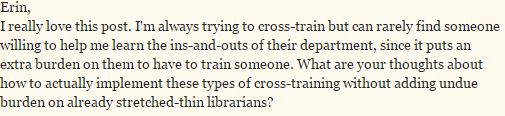
I got a really great comment on this post that made me pause for a moment in self-reflection.
It's a great question, right? How do you actually implement a cross-training program when everyone feels stretched so thin that they can't take the time to work with someone from another department?
After thinking about it a lot, I identified three things I've seen work at various places that I've worked.
1. Start small:
I don't think it's necessarily realistic to show up in another department and ask to be cross-trained, especially if it's not the culture at your library. Start by bringing genuine questions about how things work to someone in the department you'd like to learn more about. Are you a public services librarian who wants to learn more about metadata? Start by asking a friendly cataloger about why a search you did in the online catalog produced different results than you thought it would. Are you a metadata creator who wants to know more about how library users access information in the online catalog? Start by asking a friendly public services librarian about what complaint they hear the most during one-on-one transactions or during instruction sessions. They don't have to be long, in-depth conversations. But do enough to start building relationships with people in departments outside your own and showing interest in the work that your colleagues do.
2. Focus on fixed-term projects:
Sometimes the slow season for one department will align with the busy season for another. Or sometimes the workload of a person in a particular department ebbs and flows. These natural changes in the rhythm of the library make space for people to cross-train on projects. Is there a project in your department that nobody has time to do or a project that requires an extra set of hands? This would be a great opportunity to find people in other parts of the library who are looking for skill-building opportunities outside of their own departments. Bonus points if the project you're looking for help with utilizes talents that the person doing the project doesn't get to use in their day-to-day work. You don't have to give a person working on a fixed-term project enough training to be a full-fledged member of the department, which helps if you feel like you don't have time to spare with a programmatic cross-training initiative.
3. Make the first move:
Not every person in every department is going to be open to cross-training or collaboration. Some people don't want to learn more about metadata creation or information literacy because they'd rather focus on the work they're actually assigned to do.
And that's okay.
But I feel like libraries have to create a culture where people who do want to collaborate or cross-train are supported in doing so. Yes, it takes time to teach people. Yes, it is hard when you're already stretched really thin. But libraries should reward people who want to learn more and do more instead of treating those people like burdens.
Sometimes, you have to be the change agent in your library and decide that you're going to be the person to make the first move and give up your time in order to change the culture. Ask questions and make it clear you're willing to answer questions. Be friendly and curious--someone that people in other departments want to approach with questions--and use the capital you've earned to ask people questions. If you want to talk to people, try to approach them on their terms. If they prefer emails to a phone call or a drop-in conversation, respect that. If they'd like for you to make an appointment so that they have time to give your question the time and attention it deserves.
Final thoughts:
In my first job out of library school, two things happened around the same time. First, I developed an interest in library instruction because I felt like it would be my best chance (based on the climate and culture of my library) to learn more about how students accessed information. Second, I became the go-to person in the cataloging department for a couple of instruction librarians just by being friendly. Luckily for me, one of those people was the instruction coordinator and she believed in me enough to mentor me in instruction and to allow me to teach a library orientation class each semester. By being curious about what she did and friendly when she asked questions, I was able to help her and to grow my own skills.
Look, I get it. It's possible that you'll try all of these things and people will still be stretched too thin to cross-train you. In which case, you might have to find opportunities to learn more about other parts of librarianship from people you don't work with. If you're a person working in public services who feels like there is no one in metadata creation that you can talk to, feel free to reach out to me. While I can't give you work to do, I'm happy to answer your questions and to serve a sounding board for ideas you might have.
Stay positive,
Erin
Tuesday, June 28, 2016
With love and trust and friends and hammers
One of the sessions I attended was about the different relationships that technical services librarians and public services librarians have with continuing resources. It was a lively conversation, but there was one thing that stuck with me and that I've been turning over for a couple of days. One of the proposed solutions to the problem of technical services librarians not understanding the challenges that users face with continuing resources was for them to work the reference desk.
I got a lot of answers to this question that helped me better understand this, but I'm still not sure I understand. There was a sense in the responses I received that while cataloging requires an understanding of complex ideas, the barriers to being able to work the reference desk were lower. Many people who work in public services expressed a hesitancy about 'screwing up' when it came to working with metadata that seemed to preclude cross-training in technical services.
I agree that nobody should be sent to cross-train in a functional area of the library without proper training. This is as much, I think, for the person's comfort as it is to keep the person from 'screwing up.' But I think that if public services people feel too self-conscious about working with metadata because they won't get it right, metadata creators have to reflect upon why. Are we too rigid? Do we expect too much? Are we too tied to the perfect at the expense of the good?
Don't get me wrong. I think that metadata creators should assume some public-facing duties. Teaching a couple of classes each semester has taught me a lot about pedagogy and about how our users find the resources they need to do their work. And those practises have informed my experiences as a creator of metadata. And I absolutely believe that people who do reference and instruction could benefit from getting their hands dirty with metadata. I think that understanding how records are created and what goes into describing resources would help inform their practice as people who help users access information.
But just like I work with people whose primary focus in librarianship is reference and instruction to hone my teaching skills, I think it would be valuable for people with public-facing duties to work with metadata librarians to hone their metadata creation skills. I don't think it's fair to expect a public services librarian to instantly be a great cataloger in the same way that I don't think it's fair to expect a metadata creator to instantly be a good teacher. But I think if metadata creators work with public services librarians, there is room for cross-training and development for long-term growth and increased understanding.
So let me float an idea past you. If you're a public-facing librarian, consider how you could work with enhancing the metadata that describes the materials in the collection you curate. How could subject access be improved? What information could be added to catalog records to help your users decide if an item is worth their time or not? Pull a few records from your subject area and make some notes. And then instead of telling the metadata creators at your library how they could change the records to make it easier for your user to find information, offer to work with them to do the work.
At its core, I think the Unified Library Scene is about building relationships. I think there is room to welcome public services librarians into technical services in the same way that public services librarians have welcomes technical services librarians into their spaces. I think that having a more holistic view of the library makes it easier for everyone to be successful in their jobs. It's the responsibility of public services libraries to cultivate an interest in metadata creation and it's the responsibility of metadata creators to take that interest seriously. Let's help each other build the library we want to see.
Stay positive,
Erin
One thing I wonder: why do we suggest that catalogers work the reference desk but don't suggest that reference folks work in cataloging?— Erin Leach (@erinaleach) June 26, 2016
I got a lot of answers to this question that helped me better understand this, but I'm still not sure I understand. There was a sense in the responses I received that while cataloging requires an understanding of complex ideas, the barriers to being able to work the reference desk were lower. Many people who work in public services expressed a hesitancy about 'screwing up' when it came to working with metadata that seemed to preclude cross-training in technical services.
I agree that nobody should be sent to cross-train in a functional area of the library without proper training. This is as much, I think, for the person's comfort as it is to keep the person from 'screwing up.' But I think that if public services people feel too self-conscious about working with metadata because they won't get it right, metadata creators have to reflect upon why. Are we too rigid? Do we expect too much? Are we too tied to the perfect at the expense of the good?
Don't get me wrong. I think that metadata creators should assume some public-facing duties. Teaching a couple of classes each semester has taught me a lot about pedagogy and about how our users find the resources they need to do their work. And those practises have informed my experiences as a creator of metadata. And I absolutely believe that people who do reference and instruction could benefit from getting their hands dirty with metadata. I think that understanding how records are created and what goes into describing resources would help inform their practice as people who help users access information.
But just like I work with people whose primary focus in librarianship is reference and instruction to hone my teaching skills, I think it would be valuable for people with public-facing duties to work with metadata librarians to hone their metadata creation skills. I don't think it's fair to expect a public services librarian to instantly be a great cataloger in the same way that I don't think it's fair to expect a metadata creator to instantly be a good teacher. But I think if metadata creators work with public services librarians, there is room for cross-training and development for long-term growth and increased understanding.
So let me float an idea past you. If you're a public-facing librarian, consider how you could work with enhancing the metadata that describes the materials in the collection you curate. How could subject access be improved? What information could be added to catalog records to help your users decide if an item is worth their time or not? Pull a few records from your subject area and make some notes. And then instead of telling the metadata creators at your library how they could change the records to make it easier for your user to find information, offer to work with them to do the work.
At its core, I think the Unified Library Scene is about building relationships. I think there is room to welcome public services librarians into technical services in the same way that public services librarians have welcomes technical services librarians into their spaces. I think that having a more holistic view of the library makes it easier for everyone to be successful in their jobs. It's the responsibility of public services libraries to cultivate an interest in metadata creation and it's the responsibility of metadata creators to take that interest seriously. Let's help each other build the library we want to see.
Stay positive,
Erin
Tuesday, April 5, 2016
Stuck in the middle of a silly little riddle
It was announced today that the Program for Cooperative Cataloging has established a Task Group on Identities Management in NACO. The task group is made up of a lot of very smart people who will, I'm certain, come to very smart conclusions about identities management and the Name Authority Cooperative Program.
The work of the task group is informed by a white paper written by the Program for Cooperative Cataloging Advisory Committee on Initiatives. This paper, titled Name authorities in transition: implications for the PCC, was published in June 2014 and considers what role the Program for Cooperative Cataloging should play in the creation and management of authorities data. The white paper made four recommendations:
1. Develop guidelines for the use of VIAF vocabularies to authorize name entities
2. Develop a process for evaluating, endorsing, and providing guidance for the use of name vocabularies beyond VIAF
3. Significantly expand the ranks of those who can create identifiers/contribute authority data
4. Develop a testbed infrastructure to evaluate the intricacies of statementbased identity management
I reread this white paper today and recommendation #3 stood out to me as something I wanted to think about a little bit more. Before we proceed, I should say that while I am a NACO-trained cataloger, my understanding of authority data is hazy at best.
The text of this recommendation acknowledges the fact that there has been a relative lack of engagement in the metadata creation community. I went to the NACO site and counted the number of participating libraries--185. The number seems both very low and very high to me. One of the barriers to participation has been the quota of member contributions. The program requires that libraries contribute between 100 and 200 authority records depending on size and, let's be honest, many libraries do not do enough authority work on their own to meet that quota. The program established NACO funnels in order to bring together libraries who may not on their own generate enough authority work to meet the quotas. These funnels are arranged in a variety of ways including geography, subject matter, and language. That has helped to increase participation somewhat, but there are still wide swaths of the metadata community who aren't participating in the program.
The text of this recommendation also acknowledges that the emphasis of traditional authority work on the proper construction of headings is philosophically incompatible with the linked data environment where the emphasis is on establishing identifiers for named entities. Basically, it seems like traditional authority record creation is running parallel to existing identifier-creation services like ISNI and ORCID. And in many cases, identifier-creation services allow people get to be in control of managing their own identities.
The authors of the white paper conclude recommendation #3 by offering two solutions for expanding the ranks of people creating authority data. One is to have two separate encoding levels for authority records, one for full-level records and one created using a NACO-lite template. The second is to have a second authority file running parallel to the Library of Congress Name Authority File where non-NACO members can contribute headings. Both of these solutions address the fact that libraries are hesitant to devote the resources to doing the work to become NACO members, but neither seems ideal.I guess if I had to choose, I'd got with the former solution where libraries create authorities using a NACO-lite template. CONSER, the Program for Cooperative Cataloging's serials cataloging program, already follows this model. When a CONSER library finds an unauthenticated serial record in Ye Olde Bibliographic Utility, that library upgrades the record.
For whatever you can say about the utility (or futility, I suppose) of metadata creation, it seems clear that we're standing at a critical point in its history. As more libraries choose to devote less resources to the creation of metadata to describe their resources, it seems increasingly likely that library administrators will also think critically about the value of belonging to the Program for Cooperative Cataloging. While participation in PCC programs is incredibly important, it's also costly in terms of both financial and personnel resources. In this do more with less world, it seems likely that the Program for Cooperative Cataloging will need to demonstrate its value beyond a standardized and orderly bibliographic and authority files. Especially when our ways of constructing bibliographic and authority records are increasingly siloed and not at all interoperable with the open web. Since many top-tier libraries are Program for Cooperative Cataloging members, it seems to me that many of the right people are in the room to have a frank and productive conversation about what the metadata creation community can do to move itself forward into the 21st Century. I think that the Task Group on Identities Management in NACO is a good first step in that direction and it will definitely be interesting to see what conclusions this groups comes to.
Stay positive,
Erin
The work of the task group is informed by a white paper written by the Program for Cooperative Cataloging Advisory Committee on Initiatives. This paper, titled Name authorities in transition: implications for the PCC, was published in June 2014 and considers what role the Program for Cooperative Cataloging should play in the creation and management of authorities data. The white paper made four recommendations:
1. Develop guidelines for the use of VIAF vocabularies to authorize name entities
2. Develop a process for evaluating, endorsing, and providing guidance for the use of name vocabularies beyond VIAF
3. Significantly expand the ranks of those who can create identifiers/contribute authority data
4. Develop a testbed infrastructure to evaluate the intricacies of statementbased identity management
I reread this white paper today and recommendation #3 stood out to me as something I wanted to think about a little bit more. Before we proceed, I should say that while I am a NACO-trained cataloger, my understanding of authority data is hazy at best.
The text of this recommendation acknowledges the fact that there has been a relative lack of engagement in the metadata creation community. I went to the NACO site and counted the number of participating libraries--185. The number seems both very low and very high to me. One of the barriers to participation has been the quota of member contributions. The program requires that libraries contribute between 100 and 200 authority records depending on size and, let's be honest, many libraries do not do enough authority work on their own to meet that quota. The program established NACO funnels in order to bring together libraries who may not on their own generate enough authority work to meet the quotas. These funnels are arranged in a variety of ways including geography, subject matter, and language. That has helped to increase participation somewhat, but there are still wide swaths of the metadata community who aren't participating in the program.
The text of this recommendation also acknowledges that the emphasis of traditional authority work on the proper construction of headings is philosophically incompatible with the linked data environment where the emphasis is on establishing identifiers for named entities. Basically, it seems like traditional authority record creation is running parallel to existing identifier-creation services like ISNI and ORCID. And in many cases, identifier-creation services allow people get to be in control of managing their own identities.
The authors of the white paper conclude recommendation #3 by offering two solutions for expanding the ranks of people creating authority data. One is to have two separate encoding levels for authority records, one for full-level records and one created using a NACO-lite template. The second is to have a second authority file running parallel to the Library of Congress Name Authority File where non-NACO members can contribute headings. Both of these solutions address the fact that libraries are hesitant to devote the resources to doing the work to become NACO members, but neither seems ideal.I guess if I had to choose, I'd got with the former solution where libraries create authorities using a NACO-lite template. CONSER, the Program for Cooperative Cataloging's serials cataloging program, already follows this model. When a CONSER library finds an unauthenticated serial record in Ye Olde Bibliographic Utility, that library upgrades the record.
For whatever you can say about the utility (or futility, I suppose) of metadata creation, it seems clear that we're standing at a critical point in its history. As more libraries choose to devote less resources to the creation of metadata to describe their resources, it seems increasingly likely that library administrators will also think critically about the value of belonging to the Program for Cooperative Cataloging. While participation in PCC programs is incredibly important, it's also costly in terms of both financial and personnel resources. In this do more with less world, it seems likely that the Program for Cooperative Cataloging will need to demonstrate its value beyond a standardized and orderly bibliographic and authority files. Especially when our ways of constructing bibliographic and authority records are increasingly siloed and not at all interoperable with the open web. Since many top-tier libraries are Program for Cooperative Cataloging members, it seems to me that many of the right people are in the room to have a frank and productive conversation about what the metadata creation community can do to move itself forward into the 21st Century. I think that the Task Group on Identities Management in NACO is a good first step in that direction and it will definitely be interesting to see what conclusions this groups comes to.
Stay positive,
Erin
Tuesday, October 27, 2015
One chance to stay something deep in the audio
Last Wednesday, I co-presented a webinar with my friend, and former colleague, Jaleh. We talked about establishing effective Technical Services/Public Services collaborations. It was a well-attended session and the attendees were engaged and asked great questions. Overall, it was a really enjoyable experience. When the recording goes up, you should give it a listen.
In the meantime, Jaleh storified the event because she is awesome. Check it out!
One of the questions during the Q&A portion of the event was about how to establish Technical Services/Public Services collaborations in a work environment that didn't encourage collaboration to the point of outright discouraging it.
I am not great at rapid-fire Q&A. I am one of those people who likes to think about something before I talk about it. In most meetings, I am the last person to give my opinion because I like to think about an issue and hear everyone's opinions before giving my own. So, in that moment, I kind of panicked and said what was true about my experience in libraries: I have never really been told no in my professional life. It's annoying and I recognize how fortunate I am.
Having spent almost a week considering the question, I feel like I have a better answer.
I should start by saying that I have never worked in a library that actively discouraged people from different departments working together collaboratively. More often, my experience has been that some departments have a more formalized structure where they require people to go "up and over" in the org chart in order to work with people in that unit. And even then, it wasn't a guarantee that you would be allowed to collaborate.
I feel like leaders put their departments under lock and key for a couple of reasons. One, I think, is that they are more oriented toward job duties than problem solving. A job duty orientation says that I am responsible for the processes and products that are mine--nothing more or less. And in that case, why would you collaborate? A person in that kind of department picks up a process where another functional area leaves off and drops off that process where the next department picks up. I think that this kind of mindset leads to problematic processes, full of unnecessary work and pain points for users. But it's a mindset that some leaders have.
Another reason I think leaders put their departments under lock and key is that the department has a lot of daily tasks to get done and the leader believes that the only way to get things done is to cut down on distraction. After focusing on one's daily work, there is little time left in their schedule for cross-departmental collaboration or problem solving. I think that those departments are often victims of the do more with less thing that libraries seem so fond of. This myopia also leads to pain points for users, but it's also a mindset that people have.
Okay...so what?
I think that quite often, we react to a situation where a department won't make space for collaborative work by going around them to get things done. So-and-so won't work with us, we think, so we just have to figure out a way to get things done. But here's the thing about that, it allows that group of people to continue not being collaborative. And if what you want is to build a culture of cross-departmental collaboration, you have to be deliberate about getting everyone to the table when it matters.
When we think about organizational silos, the thing to know is that different functional areas have different priorities. And sometimes those priorities compete. So the way to build collaboration is to build consensus by putting everyone's priorities on the table, knowing that everything is going to have to give something up to achieve that common goal.
So, how do you build collaboration between Technical Services and Public Services in a library that doesn't encourage collaboration?
When a process breaks down or a new service is about to be implemented, bring leaders from all of the functional areas together. Start by identifying the priorities of each functional area and being honest about where those priorities compete. Then, when you've done that, come to consensus about goals and commonalities and figure out how each functional area can both give something up and gain something.
And when you do this, invite everyone--not just the people who you know are good collaborators. It's how you start to build community.
Stay positive,
Erin
In the meantime, Jaleh storified the event because she is awesome. Check it out!
One of the questions during the Q&A portion of the event was about how to establish Technical Services/Public Services collaborations in a work environment that didn't encourage collaboration to the point of outright discouraging it.
I am not great at rapid-fire Q&A. I am one of those people who likes to think about something before I talk about it. In most meetings, I am the last person to give my opinion because I like to think about an issue and hear everyone's opinions before giving my own. So, in that moment, I kind of panicked and said what was true about my experience in libraries: I have never really been told no in my professional life. It's annoying and I recognize how fortunate I am.
Having spent almost a week considering the question, I feel like I have a better answer.
I should start by saying that I have never worked in a library that actively discouraged people from different departments working together collaboratively. More often, my experience has been that some departments have a more formalized structure where they require people to go "up and over" in the org chart in order to work with people in that unit. And even then, it wasn't a guarantee that you would be allowed to collaborate.
I feel like leaders put their departments under lock and key for a couple of reasons. One, I think, is that they are more oriented toward job duties than problem solving. A job duty orientation says that I am responsible for the processes and products that are mine--nothing more or less. And in that case, why would you collaborate? A person in that kind of department picks up a process where another functional area leaves off and drops off that process where the next department picks up. I think that this kind of mindset leads to problematic processes, full of unnecessary work and pain points for users. But it's a mindset that some leaders have.
Another reason I think leaders put their departments under lock and key is that the department has a lot of daily tasks to get done and the leader believes that the only way to get things done is to cut down on distraction. After focusing on one's daily work, there is little time left in their schedule for cross-departmental collaboration or problem solving. I think that those departments are often victims of the do more with less thing that libraries seem so fond of. This myopia also leads to pain points for users, but it's also a mindset that people have.
Okay...so what?
I think that quite often, we react to a situation where a department won't make space for collaborative work by going around them to get things done. So-and-so won't work with us, we think, so we just have to figure out a way to get things done. But here's the thing about that, it allows that group of people to continue not being collaborative. And if what you want is to build a culture of cross-departmental collaboration, you have to be deliberate about getting everyone to the table when it matters.
When we think about organizational silos, the thing to know is that different functional areas have different priorities. And sometimes those priorities compete. So the way to build collaboration is to build consensus by putting everyone's priorities on the table, knowing that everything is going to have to give something up to achieve that common goal.
So, how do you build collaboration between Technical Services and Public Services in a library that doesn't encourage collaboration?
When a process breaks down or a new service is about to be implemented, bring leaders from all of the functional areas together. Start by identifying the priorities of each functional area and being honest about where those priorities compete. Then, when you've done that, come to consensus about goals and commonalities and figure out how each functional area can both give something up and gain something.
And when you do this, invite everyone--not just the people who you know are good collaborators. It's how you start to build community.
Stay positive,
Erin
Tuesday, May 5, 2015
So many wonderful treasures
The first time I read the ACRL Framework for Information Literacy was when I wrote this post a couple of weeks ago. I'd heard and read a lot about the document, but I hadn't bothered to invest the time in reading it. The Framework languished on my to-read list because I felt like it has little relevance to what I do as a cataloger. I'm committed to staying current on trends in academic librarianship, but I was prepared to see the Framework solely as a blueprint from instruction librarians.
When I read the Framework for that blog post, I was surprised to see myself in the last frame of the document: Searching as strategic exploration.
The description of this particular frame talks about the search process from beginning to end and describes the experiences of people on all parts of the learning spectrum:
When I looked at the bullet points in these sections, I saw the way in which the work that I do as a cataloger has a direct impact on whether or not a library user becomes information literate. Three bullet points in particular have me thinking.
1. Match information needs and search strategies to search tools
The bottom line for me is that the Framework isn't just a resource for instruction librarians to consider, puzzle over, interact with, and react to. Whether you accept the Framework without reservation or push back against some of its claims, I believe technical services librarians should be in conversation with it and use it as a lens through which to see our work. If you work in technical services in an academic library, I invite you to read ACRL's Framework for Information Literacy and to find yourself there. How does the work you do directly impact the ability for library users to become information literate people? And if what you're doing actually hinders their development, what can you do differently?
Stay positive,
Erin
When I read the Framework for that blog post, I was surprised to see myself in the last frame of the document: Searching as strategic exploration.
The description of this particular frame talks about the search process from beginning to end and describes the experiences of people on all parts of the learning spectrum:
The act of searching often begins with a question that directs the act of finding needed information. Encompassing inquiry, discovery, and serendipity, searching identifies possible relevant sources and the means to access those sources. Experts realize that information searching is a contextualized, complex experience that affects, and is affected by, the searcher’s cognitive, affective, and social dimensions. Novice learners may search a limited set of resources, and experts may search more broadly and deeply to determine the most appropriate information within the project scope. Likewise, novice learners tend to use few search strategies; experts select from various search strategies, depending on the sources, scope, and context of the information need.I appreciate the fact that this concept distinguishes between the novice learning and expert learner, and acknowledges that their needs and experiences are different. As with all of the other frames, there are "knowledge practices" and "dispositions" that describe what people who are becoming (and have become) information literate should be able to do.
When I looked at the bullet points in these sections, I saw the way in which the work that I do as a cataloger has a direct impact on whether or not a library user becomes information literate. Three bullet points in particular have me thinking.
1. Match information needs and search strategies to search tools
As laid out in the description of the frame, novice and expert researchers have different information needs. And libraries have responded to the one size doesn't fit all argument by offering both "next-gen" catalogs and legacy catalogs. Novice researchers may prefer to use the library catalog that has been augmented with a discovery layer, while expert researchers may prefer our legacy catalog. The "next-gen" catalog gives novice researchers the opportunity to search using keywords born from natural language and then refine based on a set of facets. The legacy catalog, on the other hand, allows expert researchers to refine at the outset based on advanced search options.
I wonder whether we put equal resources into maintaining both our "next-gen" and legacy catalogs. I have had to train myself to check my cataloging work in both catalogs to ensure that the information displayed in records is usable to both novice and expert researchers. It is so easy, as a cataloger, to prefer the legacy catalog because "next-gen" catalogs are notoriously bad for known item searching. But the point of these discovery systems is to give novice researchers a way into a research process that can be tricky. And given that, according to the 2015 State of America's Libraries report, 51% of college freshpeople have a hard time learning to navigate new tools, we owe it to our novice researchers to help them find a way into the process.
I wonder whether we put equal resources into maintaining both our "next-gen" and legacy catalogs. I have had to train myself to check my cataloging work in both catalogs to ensure that the information displayed in records is usable to both novice and expert researchers. It is so easy, as a cataloger, to prefer the legacy catalog because "next-gen" catalogs are notoriously bad for known item searching. But the point of these discovery systems is to give novice researchers a way into a research process that can be tricky. And given that, according to the 2015 State of America's Libraries report, 51% of college freshpeople have a hard time learning to navigate new tools, we owe it to our novice researchers to help them find a way into the process.
2. Use different searching language types (e.g., controlled vocabulary, keywords, natural language)
It seems obvious to say that searching with controlled vocabulary yields different results than keyword searching. It seems less obvious to suggest that well-formed metadata is an important part of developing library users into information literate people.
There are a lot of reasons why it isn't really an option anymore for catalogers to touch every piece that comes through the door. Shelf-ready books with accompanying records are a way for us to get material on the shelves faster and MARC record services for journals provide title-level access in a way that individual catalogers just can't. The move from cataloging every title to focusing on hidden collections is a smart one.
I would argue, though, that we should push back when we're given records with poor quality metadata. Sure, some access is better than none, but our users need to expect that different searching language types will surface the material they are looking for. If we teach them to use a variety of searching methods and none of those methods return the resources they're looking for because the metadata is of poor quality then we've failed them. I believe that we could get more buy-in from our library's leaders if we positioned metadata as an information literacy issue.
3. Recognize the value of browsing and other serendipitous methods of information gathering.
Serendipitous discovery is such an important part of the search process. Have you ever gone to the shelf to find the book you're looking for and recognized that the books around it are also valuable to your research? It's an amazing feeling to go to the stacks looking for one book and leave with a stack of them.
But when your collection moves off-site or you purchase electronic resources, you lose the capacity to find that material when browsing the shelves. It is important, then, that you ensure that these materials can be found by way of virtual browse. By putting call numbers in records for your electronic material, for example, you make them discoverable in a call number browse. And by ensuring that records are up to a specific standard before their corresponding physical items are moved off-site means that off-site items are found in a subject browse. By placing as much value on virtual browse as physical browse, you make the various piece of your collection easier for your users to find, identify, select, and obtain.
It seems obvious to say that searching with controlled vocabulary yields different results than keyword searching. It seems less obvious to suggest that well-formed metadata is an important part of developing library users into information literate people.
There are a lot of reasons why it isn't really an option anymore for catalogers to touch every piece that comes through the door. Shelf-ready books with accompanying records are a way for us to get material on the shelves faster and MARC record services for journals provide title-level access in a way that individual catalogers just can't. The move from cataloging every title to focusing on hidden collections is a smart one.
I would argue, though, that we should push back when we're given records with poor quality metadata. Sure, some access is better than none, but our users need to expect that different searching language types will surface the material they are looking for. If we teach them to use a variety of searching methods and none of those methods return the resources they're looking for because the metadata is of poor quality then we've failed them. I believe that we could get more buy-in from our library's leaders if we positioned metadata as an information literacy issue.
3. Recognize the value of browsing and other serendipitous methods of information gathering.
Serendipitous discovery is such an important part of the search process. Have you ever gone to the shelf to find the book you're looking for and recognized that the books around it are also valuable to your research? It's an amazing feeling to go to the stacks looking for one book and leave with a stack of them.
But when your collection moves off-site or you purchase electronic resources, you lose the capacity to find that material when browsing the shelves. It is important, then, that you ensure that these materials can be found by way of virtual browse. By putting call numbers in records for your electronic material, for example, you make them discoverable in a call number browse. And by ensuring that records are up to a specific standard before their corresponding physical items are moved off-site means that off-site items are found in a subject browse. By placing as much value on virtual browse as physical browse, you make the various piece of your collection easier for your users to find, identify, select, and obtain.
Stay positive,
Erin
Wednesday, April 29, 2015
Relationships matter: on #mashcat and building the unified library scene
I moderated the second #mashcat Twitter chat last week and it was really fantastic. You can read the Storify of this chat here and poke around the site a little more to learn about the #mashcat movement.
I wanted to talk about building relationships between catalogers and library technologists. Because if you give me the chance to talk about any topic, I will want to talk about building relationships between the major players.
I felt like the conversation was really constructive, but the downside was that I was too busy moderation to answer my own questions. So...I'm going to document them on the blog.
Q1: What do you see as areas for mutual concern for catalogers and library technologists?
Creating an encoding standard for bibliographic data (by which I mean any data that lives in your ILS) to replace MARC; creating better user experience by building systems that better leverage metadata; finding ways to migrate library-created metadata into the wider world of the Web.
Q2: How can we build consensus in these areas? What stands in our way to building consensus in these areas?
I think that the 'us vs. them' mentality that I wrote about a couple of weeks ago can definitely stand in the way of building consensus. The perceived scarcity of resources can also stand in the way of building consensus.
I think we can build consensus by creating safe spaces to have difficult conversations and to learn from each other. Creating safe spaces often means setting ground rules and creating boundaries about what is (and isn't) acceptable. Becky Yoose pointed people to social rules section of the Hacker School Rules.
Q3: Terminology is often a barrier. How can we move past our specialty’s jargon in conversations with our colleagues? What strategies have you found effective when communicating with your colleagues on the “other side of the house?”
Someone in the chat pointed out that jargon itself isn't the problem. It's the confusion it causes.
An effective way to eliminate confusion created by jargon is to always offer a definition or explanation of a word or acronym you use in conversation, even if it seems unnecessary or redundant. Don't assume that someone else knows what you know. Even more, don't assume that someone who doesn't know what you know will feel comfortable enough to ask for clarification.
On a related note--check for understanding when you're talking before moving on. Make sure that you're on the same page with the person you're speaking to.
Q4: What technical skills do you think are important
for both catalogers and library technologists to possess?
A rudimentary understanding of both cataloging rules and library software; data literacy/data modeling; logical/algorithmic thinking; project management; communication; creating documentation.
Q5: What is the most effective way to share those
skills? What would an effective skillshare program look like to you?
I think it would be cool if there was a skill share wiki for people in libraryland. I know that ALA Connect has an Opportunities Exchange, so maybe that's one way to share skills? Anyway, I think it would be cool to have a place where you list what you know and what you want to know. You could find your skill share match. In the absence of that, I think that free or low cost workshops and webinars are a good way to share skills.
Q6: What are the particular challenges for people
with feet in the cataloging and library technology worlds? How can the #mashcat
community support them?
I suspect that people with feet in both worlds end up translating the concerns of one side to the other a lot. When it goes well, I suspect it facilitates a lot of productive conversations. When it goes poorly, I suspect it ends up doing nothing to end the 'us vs. them' mentality.
I think we can help support people with feet in both worlds by not pushing back against them and wanting them to be more like us. Instead, let's listen with open minds.
Q7: What do you want to say about building
relationships between catalogers and library technologists that I haven’t
asked?
It's hard but important work. We can't build the future of bibliographic description and encoding in silos, which is what I feel like we're doing now.
Stay positive,
Erin
Tuesday, April 21, 2015
A thousand compromises (don't add up to a win)
I often find that when I
am uncomfortable with something, I need to pause and think about what it is
about that thing that makes me uncomfortable beyond my initial knee-jerk
reaction.
So it was when I read
this this essay from Inside Higher Ed. (hat tip to Jacob
Berg, noted
BeerBrarian).
I agreed with much of
what Ward had to say about how envisioning the future a campus library has to
be a collaborative effort between the library’s leadership and campus-wide
stakeholders.
Ward writes:
It will take a university community to shape a future library that meets the specific needs of learning and research at that institution. This transition is not just about libraries. It is about how colleges and universities come together to solve a collective challenge. Libraries cannot puzzle out their future alone.
And as much I as I
agreed with Ward on this, something didn’t sit right with me. After
writing and deleting several blog posts worth of material, suddenly I was
confronted with what made me uncomfortable about Ward’s essay.
Ward is right in that
academic library leadership must
understand the decision-making process of key university stakeholders and he is
correct that that process is both “complex and ambiguous.” Understanding what faculty and administrators
value is important when considering what areas of collections or services you
need to develop. Are members of your science faculty working more on securing grants?
Great—work on developing a plan to build up your data management services,
including better understanding grant requirements. Are members of your
humanities faculty working more on incorporating geospatial components to their
research? Great—maybe it’s time to consider investing in a GIS Librarian!
Ward writes:
At the same time, librarians will be unsuccessful in planning for the future on their own. They possess much expertise about libraries, but less about trends in research and curriculum. Moving forward, the process of recreating the library must be one that involves many people in many roles on campus.
But I feel like it goes
both ways. The academic library plays a unique role on a college campus, but I
feel like its leadership is not always invited to participate in conversations
in which it possesses expertise. Does someone from your library serve on your
college’s curriculum committee? Is your library represented on your college’s
committee on rank and tenure?
Academic library leaders
should absolutely involve campus stakeholders in the planning process. Have
summits, run focus groups, host strategic planning days to better understand
the needs of constituencies. Develop relationships
with your stakeholders based on areas of mutual concern. I have
written before about how important it is to develop relationships with
stakeholders by crafting compelling stories about our services and collections.
But academic library
leadership shouldn’t stop there. They should be active in their
college’s community, offering their expertise on issues where their library is uniquely
qualified to comment and offer solutions.
So, I guess the question
is—what is it that the academic library is uniquely qualified to do that no
other department on campus can? And how do we include stakeholders in
developing our future without giving that away?
Stay positive,
Erin
Tuesday, October 7, 2014
On silos
Confession time:
As much as I preach cross-collaboration, I am guilty of "silo thinking."
"Silo" is a concept developed in 1988 by Phil Ensor and documented in this essay. Essentially, a siloed organization is one where each process is managed in a top-down way with very little interaction with other functions. It's bad for an organization because there is very little cross-collaboration and it's bad for employees because they feel stuck in top-down relationships with management.
This top-down way of accomplishing things is referred to as "siloed" because the process looks, well, like a silo.
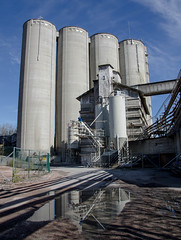
Though "silo" is a business buzzword, it certainly shows up in libraries, too. Cataloging exists in one silo and only works with Acquisitions when there are questions about order records. Reference exists in a silo and only reaches out to Cataloging when it runs into trouble with something in the OPAC. Digital Projects exists in another silo and only partners with Cataloging when a collection of items is digitized and the MARC metadata needs to be cross-walked into another schema.
I think that to some extent, there is no getting around having silos in a library. Each department in a library has its own set of priorities and its own way of accomplishing those goals. Cataloging has to get books onto the shelves, real or virtual, and must have a process for accomplishing that task. Reference has to help users find resources and must have a process for identifying what users need.
But I also think that there are functions that are larger than any one department. And that's where "silo thinking" doesn't work Responsibility for those cross-departmental functions may rest upon a single person and that person may reside in a department. But what really makes these bigger-than-me functions succeed is when we agree to bust out of this way of thinking and really work together.
I was faced with my own "siloed thinking" recently when someone suggested that ALCTS, the American Library Association's technical services division, should be involved in Open Access Week. It was a cool idea, sure, but I didn't immediately see the connection between technical services and open access. But upon further examination, I recognized my own "silo thinking" at work. Open access is one of those bigger-than-me functions that requires buy-in and effort from every part of the library. Yes, the Scholarly Communications Librarian may be situated in Reference. But in order to make a push at your library to make open access work, you need Acquisitions to be on board with adding OA publications to your Knowledge Base. And you have to have Digital Projects on board with supporting the institutional repository.
Where do you get stuck in "siloed thinking" and what can you do to bust out of it? Drop me a line in the comments!
Stay positive,
Erin
As much as I preach cross-collaboration, I am guilty of "silo thinking."
"Silo" is a concept developed in 1988 by Phil Ensor and documented in this essay. Essentially, a siloed organization is one where each process is managed in a top-down way with very little interaction with other functions. It's bad for an organization because there is very little cross-collaboration and it's bad for employees because they feel stuck in top-down relationships with management.
This top-down way of accomplishing things is referred to as "siloed" because the process looks, well, like a silo.
I think that to some extent, there is no getting around having silos in a library. Each department in a library has its own set of priorities and its own way of accomplishing those goals. Cataloging has to get books onto the shelves, real or virtual, and must have a process for accomplishing that task. Reference has to help users find resources and must have a process for identifying what users need.
But I also think that there are functions that are larger than any one department. And that's where "silo thinking" doesn't work Responsibility for those cross-departmental functions may rest upon a single person and that person may reside in a department. But what really makes these bigger-than-me functions succeed is when we agree to bust out of this way of thinking and really work together.
I was faced with my own "siloed thinking" recently when someone suggested that ALCTS, the American Library Association's technical services division, should be involved in Open Access Week. It was a cool idea, sure, but I didn't immediately see the connection between technical services and open access. But upon further examination, I recognized my own "silo thinking" at work. Open access is one of those bigger-than-me functions that requires buy-in and effort from every part of the library. Yes, the Scholarly Communications Librarian may be situated in Reference. But in order to make a push at your library to make open access work, you need Acquisitions to be on board with adding OA publications to your Knowledge Base. And you have to have Digital Projects on board with supporting the institutional repository.
Where do you get stuck in "siloed thinking" and what can you do to bust out of it? Drop me a line in the comments!
Stay positive,
Erin
Subscribe to:
Posts (Atom)