Showing posts with label ways of thinking. Show all posts

Thursday, June 14, 2018

And what I choose is my voice

I am taking a class this summer wherein we are reading newly published books about higher education. For this week's class, we read Taking It to the Streets, which I enjoyed far more than I thought that I would. Even in the places where I didn't agree with an author's ideas, I appreciated the vulnerability it took to write about how they considered their relationship to public scholarship.

While all of the author's seemed to be in favor of some degree of public scholarship, a theme that permeates Taking It to the Streets is the tension between being the kind of scholar who chooses only to write and publish and the kind of scholar who chooses to both write and publish and in some way connect to the communities about which they research and write.

It may be too reductive of an observation, but it felt to me like implicit in the tension I felt in this book is whether the goal of the scholar should be to embody a positivist epistemology or a participatory epistemology. The goal of research conducted using a positivist epistemological lens is to explain some naturally occurring phenomenon. In contrast, the goal of research conducted using a participatory epistemological lens is to create change in the world using research findings as the basis for that change.

While it might be tempting to suggest that one or the other of these epistemological lenses is more appropriate for the time in which we live, it is important for scholars on both sides of the divide to understand that there is not universality in what brings scholars to the academy and what undergirds their work. In a chapter titled "A Road Less Traveled: the Responsibilities of the Intellectual," William G. Tierney (2018) writes:
I do not believe that only one route exists for intellectual engagement, and in that light, I want each of us to be aware that we are choosing a particular path. I am troubled at times that a colleague may assume that only one choice is possible and that if another choice is made, then his or her colleague is gravely mistaken or morally failing. I am equally troubled by those who do not see their choices are choices. By assuming that the choice one has made is the only possibility or not thinking through the array of possibilities that exist appears shortsighted to me, loaded with hubris and devoid of humility. (p. 101)

Reading Taking It to the Streets helped give me words to talk about a similar tension I feel in librarianship. While the divide isn't explicitly drawn along epistemological lines, there are similarities. There are library workers who believe deeply that the work of libraries and those who work in them is to be neutral actors, providing access to all types of information to all types of library users. There are also library workers who believe deeply that the work of libraries and those who work in them is to agents for liberatory change, wherein marginalized voices are privileged and hateful rhetoric is unwelcome.

In much the same way as there is not universality in what brings scholars to the academy, there is not universality in what brings library workers to the library. But there's something in what Tierney writes that sits wrongly with me. While choosing to take a particular path or to use a particular epistemological lens is, in fact, a choice, there are people for whom the stakes are higher. In her remarks at the ALA Midwinter President's Program, Emily Drabinski (2018) suggested that:
those steeped in and rewarded by dominant ways of seeing the world don't have to see how intensely political the ostensibly neutral position is. If the white supremacists booking your meeting space are not after you, you don't have to know how dangerous they are. Books about reparative therapy for gay people can simply be another point of view if yours is not the body and mind those authors seek to destroy. To imagine that neutrality could be something we could choose is an intensely privileged position, one that I have to imagine my way into as I listen to the arguments of those whose worlds are rarely contested. (para. 6)

In his chapter in Taking It to the Streets, Shaun R. Harper (2018) echoes Drabinski's thoughts, writing "Researchers frequently mistreat Black Americans and other minoritized populations as variables in their statistical models. Then they go on to make all sorts of assumptions about my people vis-à-vis Whites and other groups in their analyses. Much about this is dehumanizing" (p. 82).

The point I'm trying to make is this: for those of us in dominant groups, acting out of a particpatory or liberatory epistemology in either the academy or the library is a choice. We can choose to turn away from neutrality or positivism because we have the safety afforded to us by being some combination of white or cisgender or able-bodied or middle-class or male. But our colleagues from marginalized communities are less able to adopt the position of neutrality because it is their identities that the world seeks to destroy.

So yes, let's accept that each of us comes to librarianship with a diversity of experiences and motivation. But let's also accept that for some people, living into a participatory or liberatory epistemology is literally a matter of life or death.

Stay positive,
Erin

References:
Drabinski, E. (2018, February 12). Are Libraries Neutral?. Retrieved from http://www.emilydrabinski.com/are-libraries-neutral/

Harper, S. R. My People's Professor. In Perna, L. W. (Ed.) Taking It to the Streets: the Role of Scholarship in Advocacy and Advocacy in Scholarship (p. 79-85). Baltimore: Johns Hopkins Press.

Tierney, W. G. A Road Less Traveled: the Responsibilities of the Intellectual In Perna, L. W. (Ed.) Taking It to the Streets: the Role of Scholarship in Advocacy and Advocacy in Scholarship (p. 100-105). Baltimore: Johns Hopkins Press.

Tuesday, February 13, 2018

You're pretty good with words, but words won't save your life

Have you even been in a moment and realized that you were witnessing a turning point in the life of a relationship or an organization? I just got back from Denver and, honestly, that's what ALA Midwinter felt like for me this year. It felt like the American Library Association is standing at a crossroads and its members and leaders are going to have to start having some hard conversations and making some tough choices if they want to organization to continue to be relevant in the current day and in a future that seems poised to leave the organization behind.

Attendance at ALA Midwinter has been declining steadily over the past few years and this year, attendance numbers fell just short of 8,000. Attendance at ALA Midwinter suffers from the fact that winter is a hard time to travel by airplane, given the chances of travel problems. But it also suffers from changing organizational norms. While ALA Council and some of the committees at various levels of the organization need to meet in person to do their business, many committees do not need to meet in person two times per year because their business can be conducted online. It was my experience that many committees where in-person attendance was not required had fewer than half of their members present. Add to that the fact that because ALA Midwinter has historically been a business meeting, there are significantly fewer opportunities at ALA Midwinter for engagement and learning. To their credit, it does seems like ALA and its leadership are trying to figure out how to reckon with these challenges. But to my untrained eye, it doesn't seem like the conference will be able to continue in its current form in perpetuity.

But beyond numbers, there was a significant dissonance that was hard to shake. Two things struck me. First, that the discussion about whether or not the ALA Executive Director should be a degreed librarian continues apace. In November, ALA Council voted to change the educational requirement for the ED from "required" to "preferred." A petition to overturn the Council's actions got enough votes to make it onto the ballot for ALA's spring elections and so here we are. The search committee will reconvene after the vote and I saw badge ribbons at ALA that read "Vote Librarian!" One of the pro-librarian talking points is that we need an ED with a MLIS because we want to find someone who is familiar with and represents our values. I have a hard time with this conversation, mostly because I feel like that's a slap in the face to the countless numbers of library workers who are not degreed and who keep our libraries running smoothly. I also wondered how those in the "Vote Librarian!" camp felt about having a non-degreed librarian as a featured speaker on the ALA Present's Program panel. Chris Bourg's comments were passionate and as representative of library values but do we discount them because she isn't a degree-holding librarian? I wonder how those in the "Vote Librarian!" camp would be able justify either discounting Bourg's words OR holding her in high esteem while also having a viewpoint that makes her less-than in the eyes of the organization. I wonder what kind of mental gymnastics that takes. Frankly, it seems exhausting.


Second, and perhaps more importantly, we have to talk about ALA's failure to walk its talk when it comes to equity, diversity, and inclusion. ALA has declared that equity, diversity, and inclusion are core values of the organization. But it felt at this conference like the organization and its leaders weren't really walking the talk. It was noted by more than one person (and I experienced it myself) that gender-neutral restrooms were few and far between at this conference. And those restrooms that had been converted were in far off corners of the convention center. Given the size of the convention center, the surfeit of restrooms, and the dearth of gender-neutral restrooms in the convention center, it seemed like a choice to not have converted more of them. And choosing not to convert more of the restrooms to gender neutral is not a great way to live into your values which foreground equity, diversity, and inclusion. Also, let's circle back to the "Are Libraries Neutral?" debate that was the ALA President's Program. Neutrality has definitely been on the minds of many in the library community so I can understand wanting to devote a program to talking about it. But as I was watching this debate I couldn't help but think of the privilege required to have a space devoted to the idea of neutrality. Because nearly 90% of librarians are white, we have the luxury of being able to have theoretical discussions about whose points of view we are required to give space to in our collections and our spaces. But I couldn't help but think about our colleagues in marginalized communities for whom this conversation is not actually theoretical because including certain points of view in our collections and our spaces is dangerous for them. How must it feel for our colleagues from marginalized populations to walk into a ballroom filled with jaunty music and sit through a conversation that argues that the rights of people who do not believe in their right to exist are more important than, well, their rights to exist. How can we, members of the Association, claim walk the talk of equity, diversity, and inclusion when we make spaces hostile for those in marginalized communities?

At ALA Midwinter, Junot Diaz gave an impassioned speech that, among other things, held those working in libraries accountable for how we treat our colleagues of color. The blog post on the American Libraries' website suggests that he "got real" in this conversation. The quote that I saw retweeted was "I wish that libraries would finally have a reckoning and know that [staffs that are] 88% white means 5000% agony for people of color, no matter how liberal and enlightened you think you are. We have to decolonize [libraries]." And I saw a lot of my more privileged colleagues quote tweeting this with some kind of "Yes!" as part of their commentary. But wokeness is performative when we say one thing and then prove with our actions that we're not really committed to it.

I have much respect for the Association and its leaders and members. But I also feel like we are really good at performative wokeness and, as Diaz points out, feeling really liberal and enlightened. I don't know where we go from here, but I also feel like this posturing is not a sustainable long-term solution. Declining Association membership and dwindling attendance numbers should tell us that what we're currently doing isn't working and that reinvisioning how the Association and its meetings are structured won't be enough to save us.

Stay positive,
Erin

Wednesday, June 14, 2017

It's not comforting, cheery, or kind

ALA Annual 2017 is nearly upon us and one of the things I am most looking forward to is Dr. Hope Olson's talk at the ALCTS Cataloging and Metadata Management Section's forum. Like most people who concern themselves with the myth of neutral and unbiased description of resources, I read Dr. Olson's book, The Power to Name, and found in it some arguments that have helped to orient my thinking on this topic.

CaMMS leadership posted some questions over on twitter in the hopes of generating discussion around the topic of a code of ethics for cataloging and one of the questions was about what a code of ethics might cover.
So let's do this. Let's talk about ethics in technical services librarianship.

The first thing to acknowledge is that The Guidelines for ALCTS Members to Supplement the ALA Code of Ethics was adopted by the ALCTS Board in 1994 at the most recent revision of the Code of Ethics of the American Library Association happened in 2008.

For a lot of us, the world today is incredibly different than the world we lived in 23, or even 9, years ago. But for a lot of us, for a lot of reasons, many things are the same as they ever were.

It's a fairly tepid take, but I think the values codified in both the Code of Ethics of the American Library Association and The Guidelines for ALCTS Members to Supplement the ALA Code of Ethics reflect the fact that our profession is almost 90% white. Yes, our identities are intersectional so some of the white librarians in that oft-quoted statistic, exist in both privileged and marginalized spaces. But the idea inherent in both of these documents that the professional is not also somehow personal comes from the privileged place of believing that people can simply turn off their personal beliefs and ignore their lived experiences when it comes time to staff a service point or catalog a book.

Let's be clear: the illusion of neutrality in libraries is a luxury afforded to those with privilege enough to believe that libraries somehow exist outside of systems of oppression. Libraries have always been biased and those of us with privileged identities have been part of systems that have oppressed our colleagues and our user communities whose identities are more marginalized than our own.

A catalog code of ethics that comes anything short of addressing both the ways in which libraries have served as an oppressive force and the ways in which our lived experiences impact our work is not worth the paper it's written on. And those of us with privileged identities need to ignore our impulse to engage in vocational awe (a term coined by Fobazi Ettarh in this wonderful post).

Libraries are not neutral spaces. The acquisition, description, and preservation of the materials in libraries is not a neutral act. Librarianship is not an inherently noble profession.

We build the systems and structures in our own image.

Stay positive,
Erin

Tuesday, April 11, 2017

All I do is keep the beat and bad company

So, last week I wrote about the Ithaka S+R US Library Survey 2016 and the importance of charting a course for the future that is built upon listening to your library's various constituencies and understanding the needs and values. After reading that report and writing that post, it was interesting to read in Inside Higher Ed that Ithaka S+R is partnering with OCLC to work on a project that looks at the relationship between university success and library success.

As someone who is about to start graduate school to study higher education, I have developed a keen interest in the idea that the library plays an important role within the campus community. So I was interested to read this part of Ithaka S+R's release on the project:
"it [a discussion of the future of libraries] often proceeds without reference to the universities of which they are a part. We contend that the most important long term influence on the library is the requirement placed on it by changing patterns of research and learning. The changing patterns, in turn, are shaped by the focus of the university and the direction it is taking."
I am interested to see higher education and librarianship put into conversation in this way because I think it draws explicit lines where there may only be implicit ones.

What gave me pause is the research question at the center of the project: what happens when libraries differentiate themselves in terms of services, not collection size; are there multiple models of success?

I think this is a fair question to ask, and I am curious to see what Ithaka S+R and OCLC find. How would our libraries be different if we thought more about the services we offer our user communities instead of the number of volumes in our collection. I think that collection size does not necessarily directly correlate with value or relevance to the user community. And while our collections are important to the people who use our libraries, they are not necessarily the first or only concern. So if the decision-makers in libraries only think of their library in terms of the number of volumes it holds, they may be missing out on making important connections with user communities. And, as the release on the project points out, a change in the patterns of research and learning on a campus can significantly alter how a library presents itself in order to response to that change in patterns. That is, in some ways the library of today looks different than the library of tomorrow will.

But what gives me pause about this question is that it surfaces a thing that often happens in libraries. Decision-makers in library seem to frame a conversation that puts collections and services at odds. Because space in a library is finite, short of the funds to undergo a building project, a choice must be made about how space is allocated: collections or services? How many new services and spaces can we offer our user communities, one wonders, if we clear our libraries of the collections they don't seem to want to use? So we clear our our stacks, either moving things offsite or withdrawing them from our collection. And we tell a story to our users about the value of the collections we have to offer them.

The collections in our libraries are not the enemy. And creating a false choice between collections and services is not the best way for a library to become more valuable to its user communities. Decision-makers have to balance the need to have a thoughtfully curated collection and the need to offer services that are relevant to the user communities that their libraries serve. Choosing to focus their efforts mostly on building a large collection is as unhelpful as choosing to focus on building a suite of new, cool services. The strength of a library, it seems to me, is at the intersection of thoughtful services and an intentionally built collection.

So yes, let's stop thinking that our value is tied up in the size of our collections. Let's weed our collections thoughtfully and relocation our collection when we need to make space for something new. But let's also stop think of our collections as the enemy of progress within our libraries and of engagement with our users.

Stay positive,
Erin


Tuesday, March 28, 2017

With a loose grip on a very tight ship

Like many of you, I went to ACRL in Baltimore last week. I was on a panel about gendered expectations for library leaders and I presented a paper that used the Framework as a lens through which to view cataloging policy and practice. I tried to think of a thread that unifies my feelings about my ACRL experience, but I honestly don't have one. So I'm going to give you a few disjointed, half-formed thoughts.

1.) ACRL is not my home within ALA--that's ALCTS, the Association for Library Collections and Technical Services. I was really happy with the increased number of collections and technical services programs this year. While I haven't been a supporter of ACRL creating a section specifically to address collections and technical services issues, I think that having a venue within the ACRL conference to talk about these issues is really important. Also, I found that having more collections and technical services-related programming helped make me feel like I wasn't a weird outlier for attending ACRL. I hope that the 2019 installment of the conference will continue this trend. If you're a collections or technical services practitioner, I would encourage you to propose a session. If the content isn't there, there isn't much the program planners can do to raise the visibility of this part of academic librarianship.

2.) I was troubled by the number of programs that were social justice-themed or Equity, Diversity, and Inclusion (EDI)-themed that were proposed and lead by white men. I feel like it requires a significant lack of self-awareness to be a white man and think that you're the person uniquely qualified to speak on issues related to social justice and/or EDI. It's especially shameful when you consider that nearly 90% of librarianship is made up of white people. And it does a lot to perpetuate the gross white savior narrative upon which librarianship seems to be built. I know that social justice and EDI are hot topics right now in librarianship, so everyone wants to be on record as saying something. But if we really want to advance these issues in our profession, those of us in positions of privilege would do well to sit down and make space to amplify the voices from marginalized communities. See also: the Roxanne Gay Q&A debacle of Aught Seventeen.

3.) I grow more and more annoyed at the Q&A periods during conference sessions. By the end of the conference, I was getting up and walking out when people finished their presentations. I feel like these Q&A periods do little to advance the work of the presenters and that questioners rarely ask good questions that are generally applicable to all in attendance. Instead, these questions usually fall along one of two lines:

1. The questioner has no question.
2. The questioner has a question that is so specific to their particular situation that the answer to the question is of little value to anyone other than the questioner.

I started to think that the Q&A period should be done away with and the time given back to the presenters. But the more I think about it, I think maybe that the Q&A period, with  some tweaks, could be useful. So don't approach the microphone unless you have a question that is general enough as to be valuable to all who are in attendance. And also, yes, do use the microphone--even if you think you can project.

4.) I had a real love/hate relationship with the social media back channel at this event. I found myself using the back channel to say some things that weren't very kind about situations and programs in which I found myself. I feel like everybody has to decide for themselves how they use social media, so this is more a self-critique than a hot take on the social media back channel writ large. At some point, in wanting to build a brand and cultivate a following, I lost track of my authentic voice in favor of something snarkier. And I don't like how I feel when I do that. I think I need to spend time thinking critically about how I use my voice in online spaces. As someone who wants to be taken seriously and who wants to have their voice heard, I recognize that my words have power and that I bring energy into a space with what I say. Maybe it's all the weird things happening in my life and in the world but at some point, I started putting snark in front of thoughtfulness in the words I express on social media. As someone who wants to build a Unified Library Scene, I can be truthful and say hard things without being...unkind, and I really need to think about how to strike that balance. That being said, I really appreciated the tweets that a lot of you made during the course of ACRL. I appreciate how thoughtfully and thoroughly you documented sessions and how smartly you held us all accountable for the ways in which we forgot to be our better selves during the course of the conference.

Stay positive,
Erin

Tuesday, February 21, 2017

Looking at life through the eyes of a tired hub

Like many libraries these days, my library is planning a migration to a new integrated library system/library management system. And, like many libraries these days, the software we're migrating to moves us from a module-based system that puts an emphasis on functional areas to a system where functionality is more process-based.

This movement toward process-based functionality has me thinking more and more about systems thinking and how libraries are, generally speaking, not great at it.

When I think of systems thinking in libraries, it is helpful to me to think of a system as a set of component parts that interact in a dynamic way. There are a lot of projects and ongoing processes in my library whose component processes "live" in different functional areas. A systems thinking approach would suggest I should look at the whole of a process or project, rather than only looking at the processes that make up the components of the system I'm responsible for. By looking at the system as a whole, I can work more flexibly and collegially with the people who are responsible for other component parts of the system.

I think that moving toward seeing the whole of a process or project rather than just the component parts that make them up is not always a natural inclination for people who work in libraries. We often tend to see the world as processes that are our job and those that aren't. It feels so unnatural, I would argue, that libraries are starting to hire project managers to help coordinate the component parts of a project or are designating someone to serve as project manager. Having someone serve as the hub of a project or process from which all of the component parts flow in and out is helpful when it comes to time sensitive, deadline-based projects. But I would argue that adopting a systems thinking mindset should be the responsibility of everyone in the organization.

One of the goals of the Unified Library Scene is to build better relationships--especially between functional areas within libraries. It's hard to do that, though, when you have a 'this is my job and everything else isn't' mentality. Having that mindset makes establishing areas of mutual concern really difficult and it makes having a shared understanding about the relationship between component parts of a process. Yes, cross-departmental projects and processes can run smoothly and efficiently without a commitment to a systems thinking approach. But there's only so far those projects and processes can go if those responsible for the component parts aren't interested in the work happening in other component parts.

As I've been thinking about how my work will change as a result of my library's adoption of software based around processes, I've been thinking more about how I can move out of a "component parts" mindset. One thing I've found valuable as a starting point is looking at a process that I'm involved in that crosses into multiple departments and talking to people about their component part tasks. Who is responsible for the process before it gets to me and what are the choices they make that impact my work? Who picks up the process where I left off and how do the choices I make impact their work? I don't need to be the center hub of the wheel from the very start, but a good place to start is understanding the spokes closest to me.

The ways that our libraries work best is when we aren't ruled by the silos that our functional areas create for us. Instead, we work best when we think of not only our place as component parts in the system, but when we think of the system as a whole.

Stay positive,
Erin

Tuesday, January 31, 2017

Not a question of if, but a question of when

Back in the fall, I wrote about how ALA could rebuild trust with its membership after the Great Press Release Debacle of Aught Sixteen. In that post I laid out a three-point plan for how I believed that the association could restore the relationship with its members. There is one point that I want to use as a framework for this post:
First, I think it is incumbent upon Association-level leadership to restore the relationship between the Association and its members by centering the voices and taking seriously the concerns the people among its membership who will be most vulnerable in the coming years.
Much of the conversation around the conflict within the Association membership seemed to center around conflating personal opinions with professional ethics. And the thing I was most disappointed about at the ALA Town Hall was that the first speaker read this part of the ALA Code of Ethics, "we distinguish between our personal convictions and our professional duties and do not allow our personal beliefs to interfere with fair representation of the aims of our institutions or the provision of access to their information resources." I could find no other way to interpret that action than as a way to silence dissent from those who wanted ALA to stand up more forcefully for the values it holds at its core and more forcefully against an administration who seems to be poised to dismantle everything our core values stand for.

I was glad to see ALA come out in opposition of recent policies enacted by the new Administration to silence, intimidate, and ban. Even more so, I was glad to see the Association say, "we encourage our members to continue to speak out and show their support for and work on behalf of our core values, in their communities as well as with their local, state, and national elected and appointed officials." Given the ways in which its membership had been holding the Association responsible, the statement was the first thing that made me believe that the Association heard what its members were saying. And while this is the beginning of a conversation and not the end, it does seem to be a promising beginning.

Let us be absolutely clear in this moment: our marginalized colleagues and user community members are at actual, literal risk right now.

And given that almost 90% of librarianship is white, those of us in positions of privilege have a decision to make. Will we stand up for our colleagues and community members as the tactics used to silence and oppress them grow more bold? Or will we stand idly by behind the "professional duties" of the clause of the ALA Code of Ethics while the rights and lives of our colleagues and community members are destroyed?

As the co-author of this blog, I get to make choices about what kind of content ends up here--the issues that get addressed and the voices that get amplified. The Unified Library Scene will always be about bringing together people from disparate groups within librarianship to build a better future for our users, and right now that means standing alongside our marginalized colleagues and user community members, not just in words but in deeds. I invite you to join me in listening to the voices of our marginalized colleagues and community members and in interrogating how we can each better use our voices, our time, our talents, and our money to support those around us who need us to show up.

Stay positive,
Erin


Thursday, January 26, 2017

Pretty soon now you're going to get older

The dust is finally settling on ALA Midwinter 2017 and I left Atlanta on Tuesday feeling like this conference was different than other ones. I know that some of it had to do with the ways in which the world changed around us during the conference, but the shift in my feelings wasn't only driven by external forces.

As I've moved into my mid-career years, I care more about ALA-level governance. In some ways, I think this deepened interest stems from my volunteer work within ALCTS. But I also think it comes from the recognition that at both the macro-level and micro-level, the Association reflects the values of the member volunteers who act as its leadership. Beginning in November, there has been a lot of chatter about whether and how ALA represents the values of its members. And while there are some people among its leaders who are paid staffers, many people in positions of power are members.

It would be foolish not to acknowledge a significant number of systems and structures that are meant to further white supremacy and oppress marginalized communities within ALA. At two different times, in two public venues, a black woman was either not given the opportunity to speak or was cut off when she was speaking. During Council II, ALA Council resolved to continue to have the MLS as a required qualification for the ALA Executive Director position. And while ALA Council resolved at Council II to protect caregiver and parent volunteers from punishment if those duties kept them from attending in-person ALA commitments, there is still no protection for people who are unable to attend for other reasons--financial or otherwise.

I have made it a priority to attend at least a little bit of ALA Council meetings at ever ALA Midwinter and Annual conference I attend. But this time I devoted significantly more time to attending these events. I attended both ALA Council I and II and felt like I got a good sense of how these meetings function. I also saw the ways in which ALA Council is (and isn't) a representative body. Many of the same councilors got up to speak at every opportunity, and many of the councilors seemed...disengaged from the process entirely. While the resolution on the MLS requirement for the ALA Executive Director position had a good bit of discussion, I wished that there had been lively conversation around every topic. I didn't attend Council III, so I can't speak to what happened there. I also didn't attend any of the Council Forums, so maybe discussion and discourse happens there instead of in the actual Council sessions? I also wondered to what extent politic-ing happens around Council resolutions. Do councilors form voting blocks?

I also attended the ALA Presidential Candidates' Forum. It was interesting to hear three candidates give platforms that both overlap and diverge wildly. I left that event not feeling sure about who I think should lead our association, and feeling like I have much more work to do before I make that decision. It was valuable to hear not only the prepared statements that the candidates made, but also to hear questions from the audience about the things that mattered to them. I look forward to reading more about and from the candidates in the weeks between now and the ALA election.

Finally, I attended the ALA Town Hall which gave members an opportunity to state their frustrations, hopes, and dreams for the association. As I stood at the microphone to make a comment, I recognized how brave you have to be to stand in an enormous room and speak your truth in front of a room of people who don't all share your views. Many, many people had much more impassioned and eloquent things to say than I did. But I felt an obligation to state publicly that I am holding ALA leadership at all levels accountable for the ways in which their actions support (or don't support) our association's emerging commitment to equity, diversity, and inclusion.

My sense from all of these experiences is that if we truly want our Association to reflect our values, we have to find candidates for ALA-level leadership positions who are willing to advance those values and them hold them accountable for the work they do (and don't do) on our behalf. I think this means fielding and voting for candidates whose values align with our own and then holding them accountable by attending Council meetings and publicizing what happens there. I livetweeted council, as did many other people in the room, in the hopes of boosting a signal about what is emerging as important work of the Association.

I keep tweeting about this, but it's worth saying again: Association governance work is boring, but it's also valuable. There are a million other things you could be doing other than reading the ALA Council listserv and attending Council meetings and forums at conference. But if we want ALA to reflect our values in an increasingly divisive and challenging world, we need to do this work. I don't think that the change that people want to happen within ALA is impossible. But I do think it requires being intentional. I'll be watching, reading, listening, and voting. If you're an ALA member, I invite you to join me.

Stay positive,
Erin


Wednesday, January 18, 2017

A Heart that Hurts is a Heart that Works

I am on my way to the Midwinter meeting of the American Library Association. There will be hundreds of librarians, vendors, and others attending the meeting for all kinds of reasons. I'm excited to learn things, see people, do the business of my institution, do the business of the association.

This meeting coincides with inauguration day, and that adds a thick, complex layer to the happenings. We'll be in Atlanta, a beautiful, diverse, and vibrant city, and I am sure that we won't be isolated from the mood of the city. And we will be bringing our own thoughts and feelings about the day with us.

I want to share this for all of us attending sessions, meetings, the vendor floor, and for everyone else as well:

Grief teaches you a lot of things. Grief has been one of the best, wisest, and most devoted teachers in my life. I am grateful for my grief, for it's lessons and it's companionship. I want to try to give you a lesson that grief has given me. An important lesson that took a long time to learn. A hard lesson. A lesson for these times.

This feeling doesn't go away. You can't stay here. 

This feeling will be with you, but it is time for you to pack your things and go. There is work to do. A lot of work to do. To prepare for the days to come. The feeling will be with you then, too. You'll learn to pack it neatly alongside your tools and clothes. To give it a look now and again and get back to work. But the time is over for trying to hold it and know it and make it go away.

You've had a time, to start. 
There will be times along the way. 
But we need to go. 
It's too late already.

Tuesday, November 22, 2016

The personal is political is personal

I'm currently reading a book by Frances E. Kendall called Understanding white privilege: creating pathways to authentic relationships across race. In the chapter titled "Understanding white privilege," Kendall tells an anecdote about something that happened in conjunction with one of the diversity-related training sessions she facilitated. During a break on the second day of the workshop, a white woman and a Latina from the class ended up at the same store. The white woman watched how the Latina was treated by the sales clerk from which she was trying to make a purchase--being asked for additional identification when she presented her credit card, being told that the security guard would want to see her receipt when she left--and contrasted that with her own experience. The white woman came back to the training session and told Kendall that she wouldn't have believed how her Latina colleague was treated if she hadn't seen it with her own eyes. Kendall writes:
even though Debbie had been listening to employees of color talk about their painful experiences for a day and a half, she had essentially chosen not to believe what they said; she had continued to say that she thought the different experiences were individual, not race based. She used her own privilege of expecting to be educated about race by the people who were most affected--those of color--and then chose not to believe them (61).
I read this passage right around the time that people were starting to express their outrage over the press releases that ALA sent out regarding its desire to work with the newly elected administration and which highlighted a trio of initiatives that it felt aligned with the newly elected administration's stated goals for its administration. People have addressed this situation in smarter, and more nuanced ways that I have. If you're interested in reading other people's points of view, I would suggest checking out #notmyALA on Twitter. A lot of opinions and posts are aggregated there.

There is a piece of this conversation that relates to the passage from Kendall's book that I want to highlight. In its most recent communication on this issue, the ALA President stated "the ALA executive board will discuss these issues and our processes and will use your comments to help guide us in our discussion and planning as we work to earn back the trust of our members and prepare for the work ahead during this new administration."

So, let's talk about trust.

ALA has identified diversity as one of its key action areas, charging a task force and then a subsequent implementation working group with considering how equity, diversity and inclusion could be built both within ALA and in wider library community. You can read the task force's final report here. By charging people at the Association-level to do the work  of identifying and proposing ways to further DEI-related initiatives, the Association has both implicitly and explicitly asked the margainalized people throughout ALA what can be done to make ALA a more diverse, equitable, and inclusive place. The Association has asked people to entrust us with their stories and told people that it is part of our value system that we will hold those stories and respond in an appropriate way. And then we have chosen not to believe them when they tell us that they are afraid that they will be the targets of state-sponsored violence.

In the same week, ALA's President released a statement affirming ALA's commitment to diversity, equity, and inclusion and two statements affirming ALA's commitment to working with the incoming administration. And, yes, one of those statements was taken down and an apology issued. But one can see how people within the Association's membership would be outraged that such an affirmation was issued in the first place. ALA asked people what they needed to trust the Association as a diverse, equitable, and inclusive organization and then didn't listen to them as they expressed their loudest fears and their deepest concerns.

In the days following the election, Hugh Acheson posted to Instagram a letter he sent to the staff at each of the restaurants he owns. In the letter he writes "The customer is always right, until they are wrong. And when they are wrong with epithets or cruelty they will be asked to leave. This is not me giving you an aggressive power to wield, but rather making sure you understand the ethos I have in protecting what I believe in, and what I do not have the patience for."

I understand that ALA has a dual responsibility to serve both libraries and the people who staff them. To that end, I believe that our goal in libraries should be to serve the communities in which we find ourselves, even when their beliefs don't align with ours. Libraries should be places that foster conversation and an exchange of ideas, but I believe that in libraries, as in Acheson's restaurants, there is a point past which the patron isn't always right--especially when a member of our user community is wrong with cruelty.

So how does the Association go about the work of rebuilding trust?

First, I think it is incumbent upon Association-level leadership to restore the relationship between the Association and its members by centering the voices and taking seriously the concerns the people among its membership who will be most vulnerable in the coming years.

Second, I think it is incumbent upon the membership to make even more space for people who are traditionally underrepresented in librarianship to take on leadership roles. The includes not only providing increased support for programs like the Spectrum Scholarship Program but also the development of a pipeline for leadership both at the Division-level and Association-level.

Finally, I think it is incumbent upon both Association-level leadership and Association membership to ensure the safety of our most vulnerable members through both our words and our actions.

I'm sure that the path toward a restored relationship between the Association and its membership will not be without bumps and will probably look different than what I've suggested here. But I do hope that it happens. And I'll continue to attend ALA Council meetings and ALA Midwinter and ALA Annual in the hopes of seeing signs of the Association working toward that restoration.

Stay positive,
Erin

Tuesday, November 15, 2016

Mountains grow from just one stone

One of the things that I talk about over and over (and over and over) again on the blog is the idea of imagining what it would be like to center the lived experiences of our user communities when it comes to creating metadata to describe our collections. I was thrilled when a friend, Anna-Sophia, sent me a link to the transcript for a 2015 talk by Sara Wachter-Boettcher called "Everybody hurts: content for kindness."

The talk centers around this idea:
And what I've come to is there's an opportunity that we have to make every decision an act of kindness. Make sure everything we write, everything that we build, come from a place of kindness at its core.
Wachter-Boettcher goes on to talk about how this mission of centering kindness can be lived in when it comes to better understanding both the needs and the triggers of our user communities. While the audience of this talk wasn't those engaged in the work of libraries or librarianship, I can get behind this premise for librarianship in general and metadata creation more specifically. I spend a lot of time wondering how metadata creation would be different if those of us who create metadata saw it as not just an act of service, but also as an act of care for the user communities that we serve and support. And then I wonder why we don't.

I was struck by something that Wachter-Boettcher referenced early in her talk. She made mention of an address given by Paul Ford, in which he states:
If we are going to ask people in the form of our products, in the form of the things we make, to spend their heartbeats--if we are going to ask them to spend their heartbeats on us, on our ideas, how can we be sure, far more sure than we are now, that they spend those heartbeats wisely?
And I think that this quote is at the center of why we don't always see metadata creation as an act of care, and why we should.

I worry that we take for granted that users will spend their  heartbeats using the collections and services that we offer. I especially worry about this in academic libraries where students and faculty require access to scholarly resources in order to conduct research and create scholarly works. As this applies specifically to metadata creation, I worry that we take for granted that user communities will have to use the library catalog in order to access our collections. As many people wiser than I have pointed out to me when I try to reckon with this mindset, it's a direct holdover from the time when our collections were kept in closed stacks and library workers were the gatekeepers to these collections. It's also a significant conflation of the catalog as both the content and the carrier--a thing that I do all the time and which my wise friend, Kyle, regularly holds me accountable for.

So what would it look like for those of us who create metadata to describe collections to choose to put kindness at the center of our work? First and foremost, I think that we should stop taking our user communities for granted and create software systems and rules for description and encoding that respect the lived experiences of our users. While I don't agree with the idea that people in Technical Services are change averse, I do think our public services colleagues have been quicker to see the ways in which the needs of our user communities are changing and then responding. Second, I think it means evaluating our local policies for metadata creation and remediation and amending them in ways that have the biggest impact on our user communities.

I don't think that evaluating our metadata reuse policies means we have to stop reusing metadata. For some materials, records don't need a significant amount of customization. And for smaller libraries, metadata reuse is the only way that their cataloging operations stay afloat. But I do think it's worth considering which types of material and which subjects are important enough to your users to provide the extra care of customization. Especially if the library for which you are describing collections has made diversity, equity, and inclusion a priority.

I think that many people who create metadata would tell you that the work they do is a public services. I think what is important for us to be explicit about is that we have the choice to treat our work as an act of care for the user communities we serve. I think it's time for us to think more about what it would mean for metadata creators if we thought about making sure that our user communities were using our heartbeats wisely when they accessed the metadata we create.

Stay positive,
Erin


Tuesday, October 18, 2016

Don't look to me for answers

So, let's talk about content standards. More specifically, let's talk about cataloging codes.

Yesterday I read an article from 1991 titled "The pragmatic basis of cataloging codes: has the user been ignored" that surfaced for me the tension I feel about the work that I do as a cataloger. In this article, Jon R. Hufford argues that while modern cataloging codes (those codes created since 1841) have had at their theoretical center the needs of catalog end users, none of those codes appear to have taken into account actual user needs in the creation or revision of those codes. In the article, Hufford cites Panizzi and his Rules for Compiling the Catalogue of Printed Books, Maps, and Music in the British Museum (aka, the 91 Rules) as the person associated with the beginnings of modern cataloging. The article predates the development and publication of Resources Description and Access (RDA) as it discusses various cataloging codes created from 1841 to the revised printing of the 2nd edition of the Anglo-American Cataloguing Rules (AACR2r) in 1988.

The argument that undergirds Hufford's article is that while many of the codes he discusses state (either implicitly or explicitly) that they are attempting to develop rules which facilitate ease of use for library users, their creation excludes actual experiences for users. Instead, Hufford argues that the codes are based either on the experiences of the single person who uses them or, when the codes are created by a committee of people, the collective wisdom of the cataloging crowd.

Hufford suggests that librarians have agreed (generally speaking) that "the catalog's main function should be to enable a user to determine whether the library has a certain item, which works of a particular author are in the collection, which editions of a particular work the library has, and what materials the library has on a particular subject" (35). If you're playing along at home, those functions share a lot in common with the Functional Requirements for Bibliographic Records (FRBR) tasks: find, identify, select, and obtain.

The author ends his article by stating "The accumulated data derived from catalog use surveys which employ valid and appropriate research techniques should be consulted whenever professional librarians consider revising cataloging codes, public catalog arrangements, and/or the content of bibliographic records" (36).

Historically, library catalogs were not meant to aid the user in finding, identifying, selecting, and obtaining library materials. But it seems like as libraries moved over time from being closed-stacks in need of a gatekeeper to open-stacks where users can browse freely, our ideas of how a cataloging code should be constructed stayed the same. And in a world where access to information is increasingly unmediated, the seeming unwillingness to change how we create our cataloging codes mean that our library catalogs are not in danger of becoming relics of a time--but have already gone their. After all, how many times have you heard, anecdotally, that users don't start their search in the catalog? And yes, our content standards are forever enmeshed with our encoding standards and our local integrated library systems. But it's still worth considering how we've shut our users and their behavior out of all of these things.

Given how recently RDA was created and adopted, one might think that this would've provided an opportunity for those responsible for its creation and adoption to think about user needs and behavior. But in her book, FRBR before and after, Karen Coyle writes "For a study that was purported to be user-centric, the user's absence is notable. There is no analysis of users; no mention of how varied the user base is; no mention of children or elders or the disabled. Instead, to my mind, the FRBR Final report reads as a study by catalogers for catalogers" (106). It is worth noting that the FRBR model serves as the basis for RDA.

So, back to the tension that I mentioned early in the post. The description of library materials is meant to be a public service and many people who do this work see themselves as advocates for library users. But I often how can we serve the public when we create records using a standard that seems to advocate for a monolithic user without considering their needs. I don't want my work to go into the ether, never to be used by my library's user communities. And, as I mentioned earlier, the content standards we use to create metadata that describes our collections are forever tied to the encoding standards we use and the local systems into which we place records created using these content and encoding standards.

I feel badly about getting to the end of this post and leaving with more questions than answers, but sometimes an opening to a conversation is a gift. I don't think I'm advocating for scrapping our current cataloging code and starting over. But I do think I'm advocating for looking at our current catalog more critically--about who created it and who it was meant to serve--and thinking about our local user communities in how those cataloging rules get applied in a local context.

Stay positive,
Erin

Works cited:
Coyle, Karen. FRBR before and after. Chicago: ALA Editions, 2016.

Hufford, Jon R. "The pragmatic basis of catalog codes: has the user been ignored?" Cataloging & Classification Quarterly 14, no. 1 (1991).

Tuesday, September 20, 2016

Stop! Take some time to think, figure out what's important to you.

Yesterday, I had mentally prepared a blog post for today about assessment and building a culture of assessment. I'll probably still write that blog post, but something else surfaced between the time I'd decided on assessment as a blog topic and the time I put fingers to keys to write this post that made me decide to change up my topic.

Yesterday, author Tessa Dare tweeted:
I totally agree with Ms. Dare and I retweeted her tweet. I added another tweet after hers:
For whatever else librarianship is, I believe it's customer service work. Our job as librarians is to help connect our users with the resources they need. Whether you work the front lines of the library or the back rooms, we all have a role to play in serving our library's users. And like most kinds of customer service work, helping library patrons can be frustrating. I think we librarians would be living in a perfect world if we weren't honest about the fact that every library has problem patrons and difficult situations. But despite what everyone has told you about how library work is reading books all the time and telling people to "shhhh!," this kind of customer service work is what we signed up for when we decided we want to work in libraries.

Knowing what we signed up for, I think it's ill advised for us as librarians to mock, ridicule, look down on our users for the services they use, the material they check out, or how they conduct themselves while they're in our libraries. It teaches people that libraries aren't a welcoming place and that librarians aren't welcoming people. It teaches people that they have to look a certain way, act a certain way, or read a certain type of materials in order to be invited into the library community. If librarians truly believe that libraries are for everyone in the communities they serve, we shouldn't ask our users to pass a test--implicit or explicit--to be welcome in our spaces. Furthermore, when we choose to mock a particular user group for the choices they're making, I would challenge us (myself included) to think about who we're choosing to mock. I could be wrong, but I would venture to guess that most of the time the users who get our ridicule are not the white, cisgender, middle-class, able-bodied among us. Instead, I would guess that more often than not it's users from marginalized communities--the people who may not have the tools to code switch and become the kind of people think is worthy of using your library's collections and service.

This doesn't mean that we shouldn't set expectations for how our users should behave in our library spaces or to develop collection policies to cover what we will and won't purchase for our users. But even when we make those choices, I think we should agree that we should treat our library users with respect--even when we're holding them accountable for the ways in which they've broken the rules we've established for library use.

But Erin, you're thinking, what about those times when I need to blow off steam or vent about a situation? What about those stories that are too good not to tell?

Look, I get it. It's totally normal to need to have a release valve for those problem patrons or difficult situations. I'm not advocating that you have to be perfect all the time. If you need to talk something through, find a trusted colleague or network of colleagues and talk about those situations in private--in person or by email. If you want to tell a story, tell it in your break room or your staff-only areas where you are certain that a library user can't hear you. The point is: if you air your library's dirty laundry in public, you risk losing the trust and support of your community.

I'm as guilty of this as anyone else, I'll admit. So let's all decide together that this is too important not to work through.

Stay positive,
Erin

Tuesday, August 2, 2016

The time to rise had been engaged

I am always a little bit cheered when someone outside of the metadata creation universe champions a metadata or metadata-adjacent cause. A lot of what I write about is about the value of well-formed metadata in the larger library ecosystem--especially as it relates to a user's ability to discover things in a digital environment.

So given my soapbox feelings about well-formed metadata and its role in discovery, I was interested to Chris Bourg's blog post about the role of serendipity in the research process and browsing in the online environment. I was even more interested to know that Chris gave this talk to members of the IviesPlus group as part of IviesPlus Discovery Day, because I feel like those are the people and institutions with the resources to really dig into these issues.

The part of Chris' blog post that really caught my attention was this:
What we are hearing are scholars who want us to build tools, or facilitate the building or deployment of tools, that will allow them to see connections to their work and their teaching and their interests that they cannot see now. They want to discover articles and books and data and images and maps and primary sources and teaching objects and people on the fringes of their own areas of focus, but that are otherwise kind of in their blindspots. They want to make happy & unexpected discoveries; and they want it not to be by accident, but to be because the library has provided the tools, the data, and the metadata to make it so.
What I appreciate about this statement is the acknowledgement of the fact that creating this kind of world, this kind of future, requires well-formed metadata. Researchers want to be able to discover the things they didn't know that they wanted to discover and I believe that library would love to make that experience available to users. But, as Chris points out, that requires a different set of tools than are currently available to users. It also requires a commitment to understanding what metadata those tools require to provide the kind of experience that users want and, once those needs are assessed, the commitment to developing that kind of metadata.

Creating the descriptive and subject access to library materials that will facilitate the kind of user experience Chris describes is costly. Yes, metadata from other parts of the supply chain can (and should) be used. And yes, linking to authoritative source outside of the current authority ecosystem will help cut down one cost. But at some point, libraries will have to take on the task of creating and remediating metadata in order to make it useable by the tools that are necessary to facilitate true, serendipitous discovery. And that creation and remediation is timely in terms of time and in terms of personpower.

I am grateful that Chris put forth this vision for the future of discovery. And I'm doubly grateful that metadata was mentioned in the same breath with tools and data. It isn't enough for metadata creators to talk ceaselessly about the value of well-formed metadata in the discovery process. We need for administrators to talk about it, too. I am inspired by the ideas that Chris put forth in the talk that lead to the blog post. And I hope that we, as metadata creators, have the resources we need to create the well-formed metadata that will lead to those ideas becoming reality.

Stay positive,
Erin


Tuesday, July 26, 2016

I never want to be anyone's enemy

At the end of June, I wrote a post about how I thought that people with reference and instruction duties should spend time working with metadata creators in order to help enhance access to the collections they curate. My thought process is that having a holistic view of the library helps everyone become better at their jobs and that the burden to cross-train shouldn't be placed exclusively upon the shoulders of technical services librarians.

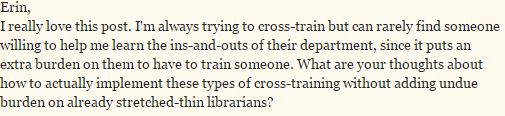
I got a really great comment on this post that made me pause for a moment in self-reflection.


It's a great question, right? How do you actually implement a cross-training program when everyone feels stretched so thin that they can't take the time to work with someone from another department? 

After thinking about it a lot, I identified three things I've seen work at various places that I've worked. 

1. Start small:
I don't think it's necessarily realistic to show up in another department and ask to be cross-trained, especially if it's not the culture at your library. Start by bringing genuine questions about how things work to someone in the department you'd like to learn more about. Are you a public services librarian who wants to learn more about metadata? Start by asking a friendly cataloger about why a search you did in the online catalog produced different results than you thought it would. Are you a metadata creator who wants to know more about how library users access information in the online catalog? Start by asking a friendly public services librarian about what complaint they hear the most during one-on-one transactions or during instruction sessions. They don't have to be long, in-depth conversations. But do enough to start building relationships with people in departments outside your own and showing interest in the work that your colleagues do.

2. Focus on fixed-term projects:
Sometimes the slow season for one department will align with the busy season for another. Or sometimes the workload of a person in a particular department ebbs and flows. These natural changes in the rhythm of the library make space for people to cross-train on projects. Is there a project in your department that nobody has time to do or a project that requires an extra set of hands? This would be a great opportunity to find people in other parts of the library who are looking for skill-building opportunities outside of their own departments. Bonus points if the project you're looking for help with utilizes talents that the person doing the project doesn't get to use in their day-to-day work. You don't have to give a person working on a fixed-term project enough training to be a full-fledged member of the department, which helps if you feel like you don't have time to spare with a programmatic cross-training initiative. 

3. Make the first move:
Not every person in every department is going to be open to cross-training or collaboration. Some people don't want to learn more about metadata creation or information literacy because they'd rather focus on the work they're actually assigned to do.

And that's okay.

But I feel like libraries have to create a culture where people who do want to collaborate or cross-train are supported in doing so. Yes, it takes time to teach people. Yes, it is hard when you're already stretched really thin. But libraries should reward people who want to learn more and do more instead of treating those people like burdens. 

Sometimes, you have to be the change agent in your library and decide that you're going to be the person to make the first move and give up your time in order to change the culture. Ask questions and make it clear you're willing to answer questions. Be friendly and curious--someone that people in other departments want to approach with questions--and use the capital you've earned to ask people questions. If you want to talk to people, try to approach them on their terms. If they prefer emails to a phone call or a drop-in conversation, respect that. If they'd like for you to make an appointment so that they have time to give your question the time and attention it deserves.

Final thoughts:
In my first job out of library school, two things happened around the same time. First, I developed an interest in library instruction because I felt like it would be my best chance (based on the climate and culture of my library) to learn more about how students accessed information. Second, I became the go-to person in the cataloging department for a couple of instruction librarians just by being friendly. Luckily for me, one of those people was the instruction coordinator and she believed in me enough to mentor me in instruction and to allow me to teach a library orientation class each semester. By being curious about what she did and friendly when she asked questions, I was able to help her and to grow my own skills.

Look, I get it. It's possible that you'll try all of these things and people will still be stretched too thin to cross-train you. In which case, you might have to find opportunities to learn more about other parts of librarianship from people you don't work with. If you're a person working in public services who feels like there is no one in metadata creation that you can talk to, feel free to reach out to me. While I can't give you work to do, I'm happy to answer your questions and to serve a sounding board for ideas you might have.

Stay positive,
Erin

Friday, July 15, 2016

I'm doing all right, getting good grades

So, I was accepted into the 2016 cohort of the ALA Leadership Institute. I am very honored to be selected, excited to attend, and just so eager to make connections with the folks in this group. On the application, one of the questions was regarding the Future Of Libraries. I thought I'd share my answer, the Unified Library Scene in a very small nutshell.


The most important thing for libraries to focus on in order to maintain relevancy in the future is to maintain focus on how our core mission of connecting users to resources is unchanging amidst any technological or political changes. Librarians and library management need to address the ways in which librarians continue to accomplish the core goals of libraries in both traditional and new ways. As a profession we tend to get hung up on specific tasks or processes which become reified as “what librarians do,” when the tasks should be continually put in the context of our larger mission. This is true both of more technical aspects such as cataloging and metadata services which remain vital to creating access to resources, and to public facing services such as developing information literacy in all library uses that addresses the varied ways in which library users access and use information. Addressing emerging technologies and societal pressures from a grounded perspective continually focused on an unchanging core mission allows for a greater level of flexibility in the ways which all library staff address their work. Listening closely to our users and our communities with our core mission in mind rather than our daily work in mind allows us to be responsive to deep needs in society rather than simply do what “what librarians/libraries do.” As leaders in the profession, our goal should be to make the connection between what is being accomplished in our field with the core mission both to outside constituents and to other leaders and workers in the field. Together, focused on our mission, we will continue to be a vital driving force in society.

What do you think? How'd I do?

Keep Rockin',
Rachel

Tuesday, June 28, 2016

With love and trust and friends and hammers

One of the sessions I attended was about the different relationships that technical services librarians and public services librarians have with continuing resources. It was a lively conversation, but there was one thing that stuck with me and that I've been turning over for a couple of days. One of the proposed solutions to the problem of technical services librarians not understanding the challenges that users face with continuing resources was for them to work the reference desk.


I got a lot of answers to this question that helped me better understand this, but I'm still not sure I understand. There was a sense in the responses I received that while cataloging requires an understanding of complex ideas, the barriers to being able to work the reference desk were lower. Many people who work in public services expressed a hesitancy about 'screwing up' when it came to working with metadata that seemed to preclude cross-training in technical services.

I agree that nobody should be sent to cross-train in a functional area of the library without proper training. This is as much, I think, for the person's comfort as it is to keep the person from 'screwing up.' But I think that if public services people feel too self-conscious about working with metadata because they won't get it right, metadata creators have to reflect upon why. Are we too rigid? Do we expect too much? Are we too tied to the perfect at the expense of the good?

Don't get me wrong. I think that metadata creators should assume some public-facing duties. Teaching a couple of classes each semester has taught me a lot about pedagogy and about how our users find the resources they need to do their work. And those practises have informed my experiences as a creator of metadata. And I absolutely believe that people who do reference and instruction could benefit from getting their hands dirty with metadata. I think that understanding how records are created and what goes into describing resources would help inform their practice as people who help users access information.

But just like I work with people whose primary focus in librarianship is reference and instruction to hone my teaching skills, I think it would be valuable for people with public-facing duties to work with metadata librarians to hone their metadata creation skills. I don't think it's fair to expect a public services librarian to instantly be a great cataloger in the same way that I don't think it's fair to expect a metadata creator to instantly be a good teacher. But I think if metadata creators work with public services librarians, there is room for cross-training and development for long-term growth and increased understanding.

So let me float an idea past you. If you're a public-facing librarian, consider how you could work with enhancing the metadata that describes the materials in the collection you curate. How could subject access be improved? What information could be added to catalog records to help your users decide if an item is worth their time or not? Pull a few records from your subject area and make some notes. And then instead of telling the metadata creators at your library how they could change the records to make it easier for your user to find information, offer to work with them to do the work.

At its core, I think the Unified Library Scene is about building relationships. I think there is room to welcome public services librarians into technical services in the same way that public services librarians have welcomes technical services librarians into their spaces. I think that having a more holistic view of the library makes it easier for everyone to be successful in their jobs. It's the responsibility of public services libraries to cultivate an interest in metadata creation and it's the responsibility of metadata creators to take that interest seriously. Let's help each other build the library we want to see.

Stay positive,
Erin

Thursday, May 26, 2016

The secret to a happy ending is knowing when to roll the credits

I mentioned in my last blog post that I'm writing a book chapter. I'd had "Naming and reframing: a taxonomy of attacks on knowledge organization" by Tina Gross on my to-read list for a while. And this chapter I'm writing provided me a great opportunity to read it.

To say that I have some Capital-F feelings about this article would be a pretty significant understatement.

In the article, Gross identifies 10 types of attacks of knowledge organization and then goes on to define and give examples for each of these attacks. Gross doesn't offer any solutions to the problem of attacks on knowledge organization and states pretty plainly that the point of the article is not to solve the problem, but to establish language through which we can describe it.

There are two attacks that I think have a symbiotic relationship: disregarding quality and distorting user behavior.

When describing disregarding quality, Gross writes:
There is such a thing as metadata being good enough without being comprehensive, and there's also such a thing as declaring hopeless garbage to be good enough without considering the implications for users. Doing the latter is self-defeating--when metadata fails to facilitate the level of searching needed by users, they have a less satisfactory experience. Usage is likely to go down resulting in even less justification to support and pay for the creation or acquisition of quality metadata. (p. 266)


via GIPHY


This particular attack leads to the library infrastructure version of chasing one's tail. For whatever reason, the metadata creation standards at a library decline. Because the metadata is incomplete, incorrect, or both, users can't find what they're looking for and usage of key resources that are powered off of the shoddy metadata goes down. Administrators look at the decline of usage of the key resources and decide that the because the usage is going down that the resources devoted to creating metadata that powers those key resources can be reallocated.

While a metadata creator might be able to draw an immediate connection between the change in metadata quality and usage of key resources, an administrator might not necessarily be able to do the same if they don't have an understanding of how metadata informs search results and all they have to go on is the usage data of key resources.

While we're on the subject of what users do or don't use, let's look at distorting user behavior. Gross describes it as "asserting that users don't use certain types of metadata, even though major search functions are powered by them" (p. 267)

This attack has as much to do with the narrative constructed by outside forces as it does with what libraries know to be true of their users based on actual evidence. There are a not-insignificant number of studies which suggest that users don't start their research in the library catalog, so administrators decide that resources used to create metadata can be reallocated to other library services. There are two things that strike me about this:

1. What seems to be missing from these studies, though, is how many library users interact with the catalog at some point during the research process. Just because a user doesn't start their search in the catalog doesn't mean they don't go there at some point in the process.

2. Our users are not a monolith. What is true about the research process of one user group may not be true of all user groups.

So which comes first--disregarding quality or user behavior? And, perhaps more importantly, where do metadata creators go from here?

I don't have the answer, but I have a couple of ideas.

First, metadata creators should be gathering as much information as we can about user behavior and using that information to guide the decisions we make. We should know what our users find most useful in catalog records and be focusing our attention on that. This differs from library to library and user group to user group. So while you can probably use those reports that construct a narrative as a starting point, you're going to have to interact with actual users to understand the context at our own library.

Second, our public services colleagues have to help us gather data about when users can't find what they're looking for because of poorly-formed metadata. This data can help metadata creators make the case for the re-reallocation of resources back to metadata creation. Nothing says 'hey, we need more resources in the cataloging department' like evidence of where users have walked away empty handed. To the extent that it's practical (and legal), I would advocate share reference interview transcripts or notes as well as catalog search logs.

Finally, I want to say that I picked on administrators a lot in this post, but I do so affectionately and with the understanding that our administrators have a lot to think about and decide on any given day. And, ultimately, they work with the information we give them to make the best decisions they can to allocate resources to library services. It's our job to give them the information and tools to make the best decision possible.

Stay positive,
Erin


Tuesday, May 24, 2016

I am king of all I see, my kingdom for a voice

I'm in the midst of writing a book chapter--which sounds like the world's worst humblebrag,I realize. While it's been a real challenge for me to write long form, it's been nice to have the space to expand my thoughts beyond the length of a blog post and explore my ideas a little more.

I'm not sure that this will make it past the cutting room floor, but yesterday I wrote:
Metadata creation has both a privilege problem and an image problem and we have to wrestle and reckon with both in order to find a place where metadata creators are both valued for the work we do and empathetic in the words we use.
This isn't a particularly novel idea, nor it is particularly inflammatory. But it's not a place I came to easily and without struggle.

The LIS program I attended didn't have a lot in the way of theoretical grounding as as a English major with a creative writing focus, I wasn't exposed to much beyond literary theory as an undergraduate. So being exposed to critical theory and ideas was something that has only happened in the last few years.

When I turn over new ideas, I am almost never walking through new territory. There are people who came well before me and people whose work is more recent. And I am both aware of, and grateful for, their work.

I appreciate how Emily Drabinski has challenged me to think about how impossible it is to fix (in any sense) language that describes people.

I appreciate how April Hathcock has challenged me to understand my privilege and my complicity in the maintenance of oppressive systems within the LIS community.

I appreciate how Maria Accardi has taught me to bring my whole self into my work and to value the worth of all of the users I serve.

I appreciate how Derrick Jefferson has challenged me to think about intersectionality in the LIS community.

I appreciate how Netanel Ganin has challenged me to think in literal terms about the construction and application of LCSH.

All of this is to say that I understand that when I think and when I write, I'm standing on the shoulders of the kindest, most thoughtful giants I can imagine.

Stay positive,
Erin

Tuesday, April 19, 2016

And when I start to feel it making sense for me

So...let's talk about this story that circulated last week about the Representative from Tennessee who wants to introduce legislation to force the Library of Congress to reverse its decision to cancel the heading Illegal aliens and, in its place, use the headings Noncitizen and Unauthorized immigration. It seems likely that this proposed piece of legislation is little more than a push for attention by a person who is up for reelection. After all, what better way to make a name for oneself than taking on the bastion of political correctness that is Library of Congress.

I think this story surfaces, again, an issue that I've written about before: the Library of Congress is not the U.S. national library even though we in the U.S. library community treat it as if it were. We use the Library of Congress' thesaurus and classification scheme for subject cataloging even though many in the U.S. cataloging community have been talking for many years about its flaws and working for many years to try to correct "-ist" headings and class numbers.

And while it would be fun to talk more about the problematic nature of treating the Library of Congress as de facto U.S. National Library, I think that there is a more important issue that this story surfaces: cataloging is not a neutral act.

While it's true that catalogers are taught to be objective in how they are taught to describe the objects they're tasked with cataloging, this feels impossible. One could argue that it feels less impossible in descriptive cataloging, because it is easier to be object about, say, the publisher of a book than the subject of that book. But this feeling of impossibility is even baked into our content standards, which leave room for "cataloger's judgment." In some cases, the standards reason, a cataloger will have to interpret a rule and apply it in a way that makes the most sense to them. Which means that even descriptive cataloging --the part of cataloging that is meant to have the greatest chance of objectivity--isn't actually all that objective.

And while it feels like a challenge to talk about objectivity in descriptive cataloging, it feels wholly impossible to talk about objectivity in subject cataloging. If the language itself isn't neutral, how can we be expected to be objective in our application of that language?

I have long thought that in addition to talking about cataloger's judgment, we should also talk about cataloger's bias. So, let's do that. One of the definitions Merriam-Webster gives for bias is "an inclination of temperament or outlook, especially: a personal and sometimes unreasoned judgment." And when we talk about cataloging--especially subject cataloging--that makes sense to me.

Catalogers bring to bear on the works they catalog a lifetime of lived experience. It is impossible to put away that lived experience in order to describe works in an objective fashion. And it is both disingenuous to library users and unfair to catalogers to continue to perpetuate this....lie. As a middle-class, white, cisgender woman, I can't put away my lived experience in order to describe the things I catalog--nor should I. And I shouldn't expect that my colleagues from marginalized groups to do the same.

So how do we reckon with this? How do we acknowledge cataloger's bias and then move through a flawed system in order to order the objects we are tasked with describing? I think we do it in two ways.

1. Appreciate the lived experiences of your colleagues and your users and think about how this is reflected in your metadata.
My experience with the heading Illegal aliens is different than someone who has lived that experience, which means I should believe them when they say that this terminology is dehumanizing. The same goes with any number of "-ist" subject headings. If someone tells you that the words you're using in your metadata to describe them invalidates their lived experiences, take that seriously. Don't dismiss it because their lived experience is not the same as yours.

2. Educate yourself and your users.
If you are unclear about your place in creating and maintaining oppressive systems, you have some work to do. I wrote before about how you have to understand your place in an oppressive system before you can dismantle it. Read everything you can and have hard conversations with you friends and your colleagues about white privilege and oppression. If you need a starting point for educating yourself, April Hathcock's blog has a lot of great posts on intersectionality and on doing the work.

If you have a relationship with library users, you should use every appropriate opportunity to talk about catalog records and bias and how the material you retrieve when you search is based on biased algorithms. It seems likely that making the catalog as transparent as possible for users will help them find the material they seek while navigating the biased language of subject headings. Emily Drabinski's article, "Queering the Catalog," is a great read when thinking about how to bring users into the conversation about metadata. And anything you can read by Safiya Noble is great for thinking about algorithmic bias.

There are a wealth of tools out there to help you get started in thinking about how to educate yourself and your users. If you have other ideas, feel free to drop them in the comments!

While coming to terms with cataloger's bias is both challenging and uncomfortable, it's unbelievably necessary. We cannot continue to believe that cataloging is a neutral act. And the quicker we move on from that point, the quicker we can help our users identify how to get the best information they need to complete the task at hand.

Stay positive,
Erin