Friday, May 15, 2015

Friday Jams! (05/05/15)

Rachel:

Intersessionnnnnnn, and the parking is eassssssyyyyy. Your email is neat, and your boss is on vacaaaaaaaaaation.

Here's a summer song.


Erin:
It is impossible to beat that Friday jam.

I followed Rachel's lead and went with solo Mike Doughty. While Haughty Melodic is a better record, I love Golden Delicious. Enjoy this live version of a track from that album, "I just want the girl in the blue dress to keep on dancing."


Thursday, May 14, 2015

Making Space for...

When I was in high school and college I worked at the same company as my mom. Technically, I worked for my mother. I did various things, which we may discuss at some other time if we ever get into our origin stories. What I learned from that job, other than a passing knowledge of microbiology (which isn't really helpful in any way, surprisingly), I learned from watching my mom go about her business.

One of the things she did was have a very tidy workspace. Surely this came from her many years running a research lab -- you can't just leave mouse spleens laying around at the end of the day.  One of the labs that my mother ran was a dirty lab, dirty in that they worked with live human pathogens that could kill you. Put everything away, clean everything, check again, check again. When working in an office, she cleaned and organized her workspace.  Daily neatening, the last hour of her week cleaning her area thoroughly.  Monday morning met with a neat clean ready-to-go workspace.

I managed to pick up some of these habits and carry them to both my kitchen and my shop, but I struggle with them at work. When the end of the work day comes I tend to pack everything into my bag and take it home. Things get more and more disorganized throughout the week, until I need to take a half-day to sort it all out. Random things get spread across my desk and I know that my calculator doesn't go there but I'm "too busy" to take three seconds to put it where it does go.

In this time between class sessions, though, I have enough time to get to inbox zero, so it is a good time to try to reinstate a habit of orderliness. It is important for me because this orderliness has a huge impact on my efficiency and clarity of mind. So I will take tomorrow to organize my office. I will book off the last hour of Friday on my calendar every week to make time for neatening the office. I will resolve once again to take the first and last 20 minutes of the day setting priorities and organizing my tasks.

We let some things slide because they are fundamental. Because we don't appreciate fully how other things are built on them. What core practices help you be your best self? How do you value these in your work day? Let me know in the comments!

Keep Rockin'
Rachel


Tuesday, May 12, 2015

They didn't name her for a Saint

The notion of controlled vocabulary is interesting. In the book Introduction to Controlled Vocabulary, Patricia Harping described controlled vocabulary this way:
A controlled vocabulary is an organized arrangement of words and phrases used to index content and/or to retrieve content through browsing or searching. It typically includes preferred and variant terms and has a defined scope or describes a specific domain.
There are a variety of thesauri with which to describe material. Library of Congress subject headings and the Getty vocabularies are probably the best known, but there are a variety of thesauri with which one could do subject analysis.

Organizing and labeling the world for the sake of information description and retrieval is not, on its face, a terrible thing. It seems advisable to be able to find all of the books on a particular topic by doing a single search, and controlled vocabulary allows you to do that.

Controlled vocabulary often falls short. An innocuous example: Until June 2010, the subject heading you would need to know to find a cookbook was "cookery." This post does a great job of showing how the subject headings were structured when the change from "cookery" to "cookbooks" took place. Before that time, if you typed in "cookbooks," the catalog would redirect your search to "cookery" and you would be dropped into a results screen. It was annoying for catalogers and for users.

One of the more damaging examples of controlled vocabulary falling short happens when we attempt to describe people. One of my favorite articles is from Amber Billey, Emily Drabinski, and K.R. Roberto. In "What's gender got to do with it: a critique of RDA 9.7," they argue against coding gender in authority records. The argument is best summed up this way by Billey et. al:
When RDA requires catalogers to select from only two gender categories—male or female—the rules affirm ideas about gender as a binary and innate characteristic, something it is always possible to know, and know completely, about an individual. Indeed, “unknown” is listed as the only possible third option. The rule fails to account for those who know their gender, but experience it as outside the bounds of simply male or female (417).
Basically, it's problematic to ask someone to make assumptions about someone else's humanity. And it's even more problematic to ask someone to codify these assumptions in authoritative sources.

Let's take a brief detour to talk about faceted search. Facets allow users to narrow down a set of search results based on a set of criteria extracted from elements in the records. Among other things, users can narrow by date of publication, format type, and subjects. Let's go back to our cookbook example. If you search for cookbooks, you could use the "publication date" facet to narrow down your search results to cookbooks published last year.

The Library of Congress is piloting a project called Library of Congress Demographic Group Terms, or LCDGT. The rationale for the project is that including these demographic terms in records allows users to find material for, or by, a particular group of people. The examples they use in the description of the program are "novels by lawyers" and "handbooks for nurses."

Seen through the lens of the Billey, Drabinski, and Roberto article, one can see how this project might be problematic--especially when it comes to assigning demographic information like gender or sexual orientation.

The pilot documentation states that:
In order for a demographic group to be proposed, a creator or contributor of a resource must self-identify with the group, or a resource must clearly indicate that the group is the intended audience. Furthermore, research in standard reference sources should be carried out and documented.  
I think that the self-identification piece embedded in the LCDGT project is the place where it has the potential to diverge from the problematic practice of recording gender in authority records. If a person self-identifies with a group, catalogers are not foisting an identity upon someone based on contextual clues. And multiple terms can be put together to describe demographic groups. But I do think that a set of controlled terms, no matter how broad, will not be able to keep pace with the spectrum of terms a group of people uses to identify itself. And, while the terms in this particular thesaurus "should reflect current usage, and pejorative terminology should be avoided," LCSH has been notoriously bad at keeping up with the current usage of terminology.

I think it's important to weigh the value of being able to find material by, and for, certain demographic groups against the dangerous act of describing demographic groups based on contextual clues. Would it be great for users to find information related to the demographic groups to which they belong? Probably. Is doing so worth the possible mis-identification of people and resources? Probably not.

The arguments for, and against, LCDGT are nuanced. And despite my best efforts, I am sure I've fallen short. The comment period for the pilot of LCDGT is open through June 5th. I will be curious to hear the reaction of the cataloging community and to see the progress of the pilot.



Friday, May 8, 2015

Friday jams (05/08/2015)

Erin:
I'm in D.C. today for a business meeting today. Well, not actually today. I'm actually posting these jams a few days early so that Rachel doesn't have to GChat me and ask me what my Friday jam is.

Jason Isbell's new album, Something More Than Free, doesn't come out until July. But he released a single from that record on Soundcloud. Isbell's tune, "24 Frames," is a lovely, jangly, rocking tune and I can't wait to hear the rest of the record.


Rachel:

Erin always fills me with guilt because I know that I should be super into the stuff that she posts because it is right up my alley but I just don't have time in my day or room in my heart for new music. I guess I'm maybe getting old?

Anyway, I am looking for a house to buy so that I can live in it.


Thursday, May 7, 2015

On Preaching To The Choir

I think most of you are probably picking up what Erin and I are laying down over here on the blog. Maybe not all of you all of the time, but most of the time most of you are smelling what we're cooking. What we're up to is Building the Unified Library Scene. However, we could be accused of preaching to the choir, talking only with folks who agree with us. Not going out and spreading the word, not going out and actually fighting any kind of real fight. There is value in preaching to the choir, I would argue.

We're building a community. All of us in our lives do this work daily, and the Unified Library Scene is about a kind of community of practice in library work. We can find support in a community, lift each other up and help each other out. A community is a safe space where you can let your emotional guard down a little bit. A community is impossible to live without.

We're exploring our beliefs. This space is not one where we want to be unchallenged. We're interested in growing. There is a base of things that we generally agree about, and we push each other to think harder and be better both in our thoughts about the Unified Library Scene and in other parts of life.

We're testing messages. A benefit of preaching to the choir is that you're preaching, and practice has myriad benefits. From a practice of writing (on deadline) to knowing what kind of messages resonate and what kind of messages spark discussion. What kind of message could we spread if we're not secure in what our beliefs are and what we want to communicate about them?

In your own organization, you may have some allies, a little choir of your own. What work you do with them does make a difference. Take some time to reflect on the kind of conversations you have with them and note all of the benefits that you're getting. It's more than a rant or a gripe session over coffee with the one person in your library who understands you. You're talking about a lot of strategic things, I would bet, and you're practicing your message.  Of course, it might sound different when you cater it to other audiences, but it might not exist at all if it weren't for your choir.

Keep Rockin'
Rachel

Tuesday, May 5, 2015

So many wonderful treasures

The first time I read the ACRL Framework for Information Literacy was when I wrote this post a couple of weeks ago. I'd heard and read a lot about the document, but I hadn't bothered to invest the time in reading it. The Framework languished on my to-read list because I felt like it has little relevance to what I do as a cataloger. I'm committed to staying current on trends in academic librarianship, but I was prepared to see the Framework solely as a blueprint from instruction librarians.

When I read the Framework for that blog post, I was surprised to see myself in the last frame of the document: Searching as strategic exploration.

The description of this particular frame talks about the search process from beginning to end and describes the experiences of people on all parts of the learning spectrum:
The act of searching often begins with a question that directs the act of finding needed information. Encompassing inquiry, discovery, and serendipity, searching identifies possible relevant sources and the means to access those sources. Experts realize that information searching is a contextualized, complex experience that affects, and is affected by, the searcher’s cognitive, affective, and social dimensions. Novice learners may search a limited set of resources, and experts may search more broadly and deeply to determine the most appropriate information within the project scope. Likewise, novice learners tend to use few search strategies; experts select from various search strategies, depending on the sources, scope, and context of the information need.
I appreciate the fact that this concept distinguishes between the novice learning and expert learner, and acknowledges that their needs and experiences are different. As with all of the other frames, there are "knowledge practices" and "dispositions" that describe what people who are becoming (and have become) information literate should be able to do.

When I looked at the bullet points in these sections, I saw the way in which the work that I do as a cataloger has a direct impact on whether or not a library user becomes information literate. Three bullet points in particular have me thinking.

1. Match information needs and search strategies to search tools
As laid out in the description of the frame, novice and expert researchers have different information needs. And libraries have responded to the one size doesn't fit all argument by offering both "next-gen" catalogs and legacy catalogs. Novice researchers may prefer to use the library catalog that has been augmented with a discovery layer, while expert researchers may prefer our legacy catalog. The "next-gen" catalog gives novice researchers the opportunity to search using keywords born from natural language and then refine based on a set of facets. The legacy catalog, on the other hand, allows expert researchers to refine at the outset based on advanced search options.

I wonder whether we put equal resources into maintaining both our "next-gen" and legacy catalogs. I have had to train myself to check my cataloging work in both catalogs to ensure that the information displayed in records is usable to both novice and expert researchers. It is so easy, as a cataloger, to prefer the legacy catalog because "next-gen" catalogs are notoriously bad for known item searching. But the point of these discovery systems is to give novice researchers a way into a research process that can be tricky. And given that, according to the 2015 State of America's Libraries report, 51% of college freshpeople have a hard time learning to navigate new tools, we owe it to our novice researchers to help them find a way into the process.

2. Use different searching language types (e.g., controlled vocabulary, keywords, natural language)
It seems obvious to say that searching with controlled vocabulary yields different results than keyword searching. It seems less obvious to suggest that well-formed metadata is an important part of developing library users into information literate people.

There are a lot of reasons why it isn't really an option anymore for catalogers to touch every piece that comes through the door. Shelf-ready books with accompanying records are a way for us to get material on the shelves faster and MARC record services for journals provide title-level access in a way that individual catalogers just can't. The move from cataloging every title to focusing on hidden collections is a smart one.

I would argue, though, that we should push back when we're given records with poor quality metadata. Sure, some access is better than none, but our users need to expect that different searching language types will surface the material they are looking for. If we teach them to use a variety of searching methods and none of those methods return the resources they're looking for because the metadata is of poor quality then we've failed them. I believe that we could get more buy-in from our library's leaders if we positioned metadata as an information literacy issue.

3. Recognize the value of browsing and other serendipitous methods of information gathering.
Serendipitous discovery is such an important part of the search process. Have you ever gone to the shelf to find the book you're looking for and recognized that the books around it are also valuable to your research? It's an amazing feeling to go to the stacks looking for one book and leave with a stack of them.

But when your collection moves off-site or you purchase electronic resources, you lose the capacity to find that material when browsing the shelves. It is important, then, that you ensure that these materials can be found by way of virtual browse. By putting call numbers in records for your electronic material, for example, you make them discoverable in a call number browse. And by ensuring that records are up to a specific standard before their corresponding physical items are moved off-site means that off-site items are found in a subject browse. By placing as much value on virtual browse as physical browse, you make the various piece of your collection easier for your users to find, identify, select, and obtain.

The bottom line for me is that the Framework isn't just a resource for instruction librarians to consider, puzzle over, interact with, and react to. Whether you accept the Framework without reservation or push back against some of its claims, I believe technical services librarians should be in conversation with it and use it as a lens through which to see our work. If you work in technical services in an academic library, I invite you to read ACRL's Framework for Information Literacy and to find yourself there. How does the work you do directly impact the ability for library users to become information literate people? And if what you're doing actually hinders their development, what can you do differently?

Stay positive,
Erin

Friday, May 1, 2015

Friday jams (05/01/2015)

Okay, I'm taking over the blog for a Friday afternoon dance party. I am commandeering Friday Jams, and you can't stop me.

Stay positive,
Erin

Song #1:
I love mash-ups. There's something about putting two songs together that seem like they shouldn't work together and making something amazing that really appeals to me.

This mash-up of Michael McDonald's I Keep Forgetting and Close to Me by The Cure by Laura Jane Grace is so amazing.


Song #2:
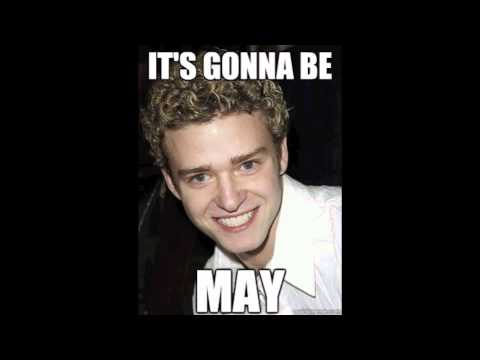
I don't know if you saw this yesterday like I did, but "It's gonna be May" was everywhere.


As a result, I have had that one particular N'Sync song stuck in my head. And, since sharing is caring, now you do too.