Have you even been in a moment and realized that you were witnessing a turning point in the life of a relationship or an organization? I just got back from Denver and, honestly, that's what ALA Midwinter felt like for me this year. It felt like the American Library Association is standing at a crossroads and its members and leaders are going to have to start having some hard conversations and making some tough choices if they want to organization to continue to be relevant in the current day and in a future that seems poised to leave the organization behind.
Attendance at ALA Midwinter has been declining steadily over the past few years and this year, attendance numbers fell just short of 8,000. Attendance at ALA Midwinter suffers from the fact that winter is a hard time to travel by airplane, given the chances of travel problems. But it also suffers from changing organizational norms. While ALA Council and some of the committees at various levels of the organization need to meet in person to do their business, many committees do not need to meet in person two times per year because their business can be conducted online. It was my experience that many committees where in-person attendance was not required had fewer than half of their members present. Add to that the fact that because ALA Midwinter has historically been a business meeting, there are significantly fewer opportunities at ALA Midwinter for engagement and learning. To their credit, it does seems like ALA and its leadership are trying to figure out how to reckon with these challenges. But to my untrained eye, it doesn't seem like the conference will be able to continue in its current form in perpetuity.
But beyond numbers, there was a significant dissonance that was hard to shake. Two things struck me. First, that the discussion about whether or not the ALA Executive Director should be a degreed librarian continues apace. In November, ALA Council voted to change the educational requirement for the ED from "required" to "preferred." A petition to overturn the Council's actions got enough votes to make it onto the ballot for ALA's spring elections and so here we are. The search committee will reconvene after the vote and I saw badge ribbons at ALA that read "Vote Librarian!" One of the pro-librarian talking points is that we need an ED with a MLIS because we want to find someone who is familiar with and represents our values. I have a hard time with this conversation, mostly because I feel like that's a slap in the face to the countless numbers of library workers who are not degreed and who keep our libraries running smoothly. I also wondered how those in the "Vote Librarian!" camp felt about having a non-degreed librarian as a featured speaker on the ALA Present's Program panel. Chris Bourg's comments were passionate and as representative of library values but do we discount them because she isn't a degree-holding librarian? I wonder how those in the "Vote Librarian!" camp would be able justify either discounting Bourg's words OR holding her in high esteem while also having a viewpoint that makes her less-than in the eyes of the organization. I wonder what kind of mental gymnastics that takes. Frankly, it seems exhausting.
Second, and perhaps more importantly, we have to talk about ALA's failure to walk its talk when it comes to equity, diversity, and inclusion. ALA has declared that equity, diversity, and inclusion are core values of the organization. But it felt at this conference like the organization and its leaders weren't really walking the talk. It was noted by more than one person (and I experienced it myself) that gender-neutral restrooms were few and far between at this conference. And those restrooms that had been converted were in far off corners of the convention center. Given the size of the convention center, the surfeit of restrooms, and the dearth of gender-neutral restrooms in the convention center, it seemed like a choice to not have converted more of them. And choosing not to convert more of the restrooms to gender neutral is not a great way to live into your values which foreground equity, diversity, and inclusion. Also, let's circle back to the "Are Libraries Neutral?" debate that was the ALA President's Program. Neutrality has definitely been on the minds of many in the library community so I can understand wanting to devote a program to talking about it. But as I was watching this debate I couldn't help but think of the privilege required to have a space devoted to the idea of neutrality. Because nearly 90% of librarians are white, we have the luxury of being able to have theoretical discussions about whose points of view we are required to give space to in our collections and our spaces. But I couldn't help but think about our colleagues in marginalized communities for whom this conversation is not actually theoretical because including certain points of view in our collections and our spaces is dangerous for them. How must it feel for our colleagues from marginalized populations to walk into a ballroom filled with jaunty music and sit through a conversation that argues that the rights of people who do not believe in their right to exist are more important than, well, their rights to exist. How can we, members of the Association, claim walk the talk of equity, diversity, and inclusion when we make spaces hostile for those in marginalized communities?
At ALA Midwinter, Junot Diaz gave an impassioned speech that, among other things, held those working in libraries accountable for how we treat our colleagues of color. The blog post on the American Libraries' website suggests that he "got real" in this conversation. The quote that I saw retweeted was "I wish that libraries would finally have a reckoning and know that [staffs that are] 88% white means 5000% agony for people of color, no matter how liberal and enlightened you think you are. We have to decolonize [libraries]." And I saw a lot of my more privileged colleagues quote tweeting this with some kind of "Yes!" as part of their commentary. But wokeness is performative when we say one thing and then prove with our actions that we're not really committed to it.
I have much respect for the Association and its leaders and members. But I also feel like we are really good at performative wokeness and, as Diaz points out, feeling really liberal and enlightened. I don't know where we go from here, but I also feel like this posturing is not a sustainable long-term solution. Declining Association membership and dwindling attendance numbers should tell us that what we're currently doing isn't working and that reinvisioning how the Association and its meetings are structured won't be enough to save us.
Stay positive,
Erin
Showing posts with label learning. Show all posts
Showing posts with label learning. Show all posts
Tuesday, February 13, 2018

Tuesday, November 22, 2016
The personal is political is personal
I'm currently reading a book by Frances E. Kendall called Understanding white privilege: creating pathways to authentic relationships across race. In the chapter titled "Understanding white privilege," Kendall tells an anecdote about something that happened in conjunction with one of the diversity-related training sessions she facilitated. During a break on the second day of the workshop, a white woman and a Latina from the class ended up at the same store. The white woman watched how the Latina was treated by the sales clerk from which she was trying to make a purchase--being asked for additional identification when she presented her credit card, being told that the security guard would want to see her receipt when she left--and contrasted that with her own experience. The white woman came back to the training session and told Kendall that she wouldn't have believed how her Latina colleague was treated if she hadn't seen it with her own eyes. Kendall writes:
There is a piece of this conversation that relates to the passage from Kendall's book that I want to highlight. In its most recent communication on this issue, the ALA President stated "the ALA executive board will discuss these issues and our processes and will use your comments to help guide us in our discussion and planning as we work to earn back the trust of our members and prepare for the work ahead during this new administration."
So, let's talk about trust.
ALA has identified diversity as one of its key action areas, charging a task force and then a subsequent implementation working group with considering how equity, diversity and inclusion could be built both within ALA and in wider library community. You can read the task force's final report here. By charging people at the Association-level to do the work of identifying and proposing ways to further DEI-related initiatives, the Association has both implicitly and explicitly asked the margainalized people throughout ALA what can be done to make ALA a more diverse, equitable, and inclusive place. The Association has asked people to entrust us with their stories and told people that it is part of our value system that we will hold those stories and respond in an appropriate way. And then we have chosen not to believe them when they tell us that they are afraid that they will be the targets of state-sponsored violence.
In the same week, ALA's President released a statement affirming ALA's commitment to diversity, equity, and inclusion and two statements affirming ALA's commitment to working with the incoming administration. And, yes, one of those statements was taken down and an apology issued. But one can see how people within the Association's membership would be outraged that such an affirmation was issued in the first place. ALA asked people what they needed to trust the Association as a diverse, equitable, and inclusive organization and then didn't listen to them as they expressed their loudest fears and their deepest concerns.
In the days following the election, Hugh Acheson posted to Instagram a letter he sent to the staff at each of the restaurants he owns. In the letter he writes "The customer is always right, until they are wrong. And when they are wrong with epithets or cruelty they will be asked to leave. This is not me giving you an aggressive power to wield, but rather making sure you understand the ethos I have in protecting what I believe in, and what I do not have the patience for."
I understand that ALA has a dual responsibility to serve both libraries and the people who staff them. To that end, I believe that our goal in libraries should be to serve the communities in which we find ourselves, even when their beliefs don't align with ours. Libraries should be places that foster conversation and an exchange of ideas, but I believe that in libraries, as in Acheson's restaurants, there is a point past which the patron isn't always right--especially when a member of our user community is wrong with cruelty.
So how does the Association go about the work of rebuilding trust?
First, I think it is incumbent upon Association-level leadership to restore the relationship between the Association and its members by centering the voices and taking seriously the concerns the people among its membership who will be most vulnerable in the coming years.
Second, I think it is incumbent upon the membership to make even more space for people who are traditionally underrepresented in librarianship to take on leadership roles. The includes not only providing increased support for programs like the Spectrum Scholarship Program but also the development of a pipeline for leadership both at the Division-level and Association-level.
Finally, I think it is incumbent upon both Association-level leadership and Association membership to ensure the safety of our most vulnerable members through both our words and our actions.
I'm sure that the path toward a restored relationship between the Association and its membership will not be without bumps and will probably look different than what I've suggested here. But I do hope that it happens. And I'll continue to attend ALA Council meetings and ALA Midwinter and ALA Annual in the hopes of seeing signs of the Association working toward that restoration.
Stay positive,
Erin
even though Debbie had been listening to employees of color talk about their painful experiences for a day and a half, she had essentially chosen not to believe what they said; she had continued to say that she thought the different experiences were individual, not race based. She used her own privilege of expecting to be educated about race by the people who were most affected--those of color--and then chose not to believe them (61).I read this passage right around the time that people were starting to express their outrage over the press releases that ALA sent out regarding its desire to work with the newly elected administration and which highlighted a trio of initiatives that it felt aligned with the newly elected administration's stated goals for its administration. People have addressed this situation in smarter, and more nuanced ways that I have. If you're interested in reading other people's points of view, I would suggest checking out #notmyALA on Twitter. A lot of opinions and posts are aggregated there.
There is a piece of this conversation that relates to the passage from Kendall's book that I want to highlight. In its most recent communication on this issue, the ALA President stated "the ALA executive board will discuss these issues and our processes and will use your comments to help guide us in our discussion and planning as we work to earn back the trust of our members and prepare for the work ahead during this new administration."
So, let's talk about trust.
ALA has identified diversity as one of its key action areas, charging a task force and then a subsequent implementation working group with considering how equity, diversity and inclusion could be built both within ALA and in wider library community. You can read the task force's final report here. By charging people at the Association-level to do the work of identifying and proposing ways to further DEI-related initiatives, the Association has both implicitly and explicitly asked the margainalized people throughout ALA what can be done to make ALA a more diverse, equitable, and inclusive place. The Association has asked people to entrust us with their stories and told people that it is part of our value system that we will hold those stories and respond in an appropriate way. And then we have chosen not to believe them when they tell us that they are afraid that they will be the targets of state-sponsored violence.
In the same week, ALA's President released a statement affirming ALA's commitment to diversity, equity, and inclusion and two statements affirming ALA's commitment to working with the incoming administration. And, yes, one of those statements was taken down and an apology issued. But one can see how people within the Association's membership would be outraged that such an affirmation was issued in the first place. ALA asked people what they needed to trust the Association as a diverse, equitable, and inclusive organization and then didn't listen to them as they expressed their loudest fears and their deepest concerns.
In the days following the election, Hugh Acheson posted to Instagram a letter he sent to the staff at each of the restaurants he owns. In the letter he writes "The customer is always right, until they are wrong. And when they are wrong with epithets or cruelty they will be asked to leave. This is not me giving you an aggressive power to wield, but rather making sure you understand the ethos I have in protecting what I believe in, and what I do not have the patience for."
I understand that ALA has a dual responsibility to serve both libraries and the people who staff them. To that end, I believe that our goal in libraries should be to serve the communities in which we find ourselves, even when their beliefs don't align with ours. Libraries should be places that foster conversation and an exchange of ideas, but I believe that in libraries, as in Acheson's restaurants, there is a point past which the patron isn't always right--especially when a member of our user community is wrong with cruelty.
So how does the Association go about the work of rebuilding trust?
First, I think it is incumbent upon Association-level leadership to restore the relationship between the Association and its members by centering the voices and taking seriously the concerns the people among its membership who will be most vulnerable in the coming years.
Second, I think it is incumbent upon the membership to make even more space for people who are traditionally underrepresented in librarianship to take on leadership roles. The includes not only providing increased support for programs like the Spectrum Scholarship Program but also the development of a pipeline for leadership both at the Division-level and Association-level.
Finally, I think it is incumbent upon both Association-level leadership and Association membership to ensure the safety of our most vulnerable members through both our words and our actions.
I'm sure that the path toward a restored relationship between the Association and its membership will not be without bumps and will probably look different than what I've suggested here. But I do hope that it happens. And I'll continue to attend ALA Council meetings and ALA Midwinter and ALA Annual in the hopes of seeing signs of the Association working toward that restoration.
Stay positive,
Erin
Tuesday, July 26, 2016
I never want to be anyone's enemy
At the end of June, I wrote a post about how I thought that people with reference and instruction duties should spend time working with metadata creators in order to help enhance access to the collections they curate. My thought process is that having a holistic view of the library helps everyone become better at their jobs and that the burden to cross-train shouldn't be placed exclusively upon the shoulders of technical services librarians.
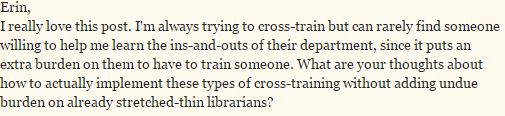
I got a really great comment on this post that made me pause for a moment in self-reflection.
It's a great question, right? How do you actually implement a cross-training program when everyone feels stretched so thin that they can't take the time to work with someone from another department?
After thinking about it a lot, I identified three things I've seen work at various places that I've worked.
1. Start small:
I don't think it's necessarily realistic to show up in another department and ask to be cross-trained, especially if it's not the culture at your library. Start by bringing genuine questions about how things work to someone in the department you'd like to learn more about. Are you a public services librarian who wants to learn more about metadata? Start by asking a friendly cataloger about why a search you did in the online catalog produced different results than you thought it would. Are you a metadata creator who wants to know more about how library users access information in the online catalog? Start by asking a friendly public services librarian about what complaint they hear the most during one-on-one transactions or during instruction sessions. They don't have to be long, in-depth conversations. But do enough to start building relationships with people in departments outside your own and showing interest in the work that your colleagues do.
2. Focus on fixed-term projects:
Sometimes the slow season for one department will align with the busy season for another. Or sometimes the workload of a person in a particular department ebbs and flows. These natural changes in the rhythm of the library make space for people to cross-train on projects. Is there a project in your department that nobody has time to do or a project that requires an extra set of hands? This would be a great opportunity to find people in other parts of the library who are looking for skill-building opportunities outside of their own departments. Bonus points if the project you're looking for help with utilizes talents that the person doing the project doesn't get to use in their day-to-day work. You don't have to give a person working on a fixed-term project enough training to be a full-fledged member of the department, which helps if you feel like you don't have time to spare with a programmatic cross-training initiative.
3. Make the first move:
Not every person in every department is going to be open to cross-training or collaboration. Some people don't want to learn more about metadata creation or information literacy because they'd rather focus on the work they're actually assigned to do.
And that's okay.
But I feel like libraries have to create a culture where people who do want to collaborate or cross-train are supported in doing so. Yes, it takes time to teach people. Yes, it is hard when you're already stretched really thin. But libraries should reward people who want to learn more and do more instead of treating those people like burdens.
Sometimes, you have to be the change agent in your library and decide that you're going to be the person to make the first move and give up your time in order to change the culture. Ask questions and make it clear you're willing to answer questions. Be friendly and curious--someone that people in other departments want to approach with questions--and use the capital you've earned to ask people questions. If you want to talk to people, try to approach them on their terms. If they prefer emails to a phone call or a drop-in conversation, respect that. If they'd like for you to make an appointment so that they have time to give your question the time and attention it deserves.
Final thoughts:
In my first job out of library school, two things happened around the same time. First, I developed an interest in library instruction because I felt like it would be my best chance (based on the climate and culture of my library) to learn more about how students accessed information. Second, I became the go-to person in the cataloging department for a couple of instruction librarians just by being friendly. Luckily for me, one of those people was the instruction coordinator and she believed in me enough to mentor me in instruction and to allow me to teach a library orientation class each semester. By being curious about what she did and friendly when she asked questions, I was able to help her and to grow my own skills.
Look, I get it. It's possible that you'll try all of these things and people will still be stretched too thin to cross-train you. In which case, you might have to find opportunities to learn more about other parts of librarianship from people you don't work with. If you're a person working in public services who feels like there is no one in metadata creation that you can talk to, feel free to reach out to me. While I can't give you work to do, I'm happy to answer your questions and to serve a sounding board for ideas you might have.
Stay positive,
Erin
Tuesday, March 8, 2016
Still I have a mind to think
I attended library school as a distance education learner in the mid-2000s. I had been working in libraries since high school--first in public libraries, then in a school library. I was an English major in undergraduate with a creative writing concentration, and I had dreams of becoming an academic. But, as so often happens, I didn't. After moving into a full-time paraprofessional position, I decided to go to library school.
My experience of my LIS program is that it was light on theory. I attribute this to the fact that, while most of my online classes were taught by people with PhDs in LIS, most of my in-person classes were taught by well-respected practitioners who worked in the city where I attended class. I heard a lot of lectures and did a lot of assignments that prepared me to work in libraries.
As someone who has had her degree for long enough to be considered mid-career, I often feel intimidated when I interact with people--mostly in online spaces--who have a much stronger theoretical grounding that I do. I stumble when I hear people talk about feminist, critical race, or queer theory because I haven't read any of the foundational texts upon which these theories are based. I feel ill equipped to talk about certain issues related to cataloging because I'm not familiar with Panizzi's 91 rules or the Paris Principles.
Up until recently, I have used this feeling of intimidation as an excuse to not engage in some interesting conversations about librarianship both in published literature and in online spaces. I recently wrote about how I've allowed imposter syndrome to keep my from adding my voice to the scholarly conversation happening in LIS research. And since I wrote that post, something inside me flipped.
Around the same time, I started reading Teaching to transgress: education as the practice of freedom by bell hooks. I read a chapter or two each day while I eat lunch. I've been deliberate about the slow pace at which I make my way through this book, spending quiet time with hooks each day. And when I finish Teaching to transgress, I'll pick up another book.
By devoting time each day to reading something, I am giving myself the theoretical grounding in librarianship that I didn't receive in library school. You've probably noticed that many of my recent blog posts have been my interactions with something I read, taking my own ideas and looking at them through the lens of something written by someone else in the field. I have even taken one of those blog posts and started a document that is the very beginning of an article.
I wanted to tell you this story, not to pat myself on the back for a job well done but because I hope that it resonates with you. If you want to learn more about something, do it. Find a book or an article on a topic that interests you and allow yourself to be moved and changed by what you read. Investing in yourself is really important. And, if you're like me, it helps you see yourself more clearly.
Stay positive,
Erin
My experience of my LIS program is that it was light on theory. I attribute this to the fact that, while most of my online classes were taught by people with PhDs in LIS, most of my in-person classes were taught by well-respected practitioners who worked in the city where I attended class. I heard a lot of lectures and did a lot of assignments that prepared me to work in libraries.
As someone who has had her degree for long enough to be considered mid-career, I often feel intimidated when I interact with people--mostly in online spaces--who have a much stronger theoretical grounding that I do. I stumble when I hear people talk about feminist, critical race, or queer theory because I haven't read any of the foundational texts upon which these theories are based. I feel ill equipped to talk about certain issues related to cataloging because I'm not familiar with Panizzi's 91 rules or the Paris Principles.
Up until recently, I have used this feeling of intimidation as an excuse to not engage in some interesting conversations about librarianship both in published literature and in online spaces. I recently wrote about how I've allowed imposter syndrome to keep my from adding my voice to the scholarly conversation happening in LIS research. And since I wrote that post, something inside me flipped.
It started when I read Emily Drabinski's great article, "Queering the catalog: queer theory and the politics of correction." I enjoyed how much I was challenged by the argument in the article and I mined its bibliography for other articles to read. And I mined the bibliographies in those articles for other articles to read.I am trying to give myself the orientation to the theory behind knowledge organization that I didn't get in library school.— Erin Leach (@erinaleach) March 3, 2016
Around the same time, I started reading Teaching to transgress: education as the practice of freedom by bell hooks. I read a chapter or two each day while I eat lunch. I've been deliberate about the slow pace at which I make my way through this book, spending quiet time with hooks each day. And when I finish Teaching to transgress, I'll pick up another book.
By devoting time each day to reading something, I am giving myself the theoretical grounding in librarianship that I didn't receive in library school. You've probably noticed that many of my recent blog posts have been my interactions with something I read, taking my own ideas and looking at them through the lens of something written by someone else in the field. I have even taken one of those blog posts and started a document that is the very beginning of an article.
I wanted to tell you this story, not to pat myself on the back for a job well done but because I hope that it resonates with you. If you want to learn more about something, do it. Find a book or an article on a topic that interests you and allow yourself to be moved and changed by what you read. Investing in yourself is really important. And, if you're like me, it helps you see yourself more clearly.
Stay positive,
Erin
Wednesday, February 10, 2016
Which describes how you're feeling all the time
I am slooooooowly making my way through Hope Olson's The power to name. In Chapter 6, "Ite/arating Women"Olson reviews catalog records that represent books that have intersectional feminist themes.
Olson's intellectual exercise in "Ite/arating Women" points out the limits of Library of Congress Subject Headings (from this point on, referred to as LCSH) as they existed in 2002 when she wrote the book, as well as exposing the places where LCSH does not have language to express a particular concept. It also points out the limits of Dewey Decimal Classification in addressing materials with intersectional themes.
What I found shocking about Olson's critique, though, was what happened when she put the Library of Congress Subject Headings Manual (from this point on, referred to as SHM) into conversation with these catalog records and points out the ways in which existing LCSH are misapplied or, in some cases, not applied at all. In doing so, Olson makes the point that while proper subject analysis of certain materials will not solve the "inadequate language" problem entirely, it would certainly help increase access.
When creating subject access, metadata creators are asked to distill complex texts down to their essence and then assign subject headings and classification numbers to describe that essence. It is a difficult task when the book being described is on a single topic or represents a single point of view. It becomes much more difficult when multiple themes are thrown into the mix. Often, an aspect of the book is ignored or omitted due to time constraints on the part of the cataloger or because a cataloger doesn't have experience with a subject.
My takeaway from "Ite/arating Women" is that catalogers need to do a better job of understanding subject analysis--especially important when analyzing texts about people whose stories get pushed to the margins of society. While controlled vocabulary is often woefully inadequate to describe both intersectionality and issues related to marginalized people, there is controlled vocabulary that we could use more thoughtfully. The SHM provides a significant amount of guidance, but that's only if we choose to acquaint ourselves with it as part of our training (or growth) as catalogers and would be an excellent place to start. I know that I plan to spend more time understanding how subject headings are put together and how I can construct them differently to provide better access for users.
Stay positive,
Erin
Olson's intellectual exercise in "Ite/arating Women" points out the limits of Library of Congress Subject Headings (from this point on, referred to as LCSH) as they existed in 2002 when she wrote the book, as well as exposing the places where LCSH does not have language to express a particular concept. It also points out the limits of Dewey Decimal Classification in addressing materials with intersectional themes.
What I found shocking about Olson's critique, though, was what happened when she put the Library of Congress Subject Headings Manual (from this point on, referred to as SHM) into conversation with these catalog records and points out the ways in which existing LCSH are misapplied or, in some cases, not applied at all. In doing so, Olson makes the point that while proper subject analysis of certain materials will not solve the "inadequate language" problem entirely, it would certainly help increase access.
When creating subject access, metadata creators are asked to distill complex texts down to their essence and then assign subject headings and classification numbers to describe that essence. It is a difficult task when the book being described is on a single topic or represents a single point of view. It becomes much more difficult when multiple themes are thrown into the mix. Often, an aspect of the book is ignored or omitted due to time constraints on the part of the cataloger or because a cataloger doesn't have experience with a subject.
My takeaway from "Ite/arating Women" is that catalogers need to do a better job of understanding subject analysis--especially important when analyzing texts about people whose stories get pushed to the margins of society. While controlled vocabulary is often woefully inadequate to describe both intersectionality and issues related to marginalized people, there is controlled vocabulary that we could use more thoughtfully. The SHM provides a significant amount of guidance, but that's only if we choose to acquaint ourselves with it as part of our training (or growth) as catalogers and would be an excellent place to start. I know that I plan to spend more time understanding how subject headings are put together and how I can construct them differently to provide better access for users.
Stay positive,
Erin
Wednesday, August 12, 2015
In the spaces in between
I like to practice what I preach over here on the blog, so yesterday I attended a lunchtime program at my library about ACRL's Framework for Information Literacy for Higher Education. I have become increasingly fascinated with the Framework and with understanding what the learning process looks like for our users. I grow more and more convinced that the key to effectively describing our collections and building our systems is to understand how our users approach the research process and are transformed by what they learn from our instruction-oriented colleagues.
But I digress. This post is not about that.
In preparation for that program, I read about threshold concepts. This primer on threshold concepts by Glynis Cousin was especially helpful for both explaining the concept of threshold concepts and grounding my understanding of the Framework. In this piece, Cousin explains that there is a space, the liminal state, between when a learner is introduced to a concept and when they master it. Cousin describes the concept of a liminal state as it relates to the mastery of threshold concepts, writing:
In the spirit of full disclosure, I should say that I did not study education at any point in my undergraduate or graduate studies. Any understanding I have of how people learn things comes from teaching people things--both informally and in a classroom setting. My limited experience with library-related instruction comes in the form of one hour one-shot sessions that are meant to serve as an orientation to library resources. When I started doing these sessions, I would cram in as much information as I could for 50 minutes. Students saw a variety of resources being demonstrated, but they didn't necessarily come away from the class understanding how to use them or understanding any of the underlying concepts of information literacy.
Over time, I have changed my teaching style, after seeing what was successful and what wasn't and modifying my lesson plans accordingly. I have landed on teaching classes where I identify 1-2 concepts I want them to come away knowing and then building my activities and discussion around those. But after reading Cousin's discussion about the liminal space, I believe it is not enough for me to pare down my lesson plans. I also need to make room in any class I teach for those I'm teaching to sit in the liminal space. I need to stop filling the space with own thoughts and, instead, leave that space for learners to consider and master a particular threshold concept.
Making room for students to be in that liminal space is, admittedly, really tough. Once you've mastered a threshold concept, you can't un-master it. And it can be hard to allow yourself to feel how you felt when you lived in the liminal space: the fear, the frustration, the feeling of isolation. It requires an extraordinary amount of empathy to put yourself back in that space. But I would argue that it is necessary if you want to be a good teacher.
When I was taking cataloging, I really struggled. For about 3/4 of the semester, I didn't not not understand it at all and I was sure that I was going to fail. At some point cataloging "clicked" for me and, as they say, the rest is history. But I remember keenly that feeling of frustration over not understanding cataloging. I carry that feeling with me and I let it guide me in how I help others master cataloging concepts.
The bottom line, I think, is this: when we teach, we are responsible for creating a safe space for people to wrestle with the mastery of a threshold concept. Whether it's teaching a class of students or training our colleagues, it is our job as teachers to make room for the the liminal space. And, while we're at it, to fill that space with empathy and support. It takes time and practice to develop the capacity to do these things. But we owe it to the people we teach and, in the end, it's so rewarding.
Stay positive,
Erin
But I digress. This post is not about that.
In preparation for that program, I read about threshold concepts. This primer on threshold concepts by Glynis Cousin was especially helpful for both explaining the concept of threshold concepts and grounding my understanding of the Framework. In this piece, Cousin explains that there is a space, the liminal state, between when a learner is introduced to a concept and when they master it. Cousin describes the concept of a liminal state as it relates to the mastery of threshold concepts, writing:
But once a learner enters this liminal space, she is engaged with the project of mastery unlike the learner who remains in a state of pre-liminality in which understandings are at best vague.Cousin goes on to challenge those tasks with teaching by stating:
Teachers must demonstrate that they can tolerate learner confusion and can 'hold' their students through liminal states.This idea of a liminal space and our responsibility to those in it stuck with me and made me think about how I approach working with people who are mastering new skills.
In the spirit of full disclosure, I should say that I did not study education at any point in my undergraduate or graduate studies. Any understanding I have of how people learn things comes from teaching people things--both informally and in a classroom setting. My limited experience with library-related instruction comes in the form of one hour one-shot sessions that are meant to serve as an orientation to library resources. When I started doing these sessions, I would cram in as much information as I could for 50 minutes. Students saw a variety of resources being demonstrated, but they didn't necessarily come away from the class understanding how to use them or understanding any of the underlying concepts of information literacy.
Over time, I have changed my teaching style, after seeing what was successful and what wasn't and modifying my lesson plans accordingly. I have landed on teaching classes where I identify 1-2 concepts I want them to come away knowing and then building my activities and discussion around those. But after reading Cousin's discussion about the liminal space, I believe it is not enough for me to pare down my lesson plans. I also need to make room in any class I teach for those I'm teaching to sit in the liminal space. I need to stop filling the space with own thoughts and, instead, leave that space for learners to consider and master a particular threshold concept.
Making room for students to be in that liminal space is, admittedly, really tough. Once you've mastered a threshold concept, you can't un-master it. And it can be hard to allow yourself to feel how you felt when you lived in the liminal space: the fear, the frustration, the feeling of isolation. It requires an extraordinary amount of empathy to put yourself back in that space. But I would argue that it is necessary if you want to be a good teacher.
When I was taking cataloging, I really struggled. For about 3/4 of the semester, I didn't not not understand it at all and I was sure that I was going to fail. At some point cataloging "clicked" for me and, as they say, the rest is history. But I remember keenly that feeling of frustration over not understanding cataloging. I carry that feeling with me and I let it guide me in how I help others master cataloging concepts.
The bottom line, I think, is this: when we teach, we are responsible for creating a safe space for people to wrestle with the mastery of a threshold concept. Whether it's teaching a class of students or training our colleagues, it is our job as teachers to make room for the the liminal space. And, while we're at it, to fill that space with empathy and support. It takes time and practice to develop the capacity to do these things. But we owe it to the people we teach and, in the end, it's so rewarding.
Stay positive,
Erin
Subscribe to:
Posts (Atom)