Showing posts with label teaching. Show all posts

Tuesday, July 26, 2016

I never want to be anyone's enemy

At the end of June, I wrote a post about how I thought that people with reference and instruction duties should spend time working with metadata creators in order to help enhance access to the collections they curate. My thought process is that having a holistic view of the library helps everyone become better at their jobs and that the burden to cross-train shouldn't be placed exclusively upon the shoulders of technical services librarians.

I got a really great comment on this post that made me pause for a moment in self-reflection.
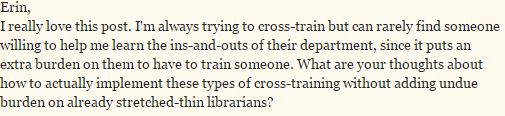

It's a great question, right? How do you actually implement a cross-training program when everyone feels stretched so thin that they can't take the time to work with someone from another department? 

After thinking about it a lot, I identified three things I've seen work at various places that I've worked. 

1. Start small:
I don't think it's necessarily realistic to show up in another department and ask to be cross-trained, especially if it's not the culture at your library. Start by bringing genuine questions about how things work to someone in the department you'd like to learn more about. Are you a public services librarian who wants to learn more about metadata? Start by asking a friendly cataloger about why a search you did in the online catalog produced different results than you thought it would. Are you a metadata creator who wants to know more about how library users access information in the online catalog? Start by asking a friendly public services librarian about what complaint they hear the most during one-on-one transactions or during instruction sessions. They don't have to be long, in-depth conversations. But do enough to start building relationships with people in departments outside your own and showing interest in the work that your colleagues do.

2. Focus on fixed-term projects:
Sometimes the slow season for one department will align with the busy season for another. Or sometimes the workload of a person in a particular department ebbs and flows. These natural changes in the rhythm of the library make space for people to cross-train on projects. Is there a project in your department that nobody has time to do or a project that requires an extra set of hands? This would be a great opportunity to find people in other parts of the library who are looking for skill-building opportunities outside of their own departments. Bonus points if the project you're looking for help with utilizes talents that the person doing the project doesn't get to use in their day-to-day work. You don't have to give a person working on a fixed-term project enough training to be a full-fledged member of the department, which helps if you feel like you don't have time to spare with a programmatic cross-training initiative. 

3. Make the first move:
Not every person in every department is going to be open to cross-training or collaboration. Some people don't want to learn more about metadata creation or information literacy because they'd rather focus on the work they're actually assigned to do.

And that's okay.

But I feel like libraries have to create a culture where people who do want to collaborate or cross-train are supported in doing so. Yes, it takes time to teach people. Yes, it is hard when you're already stretched really thin. But libraries should reward people who want to learn more and do more instead of treating those people like burdens. 

Sometimes, you have to be the change agent in your library and decide that you're going to be the person to make the first move and give up your time in order to change the culture. Ask questions and make it clear you're willing to answer questions. Be friendly and curious--someone that people in other departments want to approach with questions--and use the capital you've earned to ask people questions. If you want to talk to people, try to approach them on their terms. If they prefer emails to a phone call or a drop-in conversation, respect that. If they'd like for you to make an appointment so that they have time to give your question the time and attention it deserves.

Final thoughts:
In my first job out of library school, two things happened around the same time. First, I developed an interest in library instruction because I felt like it would be my best chance (based on the climate and culture of my library) to learn more about how students accessed information. Second, I became the go-to person in the cataloging department for a couple of instruction librarians just by being friendly. Luckily for me, one of those people was the instruction coordinator and she believed in me enough to mentor me in instruction and to allow me to teach a library orientation class each semester. By being curious about what she did and friendly when she asked questions, I was able to help her and to grow my own skills.

Look, I get it. It's possible that you'll try all of these things and people will still be stretched too thin to cross-train you. In which case, you might have to find opportunities to learn more about other parts of librarianship from people you don't work with. If you're a person working in public services who feels like there is no one in metadata creation that you can talk to, feel free to reach out to me. While I can't give you work to do, I'm happy to answer your questions and to serve a sounding board for ideas you might have.

Stay positive,
Erin

Wednesday, August 12, 2015

In the spaces in between

I like to practice what I preach over here on the blog, so yesterday I attended a lunchtime program at my library about ACRL's Framework for Information Literacy for Higher Education. I have become increasingly fascinated with the Framework and with understanding what the learning process looks like for our users. I grow more and more convinced that the key to effectively describing our collections and building our systems is to understand how our users approach the research process and are transformed by what they learn from our instruction-oriented colleagues.

But I digress. This post is not about that.

In preparation for that program, I read about threshold concepts. This primer on threshold concepts by Glynis Cousin was especially helpful for both explaining the concept of threshold concepts and grounding my understanding of the Framework. In this piece, Cousin explains that there is a space, the liminal state, between when a learner is introduced to a concept and when they master it. Cousin describes the concept of a liminal state as it relates to the mastery of threshold concepts, writing:
But once a learner enters this liminal space, she is engaged with the project of mastery unlike the learner who remains in a state of pre-liminality in which understandings are at best vague.
Cousin goes on to challenge those tasks with teaching by stating:
Teachers must demonstrate that they can tolerate learner confusion and can 'hold' their students through liminal states.
This idea of a liminal space and our responsibility to those in it stuck with me and made me think about how I approach working with people who are mastering new skills.

In the spirit of full disclosure, I should say that I did not study education at any point in my undergraduate or graduate studies. Any understanding I have of how people learn things comes from teaching people things--both informally and in a classroom setting. My limited experience with library-related instruction comes in the form of one hour one-shot sessions that are meant to serve as an orientation to library resources. When I started doing these sessions, I would cram in as much information as I could for 50 minutes. Students saw a variety of resources being demonstrated, but they didn't necessarily come away from the class understanding how to use them or understanding any of the underlying concepts of information literacy.

Over time, I have changed my teaching style, after seeing what was successful and what wasn't and modifying my lesson plans accordingly. I have landed on teaching classes where I identify 1-2 concepts I want them to come away knowing and then building my activities and discussion around those. But after reading Cousin's discussion about the liminal space, I believe it is not enough for me to pare down my lesson plans. I also need to make room in any class I teach for those I'm teaching to sit in the liminal space. I need to stop filling the space with own thoughts and, instead, leave that space for learners to consider and master a particular threshold concept.

Making room for students to be in that liminal space is, admittedly, really tough. Once you've mastered a threshold concept, you can't un-master it. And it can be hard to allow yourself to feel how you felt when you lived in the liminal space: the fear, the frustration, the feeling of isolation. It requires an extraordinary amount of empathy to put yourself back in that space. But I would argue that it is necessary if you want to be a good teacher.

When I was taking cataloging, I really struggled. For about 3/4 of the semester, I didn't not not understand it at all and I was sure that I was going to fail. At some point cataloging "clicked" for me and, as they say, the rest is history. But I remember keenly that feeling of frustration over not understanding cataloging. I carry that feeling with me and I let it guide me in how I help others master cataloging concepts.

The bottom line, I think, is this: when we teach, we are responsible for creating a safe space for people to wrestle with the mastery of a threshold concept. Whether it's teaching a class of students or training our colleagues, it is our job as teachers to make room for the the liminal space. And, while we're at it, to fill that space with empathy and support. It takes time and practice to develop the capacity to do these things. But we owe it to the people we teach and, in the end, it's so rewarding.

Stay positive,
Erin