I got a really great comment on this post that made me pause for a moment in self-reflection.
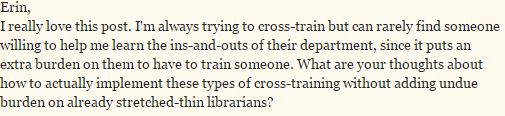
It's a great question, right? How do you actually implement a cross-training program when everyone feels stretched so thin that they can't take the time to work with someone from another department?
After thinking about it a lot, I identified three things I've seen work at various places that I've worked.
1. Start small:
I don't think it's necessarily realistic to show up in another department and ask to be cross-trained, especially if it's not the culture at your library. Start by bringing genuine questions about how things work to someone in the department you'd like to learn more about. Are you a public services librarian who wants to learn more about metadata? Start by asking a friendly cataloger about why a search you did in the online catalog produced different results than you thought it would. Are you a metadata creator who wants to know more about how library users access information in the online catalog? Start by asking a friendly public services librarian about what complaint they hear the most during one-on-one transactions or during instruction sessions. They don't have to be long, in-depth conversations. But do enough to start building relationships with people in departments outside your own and showing interest in the work that your colleagues do.
2. Focus on fixed-term projects:
Sometimes the slow season for one department will align with the busy season for another. Or sometimes the workload of a person in a particular department ebbs and flows. These natural changes in the rhythm of the library make space for people to cross-train on projects. Is there a project in your department that nobody has time to do or a project that requires an extra set of hands? This would be a great opportunity to find people in other parts of the library who are looking for skill-building opportunities outside of their own departments. Bonus points if the project you're looking for help with utilizes talents that the person doing the project doesn't get to use in their day-to-day work. You don't have to give a person working on a fixed-term project enough training to be a full-fledged member of the department, which helps if you feel like you don't have time to spare with a programmatic cross-training initiative.
3. Make the first move:
Not every person in every department is going to be open to cross-training or collaboration. Some people don't want to learn more about metadata creation or information literacy because they'd rather focus on the work they're actually assigned to do.
And that's okay.
But I feel like libraries have to create a culture where people who do want to collaborate or cross-train are supported in doing so. Yes, it takes time to teach people. Yes, it is hard when you're already stretched really thin. But libraries should reward people who want to learn more and do more instead of treating those people like burdens.
Sometimes, you have to be the change agent in your library and decide that you're going to be the person to make the first move and give up your time in order to change the culture. Ask questions and make it clear you're willing to answer questions. Be friendly and curious--someone that people in other departments want to approach with questions--and use the capital you've earned to ask people questions. If you want to talk to people, try to approach them on their terms. If they prefer emails to a phone call or a drop-in conversation, respect that. If they'd like for you to make an appointment so that they have time to give your question the time and attention it deserves.
Final thoughts:
In my first job out of library school, two things happened around the same time. First, I developed an interest in library instruction because I felt like it would be my best chance (based on the climate and culture of my library) to learn more about how students accessed information. Second, I became the go-to person in the cataloging department for a couple of instruction librarians just by being friendly. Luckily for me, one of those people was the instruction coordinator and she believed in me enough to mentor me in instruction and to allow me to teach a library orientation class each semester. By being curious about what she did and friendly when she asked questions, I was able to help her and to grow my own skills.
Look, I get it. It's possible that you'll try all of these things and people will still be stretched too thin to cross-train you. In which case, you might have to find opportunities to learn more about other parts of librarianship from people you don't work with. If you're a person working in public services who feels like there is no one in metadata creation that you can talk to, feel free to reach out to me. While I can't give you work to do, I'm happy to answer your questions and to serve a sounding board for ideas you might have.
Stay positive,
Erin
